
TL;DR:
- Detailed revisions in audio production focus on structure, purpose, and meaning beyond surface editing.
- They improve clarity, narrative flow, and client alignment, reducing late-stage fixes and enhancing project impact.
Detailed revisions are the core process through which an audio project’s true structure, meaning, and purpose are discovered and refined. They are not the same as editing or proofreading, and understanding why detailed revisions matter is the difference between a project that lands and one that falls flat. For audio production clients, this distinction shapes every deliverable, from a podcast episode to a full album mix. The revision stage is where a producer and client align on what the project is actually saying, not just how it sounds on the surface.
What are detailed revisions and how do they differ from simple edits?
Detailed revision is structural, strategic, and meaning-focused work. It asks whether the project achieves its purpose, whether the sequence makes sense, and whether every element earns its place. Editing, by contrast, focuses on sentence clarity and word choice. Proofreading catches surface errors like typos and formatting inconsistencies.
Mixing revision, editing, and proofreading causes creators to default to easier, low-stakes fixes. The result is a polished bad draft: technically clean but structurally flawed. This is the “polished bad draft” problem, and it is one of the most common traps in audio production.
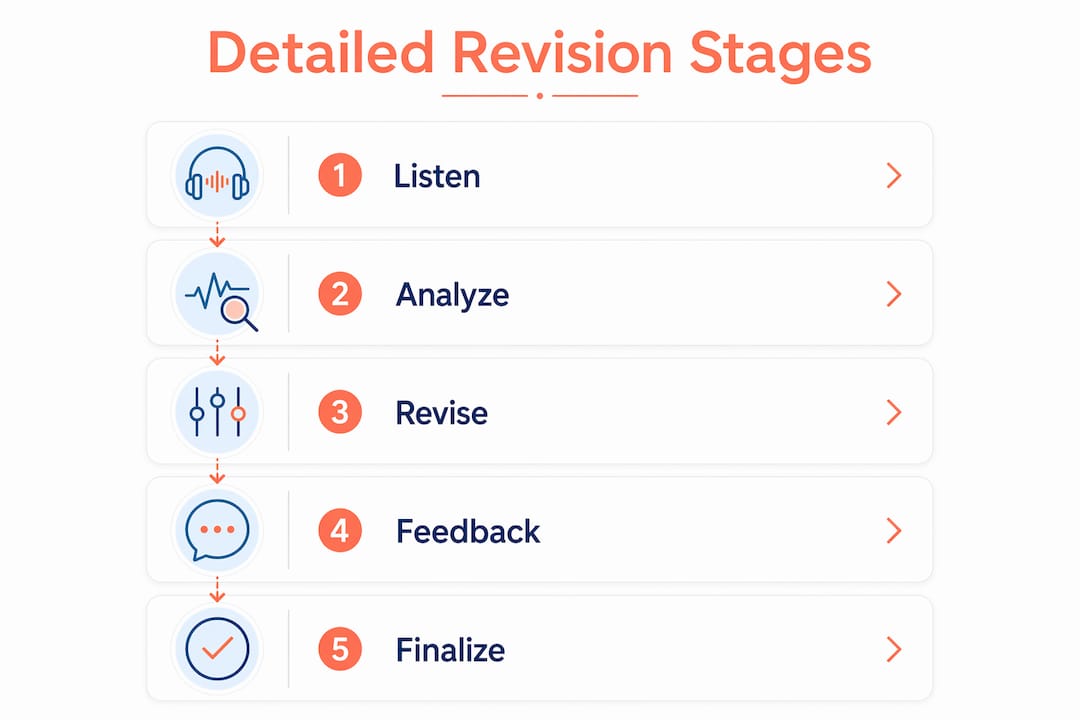
| Stage | Focus | Questions Asked |
|---|---|---|
| Revision | Structure, meaning, purpose | Does this section belong? Does the arc work? |
| Editing | Clarity, flow, word choice | Is this sentence clear? Is the pacing right? |
| Proofreading | Surface errors, formatting | Are there typos? Is the format consistent? |
Each stage demands a different cognitive mode. Switching between them mid-session reduces the quality of all three. The most effective approach is to complete a full revision pass before touching sentence-level edits.
- Revision asks: “Does this project do what it needs to do?”
- Editing asks: “Is every line clear and well-constructed?”
- Proofreading asks: “Is every detail technically correct?”
Pro Tip: Complete your revision pass on a separate day from your editing pass. The mental distance helps you see structure instead of sentences.
Why detailed revisions are essential for audio project clarity

Professional editing and detailed revisions primarily drive clarity and consistency, making the communication of project objectives stronger across every medium. In audio production, this translates directly to pacing, narrative coherence, and tonal consistency across a mix or episode. A project that skips thorough revision often has redundant sections, unclear transitions, and a muddled central message.
Detailed revisions shift focus from technical polish to strategic purpose, eliminating redundancies and deepening emotional impact. Asking “What changes here?” and “Why does this matter later?” helps producers and clients decide whether content should stay, be cut, or be rewritten entirely. That kind of questioning is not possible during a proofreading pass.
Revision is not cleanup. It is the process of discovering what your project is actually about and then making every decision serve that discovery.
The benefits of thorough revision in audio work are concrete:
- Eliminates redundant sections that dilute the project’s impact
- Strengthens narrative arc and listener engagement across episodes or tracks
- Aligns the final product with the client’s original creative intent
- Reduces the number of late-stage change requests by resolving structural issues early
- Creates a clear record of decisions made, which supports future projects
Producers who build revision into their workflow as a distinct phase consistently deliver work that requires fewer emergency fixes at the mastering or final delivery stage. The significance of this revision process shows up in client satisfaction and repeat business, not just in the audio file itself.
How detailed revisions enhance client-producer collaboration
The first draft is primarily material generation. Revision is where the creator discovers what they actually think, often leading the project in unexpected directions. For audio clients, this means the revision stage is not a sign that something went wrong. It is the stage where the project becomes what it was always meant to be.
Detailed feedback loops are the engine of effective collaboration. When a client provides timestamped, specific feedback tied to actual moments in the audio, the producer can act on it without guessing. Vague feedback like “it feels off” costs both parties time. Specific feedback like “the intro runs 20 seconds too long before the hook” gives the producer a clear target.
Pro Tip: Ask your producer to share version history alongside each revision. Seeing what changed and why builds trust and reduces back-and-forth significantly.
Effective collaborative revision also requires clear boundaries. Knowing how many revisions to include in a project scope protects both the client and the producer from scope creep. When revision rounds are defined upfront, clients give more decisive, consolidated feedback. That decisiveness improves the quality of each round.
- Share written notes before a revision session, not during playback
- Consolidate all feedback into one document or platform before submitting
- Separate creative direction feedback from technical correction feedback
- Confirm the revision goal for each round before the producer begins work
Audio engineers who handle revisions professionally treat each round as a focused problem-solving session, not an open-ended request window. That discipline keeps projects on schedule and on budget.
Common challenges in the revision process and how to avoid them
The most damaging mistake in revision is starting too late and too small. Producers and clients who jump to sentence-level edits before resolving structural issues end up with flawed final work that no amount of polishing can fix. The cognitive mode required for structural revision is incompatible with the mode required for line editing.
The hardest revision choices are not about fixing what is broken. They are about cutting what is good but not necessary.
The four most common revision pitfalls in audio production are:
- Mixing stages prematurely. Starting a mix before the arrangement is locked forces rework. Resolve structure before touching tone.
- Emotional attachment to early decisions. The process of “killing your darlings” requires cutting well-crafted elements that do not serve the project’s overall purpose. This is a sign of progress, not failure.
- Skipping the outsider perspective. Revision demands detachment to see work as a first-time listener would. Proximity bias is real. Outside feedback from a trusted collaborator or third party breaks that bias.
- Treating revision as a single pass. Effective revision is iterative. Each round should have a defined scope and a clear goal before it begins.
The “first-time reader” mindset, applied to audio, means listening to a project as if you have never heard it before. That is genuinely difficult after hours of work on the same material. Scheduling a listening session after a 24-hour break is one of the most effective ways to regain that perspective. Managing client revisions with a structured system makes this kind of disciplined approach far easier to maintain across multiple projects.
Key Takeaways
Detailed revisions are the primary stage where an audio project’s structure, purpose, and impact are established, not the final polish applied at the end.
| Point | Details |
|---|---|
| Revision is not editing | Revision addresses structure and meaning; editing addresses clarity and flow. |
| Mixing stages reduces quality | Switching between revision, editing, and proofreading in one session leads to structurally flawed work. |
| Specificity drives collaboration | Timestamped, concrete feedback gives producers clear targets and reduces wasted revision rounds. |
| Cutting is progress | Removing strong but unnecessary elements is a sign of advanced revision, not failure. |
| Outsider perspective is required | Proximity bias prevents creators from seeing their own work clearly; outside feedback breaks that bias. |
The revision mindset most clients never develop
Most clients arrive at the revision stage expecting to confirm that everything is fine. That expectation is the root of most project delays. Revision is not a quality check. It is the phase where the project earns its final form.
I have worked with producers who treat every revision round as a negotiation and others who treat it as a discovery session. The second group consistently delivers better work, faster. The difference is not talent. It is the willingness to question decisions that felt right in the first draft.
The hardest thing to accept is that a strong-sounding section can still be wrong for the project. “Killing your darlings” is not a writing metaphor. In audio production, it means cutting the bridge you spent three days on because the track is stronger without it. That decision requires clarity about what the project is for, and that clarity only comes from thorough revision.
Clients who embrace this process stop asking “Is it done?” and start asking “Does it do what we need it to do?” That shift changes the entire collaboration. Producers can work faster, communicate more directly, and deliver results that hold up over time. The revision tracking systems that support this kind of work are not bureaucratic overhead. They are what make the creative process repeatable and professional.
— Kreg
Audome makes revision management clear and organized
Scattered feedback across email threads, voice messages, and shared drives is the fastest way to lose track of what was actually agreed in a revision round. Audome is built specifically for audio production professionals who need revision management to be organized, documented, and tied directly to the audio itself.
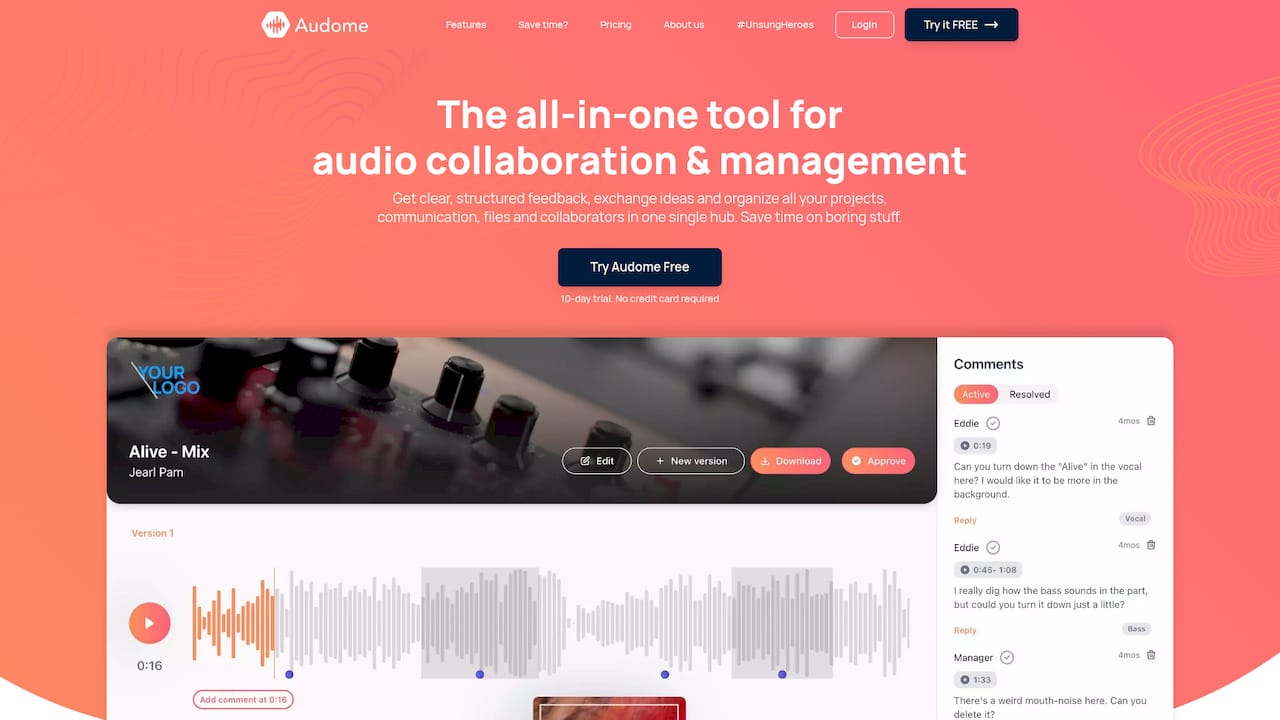
With Audome, clients leave timestamped feedback directly on the waveform, so producers know exactly what moment is being referenced. Version history is tracked automatically, revision rounds can be capped and billed through integrated Stripe Connect payments, and clients never need to create an account to participate. The result is a revision process that stays focused, professional, and on schedule. If your current workflow involves chasing feedback across multiple platforms, Audome replaces all of it in one place.
FAQ
What is the difference between revision and editing?
Revision addresses the structure, meaning, and purpose of a project. Editing focuses on sentence clarity, word choice, and flow. They require different cognitive modes and should be done in separate passes.
Why do detailed revisions matter more than proofreading?
Proofreading catches surface errors but cannot fix structural problems. Detailed revision resolves whether the project achieves its purpose, which no amount of surface correction can substitute for.
How many revision rounds should an audio project include?
The number depends on project scope and complexity. Most professional audio projects benefit from two to three focused revision rounds, each with a defined goal, rather than open-ended feedback sessions.
What is “killing your darlings” in audio production?
It is the practice of cutting well-crafted elements that do not serve the project’s overall purpose. It signals that revision has reached an advanced, high-quality stage.
How can clients give better revision feedback?
Clients give better feedback when they use timestamped notes tied to specific moments in the audio, consolidate all comments before submitting, and separate creative direction from technical corrections.