
TL;DR:
- Effective client revision management relies on clear policies, structured feedback rounds, and tools that enforce deadlines and version control. Using 2-3 consolidated review rounds prevents scope creep, while timestamped, asset-linked feedback accelerates revisions. Automation and defined policies ensure efficiency, professionalism, and protect profitability in podcast production workflows.
Client revision management for producers is the structured process of defining when, how, and how many times a client can submit feedback before a project is considered final. Without that structure, you’re not running a production business. You’re running a request hotline. The industry term for this practice is “revision workflow management,” and it covers everything from feedback consolidation to version control to approval gating. Tools like Audome, SureFeedback, and advox.io exist specifically because email threads and Dropbox folders don’t cut it anymore. If you’ve ever gotten a “one small change” message at 11pm the night before delivery… you already know why this matters.
What are structured feedback rounds and why do 2–3 rounds work best?
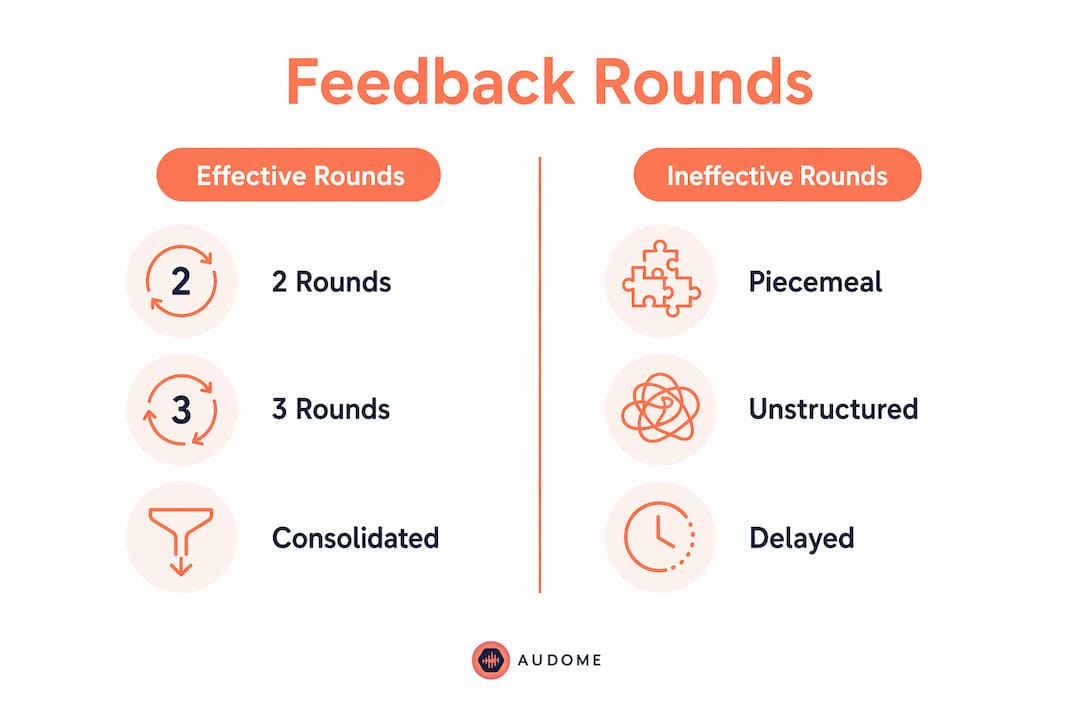
The industry standard for audio and video projects is 2–3 formal revision rounds with clients consolidating all notes before submitting. That number isn’t arbitrary. It reflects how long it actually takes a client to form a real opinion on a piece of work, and it prevents the death-by-a-thousand-cuts feedback style that kills timelines.
Here’s what structured rounds look like in practice:
- Round 1: Client reviews the draft and submits all notes in a single batch by a set deadline.
- Round 2: You address those notes and deliver a revised version. Client reviews again, same rules.
- Round 3 (if included): Final polish pass. After this, any new requests are a paid add-on.
The key word is consolidated. Clients who send feedback piecemeal, one thought at a time over three days, are the ones who blow up your schedule. A hard closing date for each review round forces decisiveness and kills the trickle-in feedback loop that stalls projects.
Pro Tip: Set a specific day in your project brief. Something like “All Round 1 feedback must be submitted by Thursday at 5pm EST.” Clients who know the window closes will actually use it.
Communicate this before the project starts, not after you’ve already delivered the first draft. Put it in your contract, your project brief, and your onboarding email. Repetition isn’t annoying here. It’s protection.
How does contextual, version-controlled feedback speed up revisions?

Vague feedback is the enemy. “The intro feels off” tells you nothing. “At 0:42, the music bed is too loud and it’s covering my voice” tells you exactly what to fix. Contextual, timestamp-specific notes eliminate the guesswork that makes revision cycles drag on longer than they should.
Here’s the difference between the two approaches:
| Feedback Method | Clarity | Speed | Risk of Confusion |
|---|---|---|---|
| Email or chat | Low | Slow | High |
| Timestamped, asset-linked notes | High | Fast | Low |
Platforms like SureFeedback and advox.io let clients pin comments directly to the moment in the audio where the issue lives. No more “around the middle part” descriptions. That specificity alone can cut a revision cycle in half.
Version control is the other half of this equation. True version control maintains full comment histories linked to each version, enabling rollback and a clear audit trail. That’s not the same as saving files as “podcast_ep12_FINAL_v3_REALLYFINAL.mp3.” Real version control means every note, every approval, and every change is logged and tied to the correct file.
Here’s a simple process that works:
- Deliver the draft through a platform that supports timestamped comments.
- Client submits all notes within the review window.
- You address the notes and upload the revised version.
- The platform links the new version to the previous one, preserving the full comment thread.
- Client approves or submits Round 2 notes. Repeat until final sign-off.
Pro Tip: The moment you receive a round of feedback, send a written summary back to the client confirming what you heard and what you plan to change. This “locks” the scope for that round and gives you something to point to if new requests appear mid-revision.
Acknowledging feedback immediately and recapping planned changes is one of the most underrated moves in the business. It takes two minutes and saves hours of argument later.
What role do automation and AI tools play in managing client revisions?
Busy producers running 3–5 concurrent projects can’t track revision rounds manually without dropping something. AI tracking for multiple projects helps producers avoid missed deadlines and protect revenue by automating the things that fall through the cracks.
Here’s what automation actually handles in a modern revision workflow:
- Round tracking: The system knows which round each project is on and flags when a client has exceeded their included revisions.
- Automated reminders: Clients get notified when their review window is closing, without you having to chase them.
- Revision billing triggers: When a client hits Round 4 on a 3-round contract, the system can automatically flag or invoice the overage.
- Deadline enforcement: Automated milestone alerts keep everyone on schedule without a single follow-up email from you.
The main reason producers lose money on revisions is undefined policies combined with slow response time. Automation fixes the response time problem. Your policies fix the undefined part. Together, they shift your focus from conflict management to actual creative work.
For podcast producers handling multiple shows simultaneously, this is not optional. It’s survival. Manually tracking which client is on which round, who owes feedback, and who’s past their revision limit is a full-time job on its own. Tools built for producer workflow automation handle that overhead so you can stay in the session.
What policies prevent scope creep and endless revisions?
Scope creep in audio production usually doesn’t start with a big ask. It starts with “can you just…” and ends with you rebuilding an episode from scratch for free. Setting revision policies before a project starts is the only real defense.
Clients generally accept revision structures when expectations are clear upfront, especially when delivered through a professional, branded system. A client who receives a polished project portal with clear terms is far less likely to push back than one who gets a Google Drive link and a verbal agreement.
Your policy should cover four things:
- Revision count: How many rounds are included in the project fee.
- Overage rate: What each additional round costs. Be specific. “$150 per additional revision round” is clear. “Extra charges may apply” is not.
- Feedback format: Notes must be submitted through the designated platform, not via text, DM, or voicemail.
- Approval gating: The next phase of the project does not begin until the current phase is formally approved.
Approval-gated systems with visible version history reduce what you might call “final version anxiety.” Clients can see every version, every note, and every change. That transparency builds confidence and makes sign-offs faster.
Pro Tip: When a client pushes back on your revision limit, don’t apologize. Explain it as a quality control measure. “I limit revisions to keep the project focused and deliver your best result” lands better than “that’s just my policy.”
The feedback collection workflow you establish at the start of a project sets the tone for the entire relationship. Producers who skip this step spend the rest of the project playing defense.
How to build a practical revision workflow for podcast projects
Theory is one thing. Here’s what the actual workflow looks like for a podcast producer managing client revisions from draft to delivery.
- Deliver the draft through a platform that supports timestamped comments and version control. Send the client a direct link. No login required on their end.
- Set the review window. Tell the client exactly when feedback is due. Put it in the delivery message and the platform itself.
- Receive consolidated feedback. If a client sends notes outside the platform or after the deadline, acknowledge receipt and log it for the next round. Don’t act on it immediately.
- Confirm and summarize. Reply with a written recap of every change you plan to make. This is your scope lock for that round.
- Upload the revision. The platform links it to the previous version with the full comment history intact. The client can compare versions side by side.
- Gate the next round. The client formally approves the current version before Round 2 begins. No approval, no next step.
- Repeat for Round 2 and Round 3. After the final included round, any new requests trigger your overage policy.
- Final delivery. Only after written approval. Not a thumbs-up emoji. An actual sign-off.
Audome supports this entire workflow in one place. Timestamped comments, version control, private collaborator spaces, and no client login required. For collaborative audio review on podcast projects, that combination removes most of the friction that makes revision cycles painful.
Key takeaways
Effective client revision management for producers requires clear policies, structured rounds, and tools that enforce both without you having to babysit every step.
| Point | Details |
|---|---|
| Use 2–3 formal revision rounds | Limit included rounds in your contract and charge a set rate for anything beyond that. |
| Require consolidated feedback | Clients submit all notes in one batch per round, not piecemeal over several days. |
| Use timestamped, version-controlled tools | Platforms like Audome and SureFeedback eliminate vague feedback and wrong-version confusion. |
| Automate round tracking and reminders | AI tools track revision counts across multiple projects and send deadline alerts without manual follow-up. |
| Lock scope after each round | Summarize received feedback in writing before starting revisions to prevent mid-round scope creep. |
The revision hell i’ve seen (and how i got out of it)
I’ve been in sessions where a client sent 47 separate messages over four days calling it “one round of feedback.” I’ve had clients approve a final mix and then email three weeks later asking for changes because their spouse didn’t like the intro music. I’ve watched producers burn 20 hours on a project that paid for 5 because nobody set a single rule at the start.
Here’s what I know for certain: clients don’t push boundaries because they’re bad people. They push them because nobody told them where the boundaries were. When you set clear revision policies upfront, most clients actually relax. They stop second-guessing because they know the process. They trust you more, not less.
The producers who resist setting these rules are usually afraid of looking difficult. What they don’t realize is that the lack of rules makes them look unprofessional. A client who gets a polished project portal with clear terms thinks “this person knows what they’re doing.” A client who gets a Dropbox link and a prayer thinks “I can ask for anything.”
Tools matter too. Relying on memory and goodwill to track revision rounds across five concurrent projects is how you end up working for free. Get a system. Use it every time. Your sanity and your bank account will thank you.
— Kreg
Audome makes client revision management actually manageable
If you’re still juggling feedback through email threads and shared folders, you’re making this harder than it needs to be.
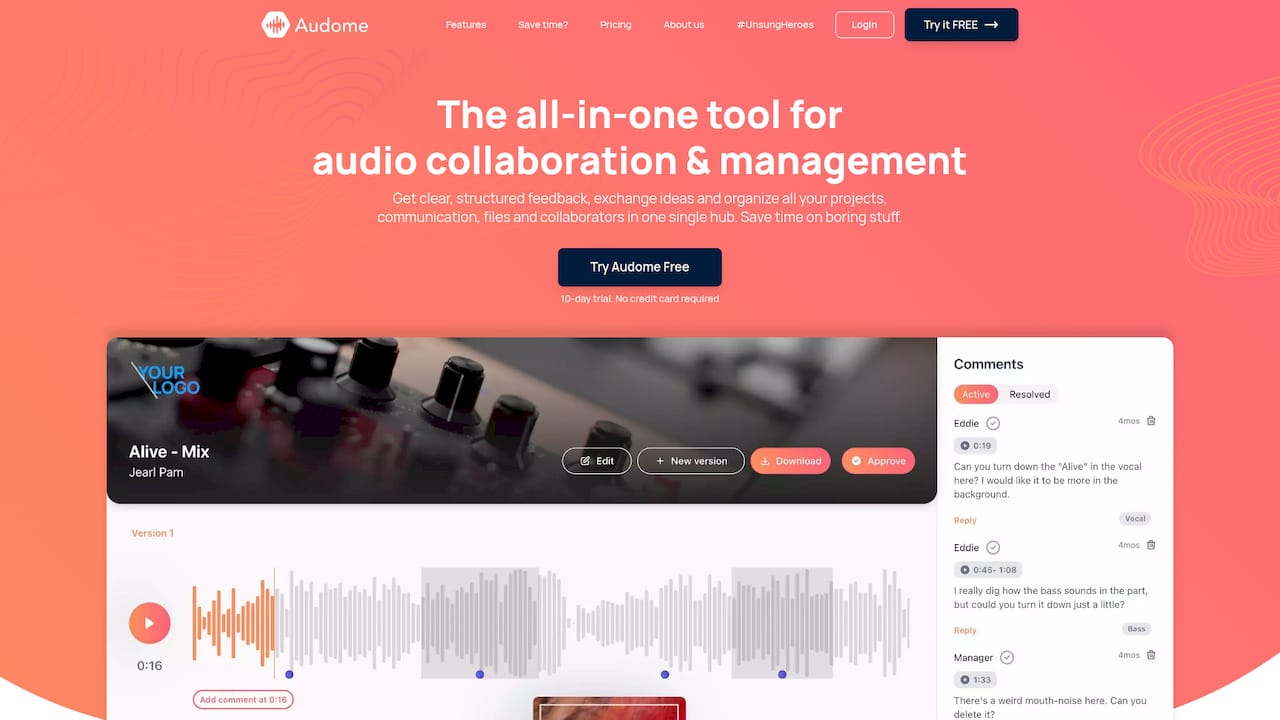
Audome is built specifically for audio professionals who need one place to handle file sharing, timestamped feedback, version control, and client approvals. No client login required. No compression on your audio files. No chasing people down for notes that should have been in the platform three days ago. Whether you’re producing one podcast or managing a full client roster, Audome keeps every revision round organized and every version accounted for. Visit Audome and see what a real audio collaboration platform looks like when it’s built for producers, not project managers.
FAQ
How many revision rounds should i include in a podcast project?
The industry standard is 2–3 formal revision rounds per project. Include this number in your contract and set a clear overage rate for anything beyond it.
What is the best way to collect client feedback on audio projects?
Timestamped, asset-linked feedback through a dedicated platform is the most effective method. Tools like Audome and SureFeedback let clients pin notes directly to the moment in the audio where the issue occurs, eliminating vague descriptions.
How do i stop clients from sending feedback after the deadline?
Set a hard closing date for each review window and communicate it before the project starts. When late feedback arrives, acknowledge it and log it for the next round rather than acting on it immediately.
Does version control really matter for podcast production?
Yes. True version control maintains full comment histories linked to each version, so you always know what changed, when, and why. File naming conventions like “v3_FINAL” don’t provide that audit trail.
How do i handle a client who keeps requesting changes beyond the included rounds?
Apply your overage policy without apology. If you set a clear rate upfront, the conversation is simple: “You’ve used your included rounds. Additional revisions are billed at $X per round.” Clients who agreed to the terms rarely argue the math.