
TL;DR:
- Effective revision management speeds up project completion and improves client satisfaction in music production. Using timestamped feedback and version control tools prevents confusion, delays, and scope creep. Adopting a hybrid collaboration approach balances creative alignment with efficient, detailed revisions.
Seamless revisions in music production are defined as organized, iterative changes to a mix or arrangement that move a project forward without creating confusion, duplicated work, or communication breakdowns. The role of seamless revisions in music production goes far beyond fixing a few EQ settings. Revision management is a process discipline that directly determines how fast projects finish, how satisfied clients are, and how much money producers actually keep. The most common reason projects stall is not a technical problem. It is a process problem rooted in vague feedback, unclear expectations, and fragmented communication tools.
How timestamped feedback transforms revision clarity
Vague feedback is the single biggest source of wasted revision time. Comments like “the chorus feels off” or “make it bigger” give a producer nothing concrete to act on. Timestamped feedback anchors every note to a precise moment in the audio, converting subjective impressions into specific, actionable instructions.
The practical impact is significant. Timestamped platforms reduce turnaround from 48 hours to same-day delivery by eliminating the back-and-forth email chains that normally follow vague notes. That is not a marginal improvement. It cuts an entire day out of a revision cycle, which compounds across every round of a project.
The workflow improvement goes deeper than speed. When feedback is tied to a specific timestamp, both the producer and the client share a common reference point. There is no ambiguity about which snare hit, which vocal phrase, or which transition is being discussed. This shared clarity reduces the number of clarification rounds, which is where most revision time actually disappears.
Audio-centric platforms that consolidate file sharing, feedback, and version control in one place make this process far more reliable than email or generic cloud storage. Producers who rely on scattered tools, such as email threads combined with generic file storage, consistently deal with lost files, outdated versions, and missed notes.
- Timestamped comments eliminate the “which part?” problem entirely.
- Clients leave feedback directly on the audio, not in a separate document.
- Producers address every note in one pass instead of hunting through email threads.
- Revision rounds become shorter and more focused with each iteration.
Pro Tip: On complex projects with multiple stakeholders, require all feedback to be submitted through a timestamped audio platform before you open a session. This single rule eliminates most clarification calls.
Why version control is non-negotiable in music production
Version control is the practice of systematically saving, labeling, and archiving every iteration of a mix or project file. Without it, producers work without a safety net. A client who loved version 3 but approved version 5 has no recourse if version 5 turns out to be a mistake.

Maintaining a systematic changelog with dates, version numbers, and modification summaries creates an auditable record of every decision made on a project. This protects producers from scope creep disputes and gives clients transparency into the revision history. It also ensures every collaborator is working from the correct file at all times.
The archival habit is the most underused protection in professional audio work. Archiving each mix version before starting a new round gives producers an instant fallback if a client changes their mind or if a new revision introduces unexpected problems. Rebuilding a mix from memory is expensive in both time and creative energy.
Here is a practical version control system that works across project sizes:
- Name every export with a version number and date. Use a format like “ProjectName_v1_20260315” so files sort chronologically without confusion.
- Write a one-line summary of changes for each version. This does not need to be detailed. “Reduced low-end on kick, raised vocal by 1dB” is enough to reconstruct the decision later.
- Archive the previous version before opening a new session. Move it to a dedicated folder labeled “Archive” so the working directory always contains only the current file.
- Share only the current version with clients. Sending multiple versions creates confusion and invites comparisons that derail the revision process.
- Keep archives for at least 12 months after project delivery. Client requests for older versions are more common than most producers expect.
Pro Tip: Use a revision management guide to build a version naming convention before your next project starts. Retrofitting a system mid-project is harder than it sounds.
How to manage client feedback without revision spirals
Revision spirals happen when feedback arrives in fragments. A client sends three notes on monday, two more on wednesday, and a final “one more thing” on friday. Each batch triggers a new session, and the project never actually closes. Drip-feed feedback causes revision spirals by preventing producers from addressing all concerns in a single, focused pass.
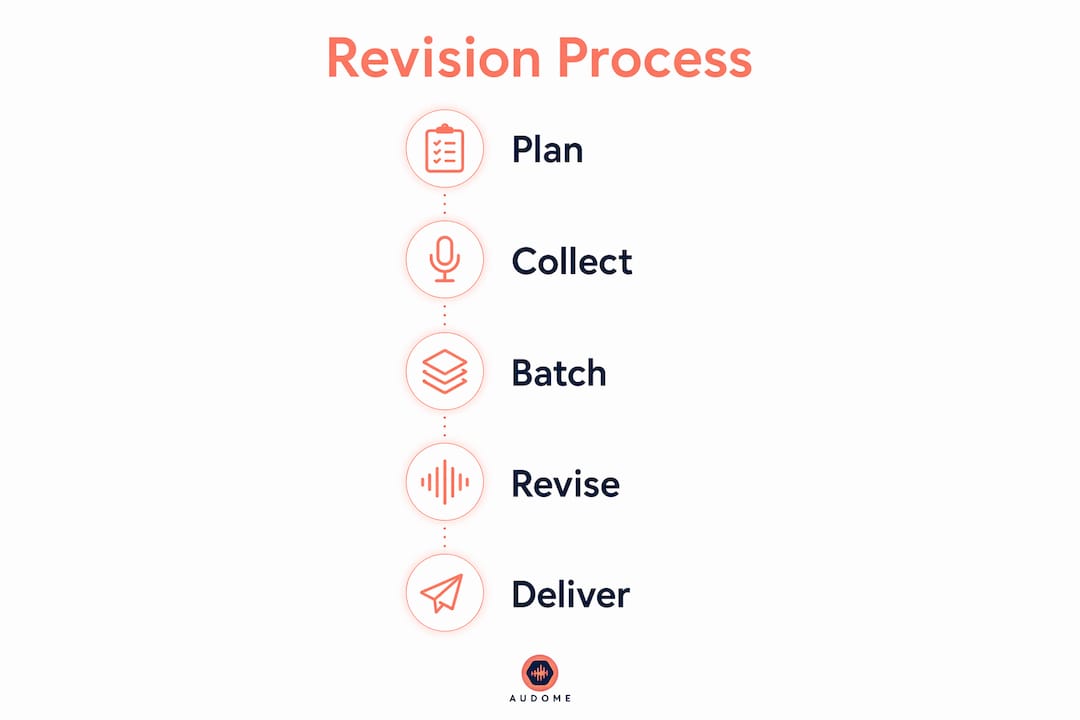
The fix is batching. A revision round should be defined as one consolidated batch of feedback submitted at one time. Batched, consolidated feedback accelerates turnaround and reduces total revision rounds because clients are forced to think through all their notes before submitting. This single structural change transforms the revision process.
Setting boundaries around revision rounds is a business decision, not a creative one. Producers who define the number of included revision rounds in their contracts before a project starts avoid the most common source of scope creep. When a client submits notes outside an agreed round, those notes become a paid addition, not a free obligation.
Practical boundaries that protect producers and clients alike:
- Define “one revision round” explicitly in your contract as one consolidated batch of feedback.
- Set a response window for client feedback, typically 5–7 business days per round.
- Ignore notes submitted outside the agreed batch window until the next formal round opens.
- Charge for additional rounds at a pre-agreed rate, stated clearly in the original contract.
- Communicate the revision process to clients before the project starts, not after the first dispute.
The client revision management mindset treats feedback as a structured deliverable, not an open channel. Producers who adopt this approach report fewer disputes, faster project closures, and stronger client relationships.
Hybrid collaboration: when to meet in person and when to go remote
The hybrid model combines in-person sessions for creative alignment with remote asynchronous workflows for detail-oriented revision work. The hybrid session model is the industry standard for maximizing both creative energy and revision efficiency. It works because the two phases serve fundamentally different purposes.
In-person sessions build trust and creative alignment. When a producer and artist sit in the same room, they can resolve creative direction questions in minutes that would take days of back-and-forth messages to settle remotely. The first session, in particular, sets the tone for the entire project. Getting that session right in person pays dividends through every subsequent revision round.
Remote asynchronous workflows are better suited for revision work. Once the creative direction is locked, the detailed work of adjusting levels, editing transitions, and refining arrangements does not require real-time collaboration. Remote workflows give both parties the flexibility to work at their best hours and review changes without scheduling pressure.
| Phase | Format | Primary goal |
|---|---|---|
| Creative direction | In-person | Align on sound, feel, and project vision |
| First draft review | Remote async | Client reviews and submits timestamped notes |
| Revision rounds | Remote async | Producer addresses batched feedback efficiently |
| Final approval | In-person or video call | Confirm delivery and close the project |
Remote collaboration best practices reinforce that the transition from in-person to remote works best when the remote tools are set up before the project starts. Producers who introduce new platforms mid-project create friction at exactly the wrong moment.
Key Takeaways
Revision quality in music production depends on process discipline, not just technical skill. Producers who batch feedback, maintain version archives, and use timestamped tools finish projects faster and with fewer disputes.
| Point | Details |
|---|---|
| Timestamped feedback cuts turnaround | Anchoring notes to audio moments eliminates clarification rounds and speeds up delivery. |
| Version control prevents costly mistakes | Archiving every mix before a new round gives producers an instant fallback if changes go wrong. |
| Batching feedback stops revision spirals | One consolidated feedback batch per round keeps scope controlled and projects on schedule. |
| Hybrid workflows maximize efficiency | In-person sessions lock creative direction; remote async rounds handle detail-oriented revisions. |
| Process discipline is a business skill | Defining revision rounds in contracts protects producers from scope creep and unpaid work. |
Why revision management is the skill most producers undervalue
The uncomfortable truth I have learned from years of working on production projects is this: most revision problems are not about the music. They are about process. Producers who struggle with endless revision cycles almost always have the same root issue. They started the project without a clear agreement on what a revision actually means.
I have seen talented engineers lose weeks of work to a single client who kept sending “one more small note” because nobody defined the rules upfront. The technical quality of their mixes was never the issue. The process was broken from day one.
The most common misconception is that revision problems are technical. They are not. They are communication and process failures. The producers I have watched build sustainable, profitable businesses treat revision management with the same discipline they bring to their mixing sessions. They document everything, define everything, and enforce the process consistently.
My honest recommendation is to treat your revision workflow as a product you deliver, not just a service you provide. When clients understand the process before the project starts, they respect it. When they do not understand it, they push against every boundary. The difference is not the client. It is how clearly you communicated the rules.
The tools matter too, but only after the process is solid. A great platform running a broken process still produces chaos. Get the process right first, then let the right tools make it faster.
— Kreg
Audome: built for producers who take revisions seriously
Producers who have fixed their revision process know the next bottleneck: fragmented tools. Email for feedback, generic cloud storage for files, and spreadsheets for version tracking create gaps where notes get lost and versions get confused.

Audome consolidates audio collaboration and revision management into a single platform built specifically for audio professionals. Timestamped comments let clients leave notes directly on the audio at the exact moment they are referencing. Version control keeps every iteration archived and accessible. Private collaborator spaces and lossless audio support up to 96kHz/24-bit mean nothing gets compressed or lost in transit. Audome also lets studios limit revision rounds and gate downloads behind payment through Stripe integration, giving producers real enforcement tools for the boundaries they set in their contracts.
FAQ
What is the role of seamless revisions in music production?
Seamless revisions define how efficiently a project moves from draft to final delivery. They reduce wasted time, prevent scope creep, and keep client relationships productive through clear communication and structured feedback rounds.
How does timestamped feedback improve the revision process?
Timestamped feedback anchors every note to a specific moment in the audio, eliminating vague comments and reducing clarification rounds. Platforms using this approach can cut turnaround from 48 hours to same-day delivery.
What is a revision spiral and how do you prevent it?
A revision spiral happens when clients send feedback in fragments across multiple days, triggering repeated sessions without resolution. Preventing it requires defining one revision round as a single consolidated batch of feedback submitted at one time.
Why is version control important in music production?
Version control gives producers an instant fallback if a new revision introduces problems or a client prefers an earlier mix. Archiving every version before starting a new round prevents time-consuming rebuilds and protects against client disputes.
How does a hybrid collaboration model work for music projects?
The hybrid model uses in-person sessions to lock creative direction and remote asynchronous workflows for revision rounds. This combination builds trust early and then uses remote tools for the focused, detail-oriented work that revisions require.