
TL;DR:
- Mastering engineers typically include two to three revision rounds in their base fee to optimize client satisfaction. Limiting revisions encourages careful feedback and speeds up approval times, while clear policies build trust. Additional rounds are billed separately, ensuring efficient workflows and professional relationships.
Mastering engineer revisions are defined as the structured rounds of changes a mastering engineer delivers after the client reviews the initial master. The professional industry standard in 2026 is to include 2–3 rounds of revisions within the base service fee. That number is not arbitrary. It reflects decades of studio practice showing that most clients need one or two passes to confirm the sound is right, and a third round covers edge cases without letting projects drag indefinitely. Getting this number wrong in either direction costs you time, money, and client trust.
How many revisions should mastering engineers include?
The answer is 2–3 rounds, and the reasoning holds up across every studio model. Two rounds give clients a real chance to respond to the master and request changes. A third round acts as a safety net for anything missed in round two. Offering more than 3 rounds without additional charges consistently causes scope creep and inefficient timelines. That pattern shows up in boutique studios and high-volume online mastering operations alike.
The psychological effect of a revision cap is just as important as the operational one. Open revision policies encourage client indecision and prolong project timelines. When clients know revisions are unlimited, they treat each round casually, sending fragmented notes instead of consolidated, specific feedback. A cap forces them to think carefully before responding.
Some studios structure this as two included rounds with a third billed separately. This revision policy encourages clients to consolidate feedback and avoid drawn-out back-and-forth. Any additional rounds beyond the included count are charged at a flat rate agreed upon before the project starts.
- 2–3 rounds included: The professional standard for base mastering fees in 2026
- Beyond 3 rounds: Billed separately, at a rate set upfront in the project agreement
- Unlimited revisions: Linked to client indecision, circular workflows, and timeline delays
- Zero revisions: Damages collaborative trust and signals inflexibility to clients
Pro Tip: State your revision count in writing before the first file is delivered. A one-sentence policy in your project agreement eliminates 90% of revision disputes before they start.
How to manage client feedback to minimize revision rounds
Most projects reach approval on the first or second pass when communication at the project start is strong. That means the work you do before delivering the master matters as much as the mastering itself. Structured onboarding cuts revision rounds more reliably than any technical adjustment.
The most effective approach combines three tools: an onboarding questionnaire, a reference track request, and a listening guideline document. The questionnaire captures the client’s genre expectations, target platforms, and loudness preferences before you touch the file. Reference tracks give you a sonic target. Listening guidelines tell the client how to evaluate the master, which prevents vague feedback like “it doesn’t feel right.”
- Send an onboarding questionnaire. Ask about genre, target streaming platforms, loudness preferences, and any reference tracks the client loves. This aligns expectations before the first pass.
- Request reference tracks upfront. A level-matched reference gives you a measurable target and gives the client a shared vocabulary for feedback.
- Provide a listening guideline. Tell clients to listen on at least two playback systems before responding. Headphones alone produce unreliable feedback.
- Ask clients to wait 24+ hours before sending notes. Artists who listen fully before giving feedback achieve faster final approval. Immediate reactions are almost always emotional rather than technical.
- Require consolidated, written feedback. One document with specific, timestamped notes beats three voice messages and a text thread. Consolidated feedback reduces the number of mastering rounds needed.
Structured feedback and listening guidelines help set expectations and improve feedback quality across every project type. The result is fewer revision rounds and faster approvals, not because you rushed the client, but because they arrived at the feedback stage prepared.
Pro Tip: Build your listening guideline into a one-page PDF and attach it to every project delivery. Clients who follow it send better notes the first time.

How revision policies affect client relationships and project efficiency
A clearly stated revision policy does more than protect your schedule. It signals professionalism and sets the tone for the entire working relationship. Clients who understand the rules upfront feel more confident, not more restricted. Quality of communication and clear agreement on revisions matters more than the raw number of revision rounds included.
The opposite is also true. A mastering engineer who offers no revisions struggles to build collaborative trust. Clients interpret zero revisions as a sign the engineer is not invested in their satisfaction. The 2–3 round standard threads the needle: it shows flexibility while protecting your time.
One situation that complicates revision policies is when client feedback reveals a fundamental mix problem. Major mix balance issues requested during mastering usually require returning to the mix stage rather than additional mastering revisions. A mastering engineer cannot fix a poorly balanced low end or a buried vocal through limiting and EQ alone. Your policy should address this explicitly, so clients understand that mix revisions are a separate service and a separate fee.
- Clear revision caps build trust. Clients know what they are getting and plan their feedback accordingly.
- Unlimited revisions create anxiety. Clients with no deadline for decisions often delay approvals and second-guess themselves repeatedly.
- Mix problems are not mastering problems. State in your policy that feedback requiring mix changes falls outside the mastering revision scope.
- Revision turnaround times matter. Boutique studios maintain 24–48 hour revision turnaround to keep project momentum. Slow turnaround breaks client confidence even when the work is excellent.
The studios with the strongest client retention are not the ones with the most generous revision policies. They are the ones with the clearest policies, communicated before the first file changes hands.
Practical recommendations for setting revision limits and pricing
Mastering engineers and studio owners who build revision policies into their pricing models from the start avoid the most common client friction points. The structure below reflects what works across fixed-price and per-project billing models.
| Revision tier | Rounds included | Turnaround | Additional round fee |
|---|---|---|---|
| Standard package | 2 rounds | 24–48 hours | Billed at agreed flat rate |
| Premium package | 3 rounds | 24 hours | Billed at agreed flat rate |
| Rush project | 1 round | Same day | Higher flat rate per round |
| Stem mastering | 2–3 rounds | 48 hours | Billed at agreed flat rate |
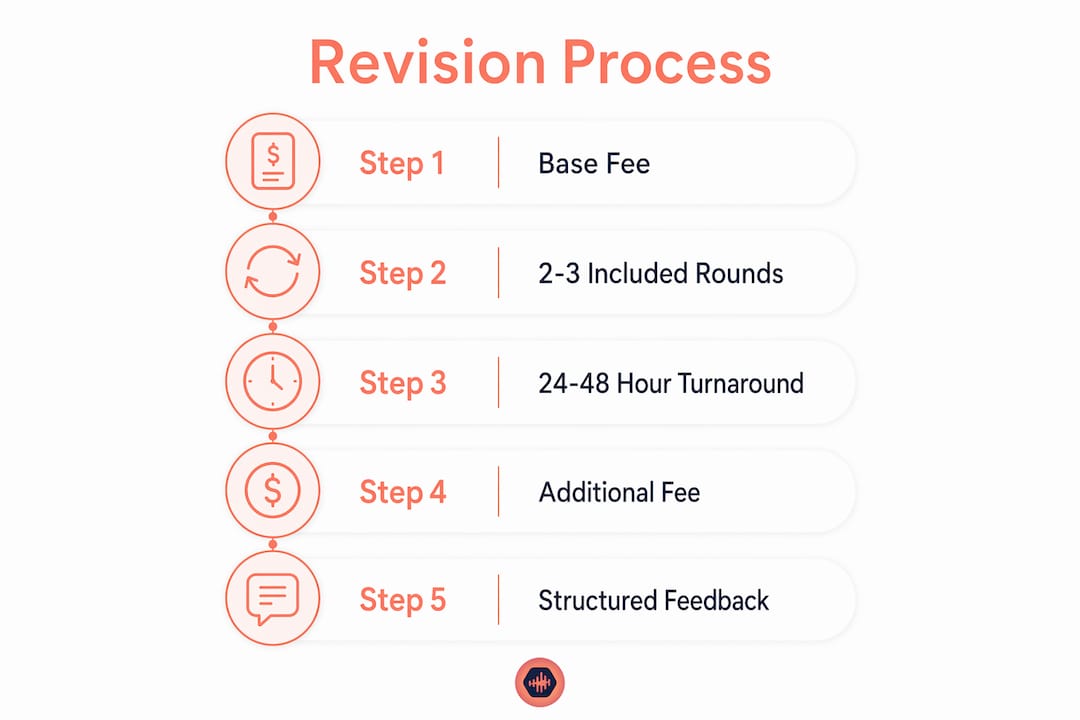
Setting a 24–48 hour turnaround for each revision round keeps projects moving without pressuring clients into hasty decisions. Boutique studios with fixed-price packages communicate additional revision fees upfront to avoid confusion at the billing stage. That transparency is what separates professional studios from engineers who negotiate revision fees after a dispute has already started.
The fee for additional rounds should be stated in your project agreement as a specific dollar amount, not a vague “additional charge.” Clients accept fees they agreed to in writing. They resist fees that appear without warning. Platforms like Audome let you set revision limits per project and automatically charge clients for additional rounds through integrated Stripe Connect payments, which removes the awkward conversation entirely.
Pro Tip: Price your additional revision rounds at a rate that reflects your actual time cost, not a token fee. If a revision round takes two hours, charge accordingly. Underpricing extra rounds trains clients to request them casually.
For a deeper look at how audio engineers handle revisions across different studio models, the principles translate directly to mastering workflows. The same logic around scope creep and client communication applies whether you are mixing or mastering.
Key Takeaways
Mastering engineers who include 2–3 revision rounds in their base fee, communicate policies upfront, and charge clearly for additional rounds protect their time and build stronger client relationships.
| Point | Details |
|---|---|
| Standard revision count | Include 2–3 rounds in the base mastering fee; bill additional rounds separately. |
| Revision caps reduce indecision | Capping rounds pushes clients to send consolidated, specific feedback faster. |
| Upfront communication is critical | State revision limits, turnaround times, and extra fees in writing before delivery. |
| Mix problems need mix solutions | Feedback requiring mix changes falls outside mastering revisions and should be scoped separately. |
| Turnaround time affects trust | A 24–48 hour revision turnaround keeps momentum and signals professionalism. |
Why revision limits are the most underrated business decision in mastering
I have worked with engineers who offered unlimited revisions because they thought it would attract more clients. What it actually attracted was clients who could not make decisions. The projects with the most revision rounds were almost never the ones with the most demanding clients. They were the ones where expectations were never set clearly at the start.
The 2–3 round standard is not a restriction. It is a framework that helps clients take the process seriously. When a client knows they have two rounds to get it right, they listen more carefully before sending notes. They consolidate their thoughts. They ask their bandmates or label contacts before responding. The result is better feedback, fewer rounds, and a faster approval.
The hardest part of enforcing a revision policy is the first time you have to charge a client for an extra round. That conversation is uncomfortable exactly once. After that, clients know you mean what you say, and the relationship becomes more professional on both sides. The engineers I respect most are not the ones who never push back. They are the ones who set clear terms and hold them consistently.
One thing I would add that most articles skip: your revision policy also protects the client. It prevents them from chasing perfection indefinitely on a master that was already done three rounds ago. Sometimes the best thing you can do for a client is tell them the master is finished. For a broader look at managing client revisions across production workflows, the same principle applies at every stage.
— Kreg
Audome helps mastering engineers manage revisions without the back-and-forth
Managing revision rounds across email threads, file-sharing links, and text messages creates confusion that no policy document can fully prevent. Audome is built specifically for mastering engineers and studio owners who want every revision, file, and piece of client feedback in one place.

Audome lets you set the number of included revision rounds per project and automatically charges clients for additional rounds through Stripe Connect, so the policy enforces itself. Clients leave timestamped feedback directly on the waveform, which replaces vague voice messages with specific, usable notes. Final downloads stay locked until payment clears. If you want to spend less time chasing feedback and more time mastering, Audome’s collaboration platform is built for exactly that workflow.
FAQ
What is the standard number of mastering revisions?
The professional standard is 2–3 rounds of revisions included in the base mastering fee. Rounds beyond that are billed separately at a rate agreed upon before the project starts.
Why do revision caps improve client feedback quality?
Capping revisions psychologically encourages clients to commit to quality feedback. Clients with unlimited rounds tend to send fragmented, unconsolidated notes because there is no cost to doing so.
What happens when client feedback requires mix changes?
Mix balance issues raised during mastering require returning to the mix stage, not additional mastering revisions. Your policy should state this clearly so clients understand the distinction before the project begins.
How long should a mastering revision turnaround take?
A 24–48 hour turnaround per revision round is the standard for professional studios. Faster turnaround on rush projects is available at a higher rate.
How should mastering engineers charge for extra revision rounds?
State the fee for additional rounds as a specific dollar amount in the project agreement before delivery. Clients accept fees they agreed to in writing and resist fees that appear without prior notice.