
TL;DR:
- Most podcast editing packages include one to two revision rounds to balance client satisfaction and profitability. Clear revision policies, pre-production planning, and feedback procedures prevent scope creep and reduce unnecessary revisions. Structured workflows, like timestamped feedback and fixed revision limits, improve efficiency and client experience.
The industry standard for podcast editing is one to two revision rounds per episode. Freelancers typically offer zero or one round, while agencies commonly include two. That number exists for a reason: it balances client satisfaction with the editor’s time, profitability, and sanity. How many revisions should podcast editors include is one of the most debated questions in the podcast editing process, yet the answer is consistent across leading production companies in 2026. Get this number wrong in either direction and you either frustrate clients or destroy your margins.
How many revisions should podcast editors include?
Standard podcast editing packages include one to two revision rounds, with additional rounds billed at $50 to $100 each. That pricing structure is not arbitrary. It reflects the real cost of a second or third pass through an episode: listening time, re-exporting, file management, and client communication.
Freelancers tend to offer fewer included rounds than agencies because their overhead is lower but their time is equally finite. Agencies that include two rounds do so because they serve higher-volume clients who expect more touchpoints. Neither model is wrong. The key is that both models define a limit upfront.
Unlimited revisions sound generous. In practice, they erode profitability faster than almost any other pricing mistake. When clients know there is no ceiling, feedback becomes less focused, requests multiply, and editors end up doing three or four passes on work that should have been approved after one. The ideal podcast revision number is not about restricting clients. It is about creating a structure that produces better feedback and better results.
Pro Tip: Build your revision pricing into your contract before the first episode, not after a client asks for a fourth round. Retroactive limits create conflict; upfront limits create clarity.
What counts as a revision vs. a clarification?
The distinction between a clarification and a revision is one of the most useful tools in the podcast editing process. Clarifications cover minor fixes, such as a mislabeled file, a missed cut that was clearly in the original notes, or an export error. Revisions involve creative changes: restructuring segments, adjusting music levels, or re-editing a section based on new preferences. Clarifications are typically free. Revisions count against the included rounds.
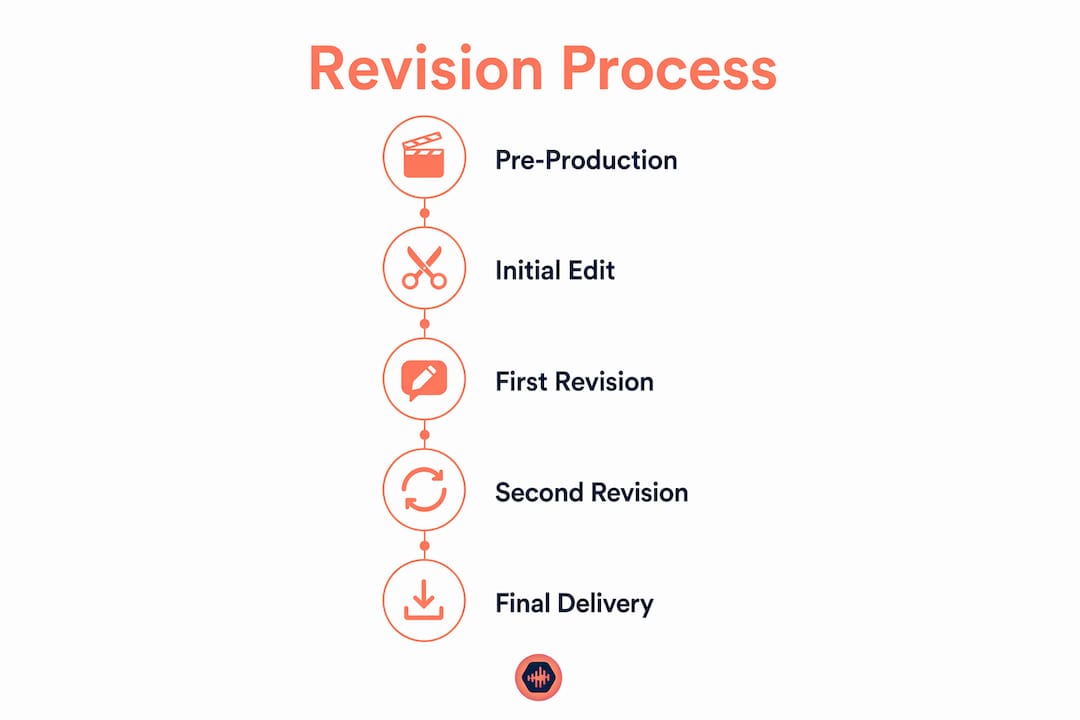
Making this distinction explicit in your contract prevents the most common source of scope creep. A client who asks you to “fix the intro” may mean a three-second trim or a complete rebuild. Without a shared definition, both parties assume different things and friction follows.
Why revision policies prevent scope creep and protect your workflow
Over 80% of scope creep in podcast production comes from undefined revision scopes and the absence of written feedback processes. That figure points to a structural problem, not a client behavior problem. When editors do not define what a revision is, clients fill that gap with their own interpretation.
A written revision policy does several things at once:
- It tells clients exactly what is included in their package.
- It sets a deadline for feedback, typically two to three business days after delivery.
- It specifies the format for feedback, ideally timestamped and consolidated in a single document or platform.
- It establishes what happens when clients exceed the included rounds, including the additional cost per round.
- It protects the editor from indefinite project stalling by including a silence clause.
The silence clause deserves special attention. Inserting a revision clause where a defined period of client silence constitutes automatic approval keeps projects moving. A two to three business day window is the standard. If a client does not respond within that window, the delivered version is considered approved. This single contract addition eliminates the most common cause of projects sitting unfinished for weeks.
Pro Tip: Send clients a one-page revision guide at the start of every project. Cover what counts as a revision, how to submit feedback, and the turnaround window. Clients who understand the process upfront submit better feedback and request fewer rounds.
Requiring consolidated, timestamped feedback also changes client behavior in a measurable way. When clients know they have one submission window, they gather all their notes before sending. That means fewer back-and-forth messages, fewer partial revision requests, and fewer situations where a client sends three separate emails over two days with conflicting notes. The feedback collection workflow you establish at the start of a project shapes every interaction that follows.
How pre-production work reduces the number of revision cycles
The most effective way to reduce revision rounds is to invest time before the first edit. Editors who skip pre-production alignment consistently report more revision requests. Editors who build a clear reference framework before touching the audio rarely need more than one round after the first episode.
Here is a practical pre-production sequence that works:
- Request a reference episode. Ask the client to share an existing episode they love, whether their own or someone else’s. This gives you a concrete target for tone, pacing, and production style.
- Annotate the reference together. Annotated reference episodes where clients mark what they want to keep and what they want cut help editors understand preferences before the first edit. This single step dramatically improves first-edit accuracy.
- Build a style sheet. Document the client’s preferences for music levels, breath removal, filler word handling, and segment structure. Update it after each episode.
- Confirm the scope in writing. Before editing episode one, send a one-paragraph summary of what you will deliver. Get written confirmation.
“Using precise, detailed pre-production notes can cut revision cycles from two to three rounds to zero. Timestamped, specific instructions double editing efficiency compared to vague feedback.”
That outcome is achievable on most projects. The editors who hit it consistently are not more talented. They are more organized at the start. The client revision management work you do before editing begins pays dividends across every episode in the series.
Balancing quality with client expectations: when to stop editing

Over-editing is a real problem in podcast production, and it is one that rarely gets discussed. Editors who chase perfection often produce episodes that sound processed and unnatural. Listeners notice. Hosts notice. And clients who initially requested heavy editing sometimes push back when they hear the result.
The best practices for podcast revisions focus on clarity and pacing, not surgical precision. Specific pitfalls to avoid include:
- Removing every filler word, which strips the conversational tone that makes podcasts engaging.
- Cutting every breath, which makes speech sound robotic and exhausting to listen to.
- Tightening every pause, which removes the natural rhythm that listeners use to process information.
- Applying heavy noise reduction that introduces artifacts and makes voices sound thin.
- Re-editing segments based on personal taste rather than the client’s stated preferences.
Good podcast editing services rarely need more than one revision round after the first two episodes because they learn client preferences quickly and apply them consistently. When a client is still sending extensive revision notes after two months of working together, that signals a communication failure, not an editing failure. The editor and client have not aligned on what the finished product should sound like.
Revision limits encourage clients to provide focused, decisive feedback rather than open-ended requests. That structure benefits both sides. Clients get a cleaner process. Editors get clearer direction. The result is better episodes with fewer rounds of back-and-forth.
Setting revision policies before starting client work prevents the burnout that comes from unlimited revision expectations. Burnout in podcast editing is almost always a policy problem, not a workload problem. Editors who define their process upfront consistently report higher client satisfaction and longer client relationships.
Key Takeaways
Podcast editors who include one to two revision rounds, define what counts as a revision, and require timestamped consolidated feedback consistently deliver better results with less rework.
| Point | Details |
|---|---|
| Standard revision count | Include one to two rounds per episode; bill additional rounds at $50 to $100 each. |
| Define revisions vs. clarifications | Minor fixes are free; creative changes count against included rounds. |
| Written policies prevent scope creep | Over 80% of scope creep comes from undefined revision scopes and missing feedback processes. |
| Pre-production reduces revision cycles | Annotated reference episodes and style sheets cut revision rounds before the first edit begins. |
| Silence clauses keep projects moving | A two to three business day approval window prevents projects from stalling indefinitely. |
Why I think most editors set revision limits too late
I have worked with editors who offered unlimited revisions at the start of their careers because they thought it would win clients. It did. And then it buried them. The clients who push hardest for unlimited revisions are rarely the clients who give the clearest feedback. They are the clients who send notes at 11 PM, change direction after approval, and treat the editing process as an ongoing negotiation rather than a defined service.
The fix is not to become rigid. It is to become clear. A contract that defines two revision rounds, specifies the feedback format, and includes a silence approval clause is not restrictive. It is professional. Clients who respect your work respond well to structure. Clients who do not respect your work will test any boundary you set, which tells you something useful about whether to continue the relationship.
The timestamped feedback process is the single biggest lever I have seen editors pull to reduce revision rounds. When clients submit feedback at specific timestamps rather than general impressions, editors know exactly what to fix. The ambiguity disappears. The revision round takes half the time. And clients feel heard because their specific notes were addressed directly.
One more thing: educate clients early. Send a short onboarding document that explains your process, defines your terms, and sets expectations for turnaround times. Clients who understand the workflow before the first episode are dramatically easier to work with than clients who learn the rules mid-project. That document takes thirty minutes to write and saves hours across every project.
— Kreg
Audome makes revision management part of your workflow
Managing revisions across email threads, shared drives, and messaging apps creates confusion that costs you time and money. Audome brings the entire podcast editing process into one workspace, from file delivery to client feedback to version tracking.

With Audome, clients leave timestamped feedback directly on the waveform, so you know exactly what they want changed and where. You can set the number of included revision rounds, automatically charge for additional rounds through Stripe Connect, and lock final downloads until payment clears. No more chasing approvals or sorting through scattered notes. Audome gives you the structure to run a cleaner, more profitable podcast editing operation without adding complexity to your day.
FAQ
How many revision rounds should a podcast editing package include?
Most podcast editing packages include one to two revision rounds. Freelancers typically offer one, while agencies commonly include two, with additional rounds billed at $50 to $100 each.
What is the difference between a revision and a clarification?
A clarification covers minor fixes like export errors or missed cuts from the original notes, and is typically free. A revision involves a creative change and counts against the included rounds in a client’s package.
How do I stop clients from requesting endless revisions?
Define your revision limit in the contract before work begins, require consolidated timestamped feedback within two to three business days, and include a silence clause that treats non-response as approval. These three steps eliminate most revision abuse.
Why do some editors still get revision requests after months of working with a client?
Extensive revision notes after two or more months of collaboration typically signal a communication failure rather than an editing problem. The editor and client have not aligned on the target sound, which is a pre-production issue, not a revision issue.
Does limiting revisions hurt client satisfaction?
No. Revision limits encourage clients to submit focused, decisive feedback, which produces better edits and faster turnaround. Clients who understand the process upfront consistently report higher satisfaction than those working under open-ended revision terms.