
TL;DR:
- Most audio production projects include two to three revision rounds in their standard fee. A revision round consists of one consolidated batch of feedback submitted within five to seven business days. Additional rounds should be priced at 15-25% of the project fee to protect profits and ensure clear client expectations.
The standard number of revisions producers should include is two to three rounds per project. This benchmark comes from professional practice across audio production, podcast studios, and creative services, where 85% of projects complete within two to three rounds when the client brief is clear. Anything beyond that threshold should be priced separately. The term used across the industry is “revision rounds,” where each round is a single, consolidated batch of client feedback rather than a stream of individual notes. Producers who define this upfront protect their margins, set realistic client expectations, and avoid the slow drain of uncompensated work that kills profitability.
How many revisions should producers include per project?
Two to three revision rounds is the professional standard for most podcast and audio production projects. The exact number depends on brief clarity and who is making decisions, but this range covers the vast majority of real-world scenarios. Producers who include more than three rounds in their base price without additional fees are effectively subsidizing client indecision.
A revision round is defined as one consolidated batch of feedback submitted within a single feedback window, typically five to seven business days. That definition matters more than the number itself. Without it, a client who sends five separate emails with one note each has technically submitted five revision rounds, even if the total feedback volume is small.
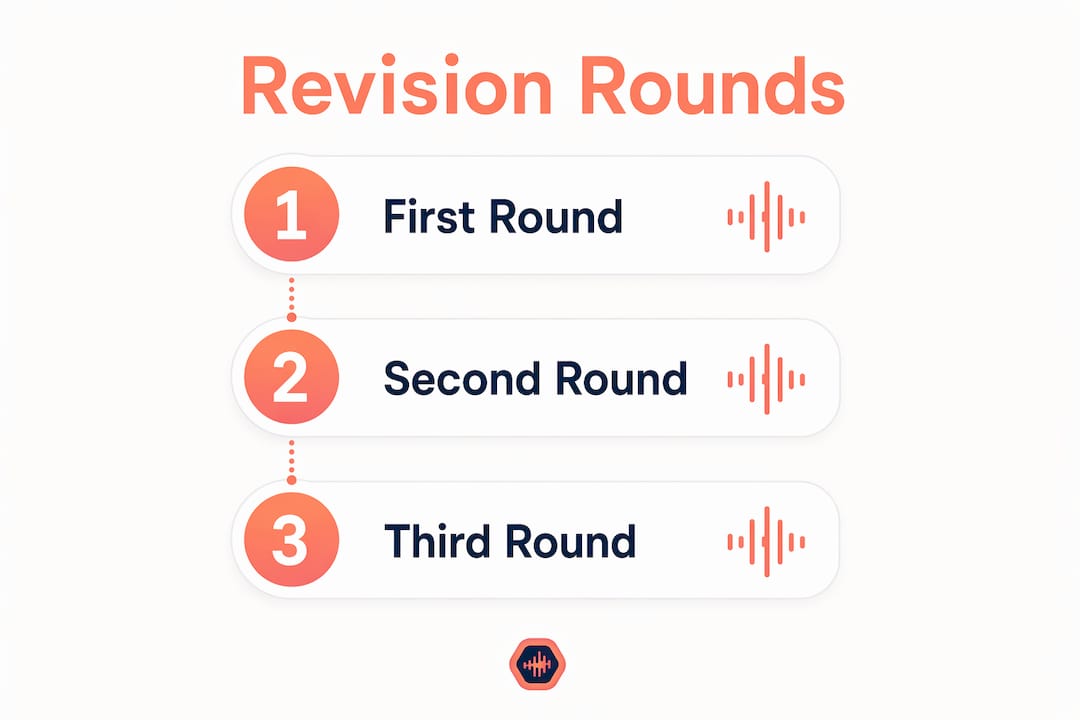
The revision process for producers breaks down into three stages: the first round catches structural issues, the second round addresses detail and tone, and the third round, when needed, handles final polish. Projects that require more than three rounds usually signal a problem with the original brief, not the production quality.
What counts as a single revision round?
A single revision round is one document, message, or session containing all current client feedback, submitted at once. Staged, incremental feedback sent across multiple messages counts as separate rounds. This distinction is not pedantic. It directly affects how many edits a producer ends up doing for free.
Studios that manage this well use a structured feedback window. The client receives the draft, reviews it within the agreed timeframe, and submits all notes in one batch. The producer then addresses every note in that batch before the next round opens.
- One consolidated document per round, not a thread of individual messages
- A defined feedback window of five to seven business days per round
- All stakeholders aligned before the client submits, not after
- Scope limited to the original brief unless a change order is issued
Pro Tip: Send clients a simple feedback form or shared document before each round. It forces them to gather all notes in one place before submitting, which cuts revision volume significantly.
How does project complexity affect the ideal revision count?
Project complexity is the single biggest variable when deciding how many edits to include. A solo podcast host with a clear episode structure needs fewer rounds than a branded podcast with multiple stakeholders, legal review, and sponsor reads.

Two revision rounds suit projects with a single decision-maker and a well-defined brief. Three or more rounds fit projects with multiple stakeholders, subjective creative direction, or deliverables that evolve during production. The table below maps common project types to their typical revision counts.
| Project type | Stakeholders | Recommended rounds |
|---|---|---|
| Solo podcast episode | 1 | 2 |
| Branded podcast series | 2–3 | 3 |
| Audio ad or commercial | 3+ with legal review | 3–4 |
| Music production (single) | 1–2 | 2 |
| Post-production for video | 2–4 | 3–4 |
The table reflects standard practice, not a ceiling. A solo host who struggles to make decisions may need three rounds. A corporate team with a locked brief may finish in one. The point is to set the number before the project starts, not after the client has already sent their fourth round of notes.
Pro Tip: Add a stakeholder question to your intake form. Ask clients how many people will be approving the final deliverable. If the answer is more than two, price for three rounds from the start.
Producers who work on editorial playlists or music distribution projects face similar dynamics. Understanding editorial feedback cycles in adjacent creative fields reinforces why consolidating feedback into defined rounds is a universal best practice, not just an audio production quirk.
How should producers price additional revisions?
Pricing extra revision rounds is the most direct way to protect project profitability. The standard formula charges 15–25% of the total project fee per additional round, or an hourly rate for projects where scope varies significantly. Both approaches work. The key is choosing one before the contract is signed.
Flat fees work best for projects with predictable deliverables, like a standard podcast episode. Hourly billing fits better for complex post-production or multi-episode series where revision depth is hard to predict. Either way, the rate must be stated in the contract.
Here is a practical pricing framework for additional rounds:
- Define the base package. State exactly how many rounds are included and what a round means.
- Set a flat fee per extra round. Use 15–25% of the project fee as your baseline.
- Classify scope changes separately. New segments, added interviews, or format changes are not revisions. They are new deliverables with new pricing.
- Require payment before delivery. Automated payment triggers that lock final files until payment clears prevent unpaid endless revisions.
Unlimited revisions offered as a premium tier must be priced at two to three times the capped revision price to remain sustainable. Offering unlimited revisions at standard rates is a margin trap. It rewards indecisive clients and penalizes producers who work efficiently.
- Never offer unlimited revisions without a significant price premium
- Always separate revision requests from scope changes in writing
- Use payment-gated delivery to enforce your policy automatically
- Review your revision pricing annually as your hourly rate changes
The revision tracking process for audio professionals reinforces one consistent principle: the moment revisions become free and unlimited, clients stop making decisions. Pricing creates urgency and focus.
How do you communicate revision policies clearly to clients?
Clear revision policies belong in the contract, the project kickoff call, and the first email after signing. Stating the policy once is not enough. Clients forget, and ambiguity always benefits the person asking for more work.
A well-written revision clause includes the number of rounds, the definition of a round, the feedback window length, the cost of additional rounds, and the distinction between revisions and scope changes. Clear revision policies reduce client pushback and protect against scope creep. Clients who understand the rules before the project starts rarely challenge them mid-project.
Practical steps for communicating your revision policy:
- State it in the contract. Use plain language. “This project includes two revision rounds. Each round is one consolidated batch of feedback submitted within seven business days.”
- Repeat it at kickoff. Walk the client through the revision process verbally. Confirm they understand what counts as a round.
- Reference it when a round opens. Send a short note when you deliver a draft: “This is revision round one of two. Please submit all feedback by [date].”
- Address pushback directly. When a client asks for more rounds, respond with the contract language and your additional round fee. No apology needed.
Transparency in revision policies is the single most effective tool for client retention. Clients who push back on clear policies are the same clients who cause profit loss when policies are vague. Setting expectations upfront filters for clients who respect professional boundaries.
The feedback collection workflow used by experienced audio pros reinforces this point. Structured intake, defined windows, and written confirmation at each stage eliminate the gray areas that lead to disputes.
Pro Tip: Include a “revision policy acknowledgment” checkbox in your onboarding form. It takes ten seconds for the client and creates a paper trail that prevents almost every revision dispute.
Key Takeaways
Producers who define revision rounds clearly and price additional rounds appropriately protect their margins, reduce disputes, and deliver better client experiences.
| Point | Details |
|---|---|
| Standard revision count | Include two to three rounds in your base price for most projects. |
| Define a revision round | One consolidated feedback batch submitted within five to seven business days. |
| Price extra rounds | Charge 15–25% of the project fee per additional round beyond the included count. |
| Adjust for complexity | Add rounds for projects with multiple stakeholders or subjective deliverables. |
| Enforce with payment gates | Require payment before releasing final files to prevent unpaid revision cycles. |
The revision number that changed how I run my studio
The first time I lost money on a podcast project, it was not because I undercharged for production. It was because I had no revision policy at all. The client sent notes over six weeks in dribs and drabs, and I addressed each one as it arrived. By the time the project closed, I had done what amounted to five full revision passes for the price of one.
The fix was not complicated. I wrote a two-sentence revision clause, added it to my contract, and started enforcing it. The first client who pushed back was the most demanding client I had. When I quoted the additional round fee, they consolidated their notes and submitted everything at once. The project closed in one more round.
What I have learned since then is that the number itself matters less than the clarity around it. Two rounds, three rounds, even four rounds can work if the client knows what they are getting and what extra rounds cost. The revision management approach that works is the one you actually enforce, not the one that sounds generous in a proposal.
New producers often think that offering more revisions wins clients. It does, but it wins the wrong clients. The clients who choose you because you offer unlimited revisions are the clients who will use every single one of them.
— Kreg
Audome makes revision management automatic
Managing revision rounds manually across email threads, shared drives, and text messages creates the exact confusion that leads to scope creep and unpaid work.

Audome is built specifically for podcast producers and audio professionals who need a better way to handle client feedback and revision cycles. Clients leave timestamped feedback directly on the waveform, so notes are precise and tied to the exact moment in the audio. Studios set the number of included revision rounds inside the platform, and Audome automatically charges clients for additional rounds through Stripe Connect. Final files stay locked until payment clears. No chasing invoices, no ambiguous email threads, and no more free revision rounds that were never part of the deal.
FAQ
How many revision rounds is standard for podcast producers?
Two to three revision rounds is the industry standard for most podcast projects. Projects with clear briefs and single decision-makers typically complete within two rounds.
What is the difference between a revision round and a scope change?
A revision round addresses changes within the original project brief. A scope change adds new deliverables, segments, or requirements and should be priced as a separate item.
How should producers price extra revision rounds?
The standard formula is 15–25% of the total project fee per additional round, or an hourly rate for projects with variable scope. The rate must be stated in the contract before the project starts.
Should producers ever offer unlimited revisions?
Unlimited revisions are only sustainable when priced at two to three times the capped revision price. Offering them at standard rates erodes margins and rewards indecisive clients.
How do you prevent clients from sending feedback in pieces?
Define a feedback window of five to seven business days per round and require all notes in one consolidated submission. Staged feedback sent across multiple messages counts as separate rounds under a properly written revision policy.