
TL;DR:
- Professional mixing engineers typically include two to three revision rounds in their base fee as the industry standard for 2026.
- Revisions are defined as one consolidated batch of client notes, not multiple small messages, to prevent scope creep and improve collaboration.
Professional mixing engineers include two to three revision rounds in their base per-song fee as the recognized industry standard for 2026. This number protects your time, keeps projects moving, and gives clients enough room to refine the sound without opening the door to endless requests. How many revisions should mixing engineers include is one of the most common questions in freelance audio work, and the answer has real consequences for your income and your sanity. Get this number wrong in either direction and you either burn out or lose clients.
How many revisions should mixing engineers include in a base fee?
Two to three revision rounds is the standard inclusion in professional mixing contracts as of Q2 2026, with additional rounds billed separately. Two rounds is the most common choice among working engineers. Three rounds is considered generous and works well for clients who are newer to the mixing process or who tend to need more guidance.
The logic behind this range is straightforward. One round rarely gives clients enough time to sit with the mix, share it with collaborators, and return with consolidated notes. Four or more rounds included in the base fee creates an open-ended project that eats into your monthly throughput. Independent mix engineers typically handle four to eight songs per month, which means every extra unplanned revision round directly reduces how many projects you can take on.
Billing additional rounds separately is not punitive. It creates a natural incentive for clients to listen carefully and submit complete, thoughtful feedback the first time. That incentive benefits both parties.
What counts as a revision round?
A revision round is one consolidated batch of client notes submitted at one time, not a series of small messages sent throughout the day or week. Defining a revision round this way is the single most effective way to prevent scope creep in audio projects.
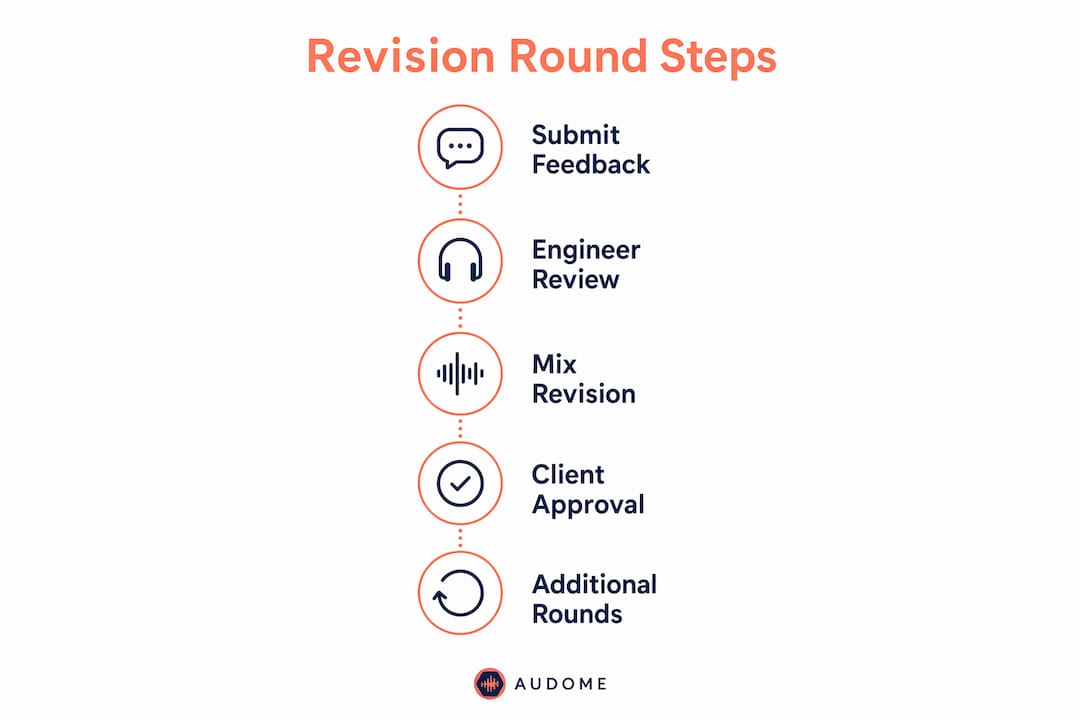
The distinction matters more than most engineers realize. Without a clear definition, clients send one note on Monday, two more on Wednesday, and a correction on Friday. Each message triggers a new session in your DAW. By the end of the week, you have completed what amounts to three revision rounds while billing for one.
Here is what a proper revision round looks like versus what it does not:
- Correct: Client listens to the full mix, collects all notes in one document or message, and submits everything at once.
- Incorrect: Client sends a voice memo about the kick drum, then emails about the vocals two hours later, then texts about the reverb the next morning.
- Correct: A band designates one member to collect all internal feedback before submitting to the engineer.
- Incorrect: Three band members each send separate notes through different channels over several days.
Pro Tip: State your revision round definition in writing before the project starts. A single sentence in your contract or project brief eliminates most disputes before they happen.
Batching feedback also forces clients to prioritize. When they know they have one submission window, they listen more carefully and distinguish between changes they genuinely need and changes they are simply considering. That discipline produces better creative decisions.
Industry standards and pricing strategies for revision rounds
The clearest way to protect your profitability is to treat revision rounds as a line item, not an afterthought. Clear upfront communication of revision limits and costs prevents scope creep and aligns expectations before any work begins.
Most working engineers structure their revision pricing in one of two ways:
- Flat rate per additional round: A fixed fee per extra revision round, typically set at a rate that reflects one to two hours of focused work.
- Hourly billing: Charging your standard hourly rate for any time spent on rounds beyond the included number.
Both approaches work. The flat rate is easier for clients to understand and budget for. Hourly billing is more accurate if your revision sessions vary widely in complexity.
Contract language does not need to be complicated. A short, direct clause works better than a paragraph of legal text. Here is an example of language that sets clear boundaries:
“This agreement includes two revision rounds. A revision round is defined as one consolidated batch of notes submitted at one time. Additional rounds are billed at $[rate] per round. Revisions requested after final delivery are not included.”
This kind of language removes ambiguity. Clients know exactly what they are getting and what extra rounds will cost. Engineers know exactly when the scope of work ends.
One pricing mistake to avoid: offering “unlimited revisions” as a selling point. This sounds appealing to clients but destroys your ability to manage workload. The engineers who charge for revisions beyond a defined limit consistently report better client relationships, not worse ones, because expectations are clear from the start.
How do revision limits improve collaboration?
Revision limits improve collaboration by forcing structure into a process that naturally tends toward drift. Limiting revisions encourages clients to consolidate feedback, which reduces back-and-forth and prevents the contradictory requests that derail projects.
The behavioral effect is real. When clients know they have two rounds, they treat each one seriously. When rounds feel unlimited, clients treat feedback as a running conversation rather than a deliberate creative decision. The result of unlimited rounds is not better music. It is more confusion, more fatigue, and mixes that drift away from the original vision.
Four practices that protect collaboration quality within a revision structure:
- Designate a single point of contact. For band or label projects, unified client feedback through one person prevents contradictory notes from reaching you simultaneously. One voice speaks for the group.
- Set a soft checkpoint before the final included round. Check in with the client to confirm alignment. This prevents the surprise of a client who thinks they have more rounds left when they do not.
- Communicate the round count after each submission. A short message saying “That completes revision round one of two” keeps everyone on the same page without confrontation.
- Set a soft checkpoint near the revision limit. Proactive communication before billing for extra rounds prevents billing surprises and keeps the relationship intact.
Pro Tip: Send a brief summary after each revision round noting what changed and how many rounds remain. Clients appreciate the transparency, and it creates a written record if disputes arise later.
The single point of contact rule deserves extra attention for group projects. A band with five members will produce five different opinions. Without one designated decision-maker, you receive contradictory notes that cannot all be honored simultaneously. Requiring one contact is not a restriction on the client. It is a service to them.
Best practices for managing revision rounds efficiently
Efficient revision management comes down to three things: version control, clear communication, and centralized feedback. All three require deliberate systems, not good intentions.

Saving baseline versions before starting each new revision round is non-negotiable. Clients change their minds. A client who asked you to remove the room reverb on the snare may ask you to restore it two rounds later. Without a saved baseline, restoring that sound means working from memory. With a baseline, it takes thirty seconds.
Version naming should be consistent and unambiguous. A system like “SongTitle_Mix_v1,” “SongTitle_Mix_v2R1,” and “SongTitle_Mix_v2R2” tells you exactly where each file sits in the revision timeline. Avoid names like “SongTitle_FINAL,” “SongTitle_FINAL2,” or “SongTitle_ACTUALFINAL.” Those names create confusion and signal a disorganized workflow to clients who see them.
| Practice | Why it matters |
|---|---|
| Save baseline before each round | Allows fast reversion if client reverses a decision |
| Consistent version naming | Eliminates confusion about which file is current |
| Written round confirmation | Creates a record and keeps clients informed |
| Single feedback channel | Prevents notes from getting lost across email, text, and DMs |
| Soft checkpoint at round limit | Avoids billing surprises and maintains trust |
Centralizing feedback to one platform or contact is the practice most engineers skip and most regret skipping. Feedback scattered across email, text messages, voice memos, and social media DMs is nearly impossible to track. A single organized client workflow reduces the chance of missing a note and gives you a clean record of every request made during the project.
Key Takeaways
Two to three revision rounds included in the base fee is the professional standard, and enforcing that limit with clear contracts and centralized feedback protects both your income and your creative output.
| Point | Details |
|---|---|
| Standard revision count | Include two to three rounds in your base fee; bill additional rounds separately. |
| Define a revision round | One consolidated batch of notes counts as one round, not multiple scattered messages. |
| Contract language | State revision limits, definitions, and extra-round costs in writing before work begins. |
| Single point of contact | Require one designated contact for group projects to prevent contradictory feedback. |
| Version control | Save baseline mixes before each revision round to allow fast, accurate rollbacks. |
Why I think “unlimited revisions” is the most expensive mistake in audio freelancing
The engineers I respect most all share one habit: they set a revision limit and they hold it. Not because they are rigid, but because they understand that unlimited revisions do not produce better mixes. They produce exhausted engineers and indecisive clients.
I have seen engineers offer unlimited revisions as a competitive differentiator, thinking it signals confidence and client-first values. What it actually signals is that the engineer has not yet learned to value their own time. Every extra unplanned round is time you are not spending on the next project, on your own music, or on rest that keeps your ears sharp.
That said, flexibility beyond the stated limit is sometimes the right call. A client going through a difficult situation, a project that genuinely evolved in scope, or a long-term relationship worth protecting can all justify an extra round at no charge. The key is that the decision is yours to make deliberately, not the client’s to take by default.
My advice: set your limit at two rounds, price your extra rounds at a rate that makes them worth your time, and communicate both clearly before the first file is ever shared. You will close fewer clients who want unlimited revisions for free. The clients you do close will be better to work with.
— Kreg
Audome makes revision limits easy to enforce
Managing revision rounds gets complicated when feedback arrives from five different directions at once. Audome is built specifically for audio professionals who need one place to collect client feedback, track versions, and enforce revision limits without chasing anyone down.

With Audome, you can set the number of free revisions included in a project, automatically charge clients for additional rounds through Stripe Connect, and collect timestamped waveform feedback directly on your audio files. Clients do not need to create an account. You get a clean, professional audio collaboration platform that replaces the scattered mess of email, Discord, and shared drives with one organized workspace built for the way mixing engineers actually work.
FAQ
How many revision rounds is standard for mixing?
Two revision rounds is the most common standard included in a base mixing fee, with three considered generous. Additional rounds are billed separately to protect the engineer’s time and profitability.
What is a revision round in audio mixing?
A revision round is one consolidated batch of client feedback submitted at one time. Multiple messages sent across several days do not count as one round unless they are grouped into a single submission.
Should I charge for extra revision rounds?
Yes. Billing additional rounds at a flat rate or hourly rate is standard practice. Charging for extra rounds encourages clients to submit complete, thoughtful feedback and protects your monthly workload.
How do I prevent revision scope creep?
Define a revision round clearly in your contract, require a single point of contact for group projects, and send mixes to clients through a platform that tracks feedback and version history in one place.
What should I do when a client reaches the revision limit?
Set a soft checkpoint before the final included round to confirm alignment. If the client needs more rounds, communicate the additional cost clearly before starting work. Proactive communication prevents billing disputes and keeps the relationship professional.