
TL;DR:
- Demoitis causes clients to prefer rough demos due to familiarity, leading to endless revision requests. Managing demoitis and revision fees with clear limits and structured feedback protects your profit and relationship. Using proper communication and tools like timestamps or platforms reduces subjective feedback and speeds up project completion.
Demoitis is defined as a client’s emotional over-attachment to a rough mix or demo recording, which causes them to resist changes even when the final version is objectively better. Every mixing and mastering engineer encounters it. The problem is that demoitis and charging for revisions are directly connected: when clients can’t let go of a demo, revision cycles multiply, and your profit margin shrinks with each unbilled round. This guide covers the psychology behind demoitis, industry-standard revision pricing, and the communication strategies that protect both your income and your client relationships.
What is demoitis and why does it derail revision cycles?
Demoitis is not a client flaw. It is a predictable psychological response rooted in the mere-exposure effect, where repeated listening to a rough mix makes it feel correct, familiar, and emotionally true. The brain interprets familiarity as quality. That’s why a client who has heard a demo 200 times will often prefer it over a polished final mix they’ve heard twice.
The emotional stakes are real. Demos often capture a raw performance energy that gets refined away during production. The Adele vocal demo example is well known in production circles: the demo beat Rick Rubin because it held an emotional truth the final version couldn’t replicate. That’s not irrational. That’s a client protecting something they value.
The problem for engineers is what happens next. A client experiencing demoitis often can’t articulate what’s wrong with the final mix. They just know it doesn’t feel right. This vagueness generates revision requests that aren’t really about the mix at all. They’re about emotional loss. If a client cannot name three specific changes they want made, demoitis is almost certainly the cause, not a genuine mix problem.
- Clients loop back to earlier versions without clear reasoning
- Feedback becomes subjective and hard to act on (“it just felt warmer before”)
- Revision rounds multiply without a clear endpoint
- Engineers absorb unbilled hours trying to chase a feeling, not a fix
Pro Tip: Ask your client to write down three specific, technical changes before you open the session. If they can’t, name the issue directly and compassionately. “It sounds like you might be missing the feel of the original demo. Let’s talk about what specifically felt right.”
How do industry professionals handle revision rounds and fees?
The standard practice across audio production is to include 2–3 revision rounds in the base project fee, with additional rounds billed separately. Extra revision rounds typically cost 15–25% of the project fee or an equivalent hourly rate. On a $2,000 project, that means each additional round runs $300–$500. That number gives clients a concrete reason to consolidate feedback before submitting it.

The financial risk of skipping this structure is significant. Unlimited revisions erode margins in ways that compound fast. On a $50,000 project, 20 hours of unbilled revision labor represents a $3,000 loss before you account for opportunity cost. Caps aren’t about being rigid. They’re about staying solvent.
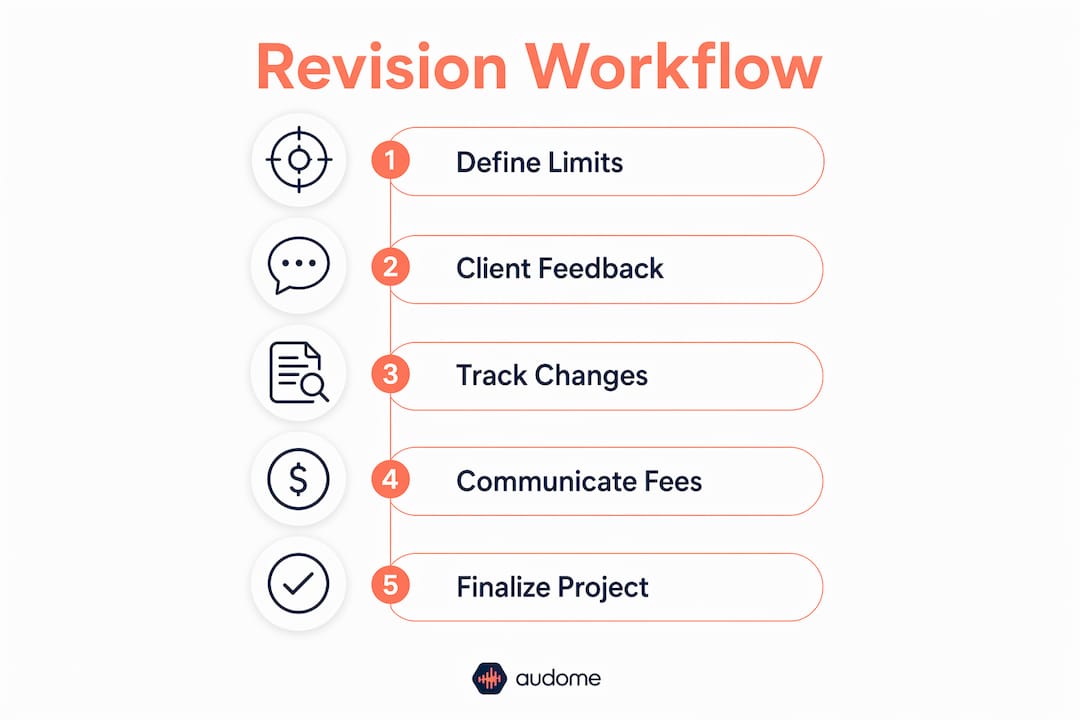
Defining what counts as a revision round is just as important as setting the price. Here’s how professionals typically structure it:
- Define a revision round clearly. One round equals one consolidated set of feedback submitted at the same time. Multiple emails sent over three days do not constitute one round.
- Separate minor tweaks from revisions. Minor fixes like a volume level or a brief timing adjustment are often absorbed as goodwill. Layout changes, structural edits, or new creative directions are billable revisions.
- Set the price before the project starts. State the revision fee in your proposal, not buried in contract fine print. Clients who see it early treat it as a project management tool, not a penalty.
- Communicate the policy at kickoff. Explaining revision rounds during the kickoff meeting, not just in the contract, dramatically improves client respect for boundaries.
Pro Tip: Build a simple revision tracker into every project. A shared document or a dedicated platform that logs each round, the feedback submitted, and the date keeps everyone accountable and makes billing disputes nearly impossible.
The comparison between a loose verbal agreement and a written revision policy is not subtle. Engineers who rely on informal understandings consistently absorb more unbilled rounds than those who present revision terms alongside deliverables from day one.
What strategies help manage demoitis and structure client feedback?
Managing demoitis starts with resetting client perception before the next revision round begins. The most effective technique is a 48-hour break between delivering a mix and collecting feedback. Distance from the demo reduces the mere-exposure effect. Clients who listen fresh are far more likely to hear the final mix on its own terms rather than comparing it to a memory.
Structured feedback cycles do the rest of the work. When clients submit feedback through a platform that requires timestamped notes directly on the waveform, vague comments like “it feels off” become harder to submit. Specificity is built into the process. Tools that require a final approval click create a professional transaction, reducing nitpicking and signaling that each round has a defined endpoint.
Audome is built specifically for this workflow. Engineers can collect timestamped feedback directly on the waveform, manage version history, and require client approval before moving to the next round. Clients don’t need to create an account, which removes friction while keeping the process formal. That formality matters: it signals that revisions are a structured part of the project, not an open-ended conversation.
- Send the mix with a short note acknowledging the transition from demo to final
- Ask clients to listen twice before writing any feedback
- Require all feedback to be submitted in one consolidated round, not across multiple messages
- Use a collaborative audio review platform that logs every comment with a timestamp
- Validate the client’s emotional response before redirecting toward technical specifics
Pro Tip: When a client says the demo felt better, don’t defend the final mix. Say: “I hear you. What specifically felt right about it?” That one question shifts the conversation from emotion to information, and information is something you can actually work with.
Validating client feelings is not a soft skill. It’s a practical tool for shortening revision cycles. Clients who feel heard are more likely to trust your judgment on the mix. Clients who feel dismissed dig in harder.
How do you communicate revision charges without damaging client trust?
Transparent communication about revision fees starts before the project does. Revision limits placed alongside deliverables in a proposal read as professional project management. The same limits buried in paragraph 14 of a contract read as a trap. The placement changes the perception entirely.
Here’s a practical sequence for communicating revision charges at every stage of a project:
- In the proposal. State the number of included revision rounds, what constitutes a round, and the fee for additional rounds. Use plain language. “This project includes two revision rounds. Additional rounds are billed at $X each.”
- At the kickoff meeting. Walk through the revision policy verbally. Clients retain spoken information differently than written terms. Hearing it from you directly makes it real.
- After the last included round. Send a billing checkpoint message that is neutral in tone. “You’ve used your two included revision rounds. Additional rounds are available at $X. Let me know how you’d like to proceed.” No apology. No pressure. Just information.
- Before delivering the final file. Confirm that all revisions are complete and that the client approves the final version. A written confirmation protects you if disputes arise later.
Framing matters throughout. Revision fees are not penalties for difficult clients. They are the cost of additional professional time. Engineers who communicate this clearly, early, and without apology rarely face pushback. Engineers who bring it up only after frustration has built almost always do.
Clients often don’t know when a project officially ends. Defining that endpoint explicitly, and tying it to a revision count, gives both sides a shared understanding of scope. That clarity is what prevents the slow scope creep that burns out engineers and strains client relationships.
Key Takeaways
Demoitis and charging for revisions are inseparable challenges: managing client attachment to demos requires the same structured, upfront approach as setting revision fees, and both protect your margins and your working relationships.
| Point | Details |
|---|---|
| Define demoitis early | Explain the mere-exposure effect to clients so they understand why the demo feels better. |
| Set revision limits in writing | Include 2–3 rounds in your base fee and charge 15–25% of the project fee for extras. |
| Require a 48-hour break | A cooling-off period between delivery and feedback resets client perception and reduces demoitis-driven requests. |
| Use structured feedback tools | Timestamped, waveform-level feedback and approval clicks reduce vague requests and shorten revision cycles. |
| Communicate fees before frustration | State revision charges in proposals and at kickoff, not after a dispute has already started. |
Why I stopped apologizing for revision fees
I spent the first few years of my career treating revision charges like an awkward conversation I had to survive. I’d bury the policy in the contract, hope clients wouldn’t notice, and then feel guilty bringing it up when they hit the limit. That approach cost me money and, more importantly, it cost me clarity.
The shift happened when I started treating revision limits the way a contractor treats a change order. No contractor apologizes for billing extra when a client adds a room to the blueprint. The scope changed. The fee reflects that. Audio work is no different.
What I’ve found is that clients who understand the revision structure from the start almost never push back when they hit the limit. The ones who push back are almost always the ones who weren’t told clearly upfront. That’s not a client problem. That’s a communication problem on my end.
Demoitis is real, and I’ve learned to name it directly when I see it. Telling a client “I think you might be experiencing demoitis” is not an insult. It’s a diagnosis that opens a productive conversation. Most clients are relieved to have a name for what they’re feeling. It shifts the dynamic from conflict to collaboration.
The engineers I respect most treat their revision policies the same way they treat their rates: with confidence, clarity, and zero apology. If you handle revisions like a pro, your clients will treat them that way too.
— Kreg
Audome makes revision management part of your workflow
Managing demoitis and revision fees gets significantly easier when your tools are built for it. Audome is an audio collaboration platform designed for mixing and mastering engineers, producers, and studios who need structured revision tracking built into every project.

With Audome, you can set a revision limit per project, collect timestamped waveform feedback from clients, and automatically charge for additional rounds through integrated Stripe Connect payments. Clients can submit feedback and approve mixes without creating an account, which keeps the process professional without adding friction. Final downloads are locked until payment clears, so you never deliver work before you’re paid. If you’re ready to take control of your revision workflow, Audome gives you the structure to do it.
FAQ
What is demoitis in audio production?
Demoitis is a client’s emotional attachment to a rough demo or early mix, caused by the mere-exposure effect. It leads clients to prefer the demo over a polished final version, often triggering unnecessary revision requests.
How many revision rounds should I include in my fee?
The industry standard is 2–3 revision rounds included in the base project fee. Additional rounds are typically billed at 15–25% of the project fee or an equivalent hourly rate.
How do I charge for extra revisions without upsetting clients?
State your revision policy clearly in your proposal and at the kickoff meeting, before any work begins. A neutral billing checkpoint message after included rounds are used keeps the conversation professional and avoids surprises.
How do I know if a client has demoitis or a real mix problem?
Ask the client to name three specific, technical changes they want made. If they can’t, the issue is almost certainly demoitis rather than a genuine mix problem.
Does a 48-hour break really help with demoitis?
A 48-hour break between mix delivery and client feedback resets perception by reducing the mere-exposure effect. Clients who listen fresh are more likely to evaluate the final mix on its own merits rather than comparing it to a memorized demo.