
TL;DR:
- Free audio apps often compromise privacy, stability, and support, costing professionals in time and risk. They share user data with multiple third parties, lack guaranteed support, and can trigger costly migration challenges, outweighing any initial savings. Paid platforms provide better security, dedicated support, and stability, making them indispensable for professional audio workflows.
Free apps like Samply and Opusonix are free in name only. The real costs show up in compromised privacy, missing support, and workflows that break at the worst possible moments. For podcast producers and audio professionals, the disadvantages of free software go far beyond the absence of a price tag. Free apps are 7 times more likely to share your data than paid alternatives. That single fact reframes the entire value proposition. If you’re not paying for the product, you are the product.
Why free apps like Samply and Opusonix aren’t a good idea
The industry term for what free apps actually sell is behavioral monetization. The app is the vehicle. Your attention, your usage patterns, and your data are the revenue stream. Understanding this model is the first step toward making a smarter decision about the tools you trust with your work.
Free apps routinely send your data to between 5 and 10 companies you have never heard of. These transfers happen through embedded ad libraries that carry permissions far beyond what the app itself needs. The legal disclosures authorizing this are buried in terms of service that 91% of users never read. For audio professionals sharing unreleased tracks, client sessions, or proprietary mixes, that exposure is not a theoretical risk. It is a live one.
A regulatory review found that 76% of free apps use dark patterns to push users toward paid upgrades or higher engagement. Nearly 67% of those apps used multiple dark patterns simultaneously. The result is manufactured frustration designed to extract money or attention from users who thought they were getting something for nothing.
What hidden costs come with free audio apps?
The hidden costs of free audio tools fall into three categories: data, time, and stability. Each one compounds the others.
- Data harvesting. Free apps collect behavioral intelligence beyond standard personal data. They track scroll depth, pause times, and interaction loops to build detailed user profiles that are sold to advertisers or data brokers. Your listening habits, session lengths, and file interaction patterns all become sellable signals.
- Productivity loss. Unmanaged free tools require your team to handle their own troubleshooting, updates, and workarounds. That time is not free. It comes directly out of your production schedule.
- Instability. Free apps rarely commit to update schedules. Security patches get delayed. Features break without warning. When a tool fails mid-project, the cost is not just frustration. It is missed deadlines and damaged client relationships.
- Switching costs. Every week you build workflows around a free tool, you accumulate dependencies. When that tool eventually fails or gets abandoned, migration costs can far exceed anything you saved by avoiding a subscription.
Pro Tip: Audit every free app in your current workflow. List the permissions each one requests, then calculate the hours your team spends troubleshooting it per month. The number will surprise you.
How does missing support hurt professional audio workflows?
No service-level agreement means no guaranteed response when something breaks. For a podcast producer on a weekly release schedule, that is not an inconvenience. It is a production crisis.

Free apps rely on community forums, GitHub issue threads, or Reddit posts for support. Response times are unpredictable. Solutions are inconsistent. The person who built the tool may have moved on entirely. Free tools can be abandoned when the developer’s motivation fades, leaving professional teams dependent on software with no future.
Here is what the support gap actually costs a professional audio team:
- Diagnosis time. Your engineer spends hours identifying whether a bug is in the app, your system, or your files. That time costs money regardless of who pays for the tool.
- Forum dependency. You post a question and wait. In a professional environment, waiting is not an option when a client is expecting a deliverable.
- Workaround accumulation. Teams build unofficial fixes on top of unofficial fixes. The workflow becomes fragile and undocumented.
- No escalation path. With a paid platform, you can escalate a critical issue to a support team. With a free app, there is no one to call.
Paying for software creates an implicit contract. The vendor has a financial reason to keep the product working and to respond when it does not. Free tools carry no such obligation.
Pro Tip: When evaluating any audio tool, ask one question before anything else: “Who do I call when this breaks?” If the answer is a forum, factor that into your total cost of ownership.
What are the security and privacy risks of free tools in media production?
Free software frequently lacks the encryption, access controls, and audit capabilities that professional media environments require. The consequences range from data leaks to full compliance failures.
- No enterprise-grade encryption. Free apps rarely implement end-to-end encryption for file transfers or storage. Unreleased audio, client contracts, and session data travel through infrastructure with no guaranteed protection.
- Shadow IT. When team members adopt free tools independently, data gets siloed across platforms with no centralized oversight. Shadow IT from free apps creates compliance gaps and increases liability exposure for the studio or production company.
- No audit trail. Professional environments need to know who accessed what and when. Free apps almost never provide this. Without an audit trail, you cannot prove chain of custody for your own work.
- Brand and legal risk. A data leak involving unreleased client audio is not just embarrassing. It can trigger contract penalties and destroy professional relationships built over years.
Free apps that lack centralized control and audit capabilities do not just create technical risk. They create legal and reputational risk that no amount of upfront savings can offset.
Audome addresses this directly by offering privacy-focused collaboration with password protection, download toggling, and private collaborator spaces. No client login is required, which removes a common attack surface entirely.
Why do free apps cost more than paid subscriptions over time?
The most cited figure in this space is stark. Maintaining free, unmanaged tools can cost professional audio teams over $45,000 annually in labor time alone. A commercial SaaS subscription with full support and security typically runs around $500 per month. The math is not close.
| Cost category | Free app | Paid professional platform |
|---|---|---|
| Upfront fee | $0 | Fixed monthly subscription |
| Support cost | Engineer hours on forums | Dedicated support team included |
| Security patching | Delayed or absent | Scheduled and guaranteed |
| Migration risk | High, accumulates daily | Low, vendor manages continuity |
| Annual hidden labor | Potentially $45,000+ | Minimal, covered by subscription |
Switching costs accumulate silently. Every workflow, every file naming convention, every integration you build around a free tool becomes a dependency. When the tool fails or gets discontinued, unwinding those dependencies is expensive and disruptive. Infrastructure built on free software locks teams into fragile ecosystems that require costly transitions when support ends.
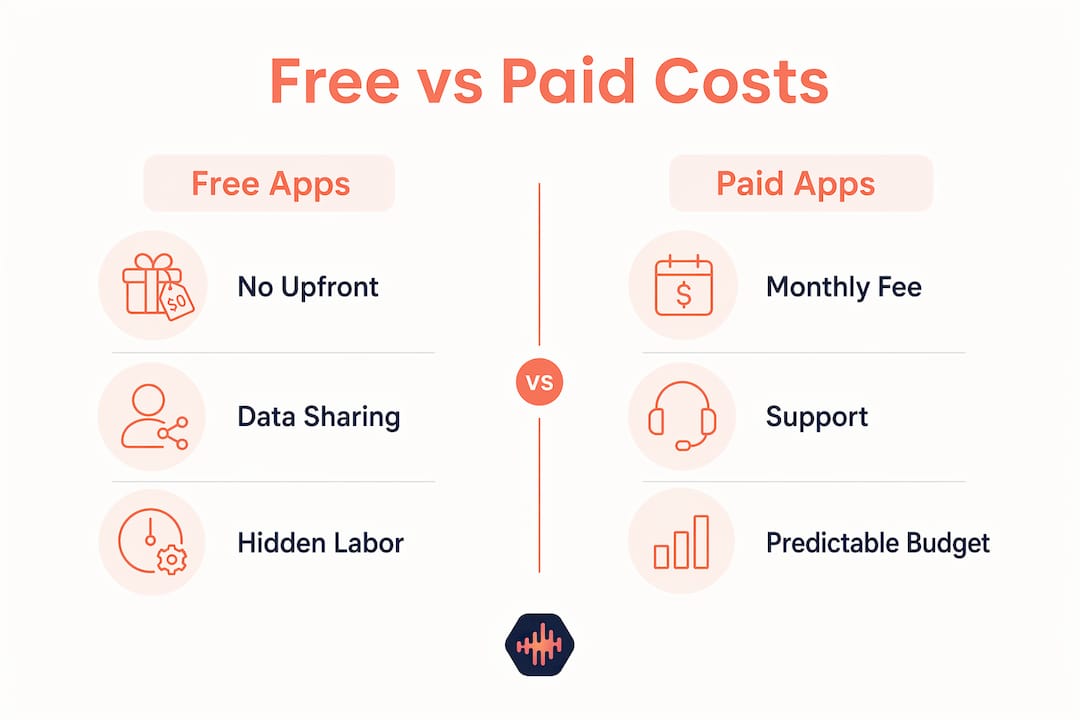
Paid platforms provide predictable budgeting. You know what you pay each month. You know what you get. That predictability has real value in a professional environment where time is billable and deadlines are contractual.
Pro Tip: Build a simple spreadsheet tracking hours spent on any free tool each month, including setup, troubleshooting, and workarounds. Multiply by your hourly rate. Compare that number to the cost of a paid alternative.
How should audio professionals evaluate free versus paid tools?
The evaluation framework for any audio app should start with five questions, not the price tag.
- Feature completeness. Does the tool support the audio quality your work demands? Lossless formats, high sample rates, and version control are not optional for professional production. Check whether the app handles audio file formats at the quality your clients expect.
- Support structure. Is there a dedicated support team, a documented SLA, or a clear escalation path? If not, your team absorbs that cost.
- Update frequency. When was the last release? How often are security patches issued? A tool with no recent updates is a tool with no active maintenance.
- Data privacy credentials. Does the app publish a clear, readable privacy policy? Does it disclose exactly which third parties receive your data? If the answer is vague, assume the worst.
- Vendor commitment. Is the company behind the tool financially stable and publicly committed to its future? Free tools can disappear without notice. Professional users consistently favor paid tools because free offerings fail to meet the integrity and support required for critical media projects.
For a broader view of what secure, professional-grade collaboration looks like in practice, the 2026 guide to producer collaboration tools covers the key criteria worth applying to any platform you evaluate.
Key takeaways
Free audio apps carry real costs that show up in data exposure, lost productivity, and workflow instability. Paid professional platforms consistently deliver better security, support, and long-term reliability for audio teams.
| Point | Details |
|---|---|
| Data sharing is the default | Free apps send your data to 5–10 unknown third parties through embedded ad libraries. |
| Support gaps cost real money | No SLA means your team absorbs all troubleshooting time, which adds up fast. |
| Hidden labor exceeds subscription fees | Annual maintenance labor on free tools can exceed $45,000, far more than a paid plan. |
| Switching costs accumulate daily | Every dependency built on a free tool increases the cost of migrating away later. |
| Security controls matter | Free apps rarely offer encryption, audit trails, or centralized access control for media teams. |
Why I stopped trusting free tools with professional work
I used a free audio collaboration app for about eight months on a mid-sized podcast production project. It worked fine until it did not. One morning, the project files were inaccessible because the developer had quietly deprecated a core feature without notice. No email. No migration path. Just a forum post from three weeks earlier that nobody on my team had seen.
That experience taught me something I now consider non-negotiable: the tool you trust with your work needs to have skin in the game. Paying creates a relationship that free tools simply cannot replicate. When a vendor charges you money, they have a reason to answer the phone, fix the bug, and keep the lights on.
Free tools feel like savings until the moment they cost you a client. The math on that trade-off is not complicated. A $500 monthly subscription looks expensive until you compare it to a missed deadline, a data leak, or a week of your engineer’s time spent rebuilding a workflow from scratch. Audio professionals who scale their operations need tools that scale with them, and free apps are not built for that. They are built for casual use, funded by your attention and your data.
— Kreg
Audome: built for the work you can’t afford to lose
Audio professionals who need reliable file sharing, version control, and secure collaboration have a direct alternative to free apps.
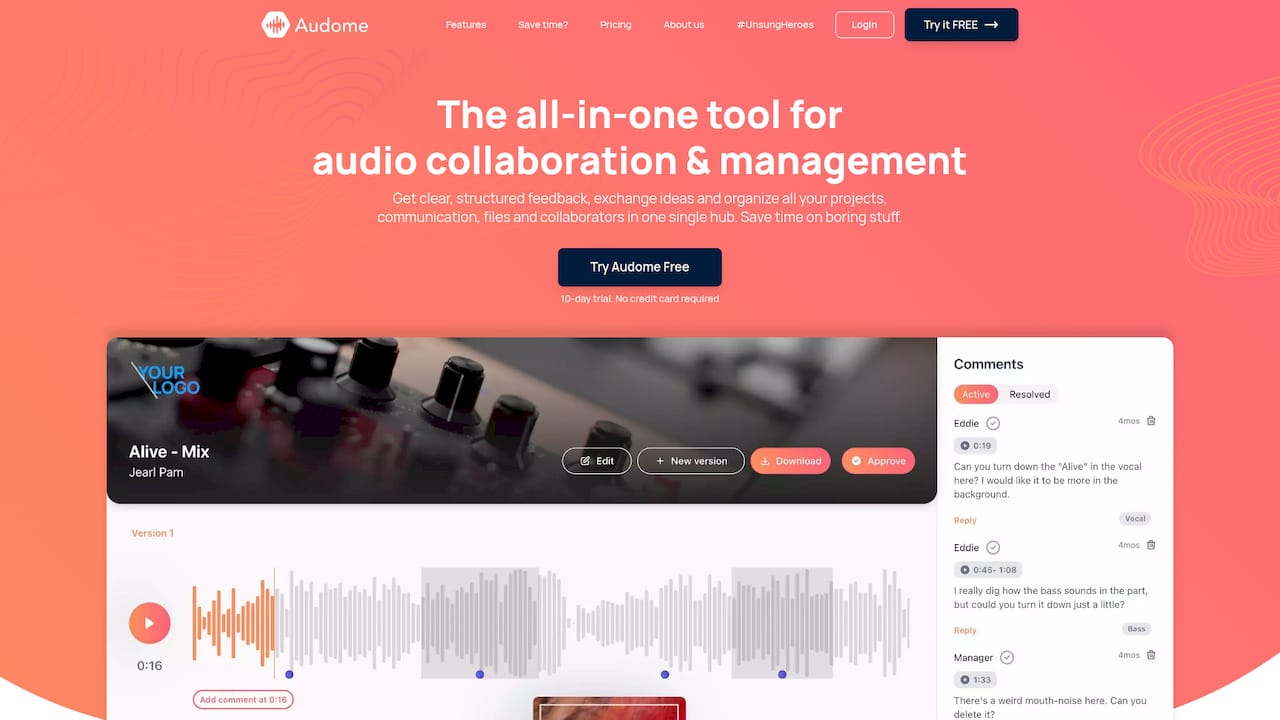
Audome is a purpose-built platform for music producers, podcast teams, and post-production engineers. It supports lossless audio up to 96kHz/24-bit, offers unlimited file uploads, and includes timestamped comments, version control, and private collaborator spaces. Password protection and download toggling give studios full control over who accesses what and when. The newest features include paywalled downloads with Stripe integration, so studios can collect payment before files are released, and revision limits that protect both the studio and the client relationship. For teams ready to move away from fragile free tools, Audome provides the structure, security, and support that professional audio work demands.
FAQ
Are free audio apps safe for professional use?
Free audio apps are generally not safe for professional use. They frequently lack enterprise-grade encryption, share data with multiple third parties, and offer no audit trail for file access.
What are the real costs of using free apps?
The real costs include data exposure, lost productivity from troubleshooting, and hidden labor that can exceed $45,000 annually. These costs consistently outpace the price of a paid professional subscription.
Why do free apps share so much user data?
Free apps monetize user attention and behavioral data because they have no subscription revenue. They send data to ad networks and third-party brokers to generate income, often without clear user disclosure.
What should I look for in a paid audio collaboration tool?
Look for dedicated support, a clear SLA, end-to-end encryption, version control, and transparent data privacy policies. Tools like Audome also offer secure file sharing built specifically for audio professionals.
Can switching from a free app to a paid platform be disruptive?
Yes, switching costs accumulate the longer you use a free tool. The earlier you migrate to a paid platform, the lower the disruption and the lower the long-term cost.