
A project recap summary is the one document that tells a client, in plain language, what they’re getting, what changed along the way, and what happens next. At minimum, it names the final approved file or files and their formats, states the version label along with payment and approval status, and links to where the project lives for archiving or the next production step, like mastering or distribution.
TL;DR:
- Final deliverables should specify all included variants, such as stems and instrumentals, along with clear technical specs like sample rate and bit depth.
- The recap must clearly state the project name, version number, revision count, and the exact location of stored backups, following consistent naming conventions.
- Document timestamped client feedback and revision history in detail to prevent disputes and ensure clarity about what was approved.
- The recap should include written approval instructions, specify how many revision rounds were used, and establish a deadline for client feedback to protect payment.
- Always link the final approved file explicitly with recognition of the version and include location details for primary and backup archives to safeguard the project long-term.
Table of Contents
- What Is a Project Recap Summary in Audio Production?
- Final Deliverables and File Specs to List in the Recap
- How to Structure the Project Manifest and File List
- How Do You Document Revision History and Client Feedback?
- Final Delivery, Acceptance Criteria, and Payment Triggers
- Archive and Backup Notes to Include in the Recap
- Copy-Ready Project Recap Template You Can Paste Today
- Why Recap Discipline Protects Your Margins
- How Audome Handles Your Project Recap Summary
- Sources
- FAQ
What Is a Project Recap Summary in Audio Production?
Most producers already send something at the end of a job. A folder link, a text that says “here’s the final mix,” maybe an invoice attached separately. That’s not a recap. A real project summary report ties the final deliverables, the revision history, and the payment status into one document the client can reference weeks or months later without emailing you to ask “wait, which version did we approve?”
The term itself borrows from general project management, where a project conclusion report wraps up scope, timeline, and outcomes. Audio work needs its own version because the outcomes aren’t milestones on a Gantt chart. They’re files, formats, and timestamped notes tied to a waveform. A summary of project outcomes for a mix session looks nothing like one for a marketing campaign, and treating them the same is how studios end up with vague, useless paperwork nobody reads.
Done right, a recap serves three audiences at once: the client who needs proof of what they bought, the mastering engineer who needs to know what’s final, and your future self trying to remember why v7 replaced v5 eight months from now.
Final Deliverables and File Specs to List in the Recap
Every recap needs a deliverables section that removes any doubt about what “final” actually means. The AES delivery recommendations call for a primary master plus two secondary backups (safeties), each at equal or better sample rates and bit depths, and preferably packaged in Broadcast Wave format so metadata travels with the audio.
Beyond the master itself, list every downloadable variant included in the delivery:
- Stereo master — the finished mix, ready for release or mastering
- Stems — grouped elements (drums, bass, vocals, music) for remixing or sync licensing
- Instrumental — full mix minus lead vocal, common for podcast intros or licensing requests
- A cappella — isolated vocal, useful for remix work or dubbing
- TV mix — instrumental with backing vocals retained, standard for broadcast placements
State the technical specs plainly: sample rate, bit depth, and any headroom notes (for example, “peaks at negative six dB for mastering headroom”). Add one line making clear you didn’t upsample or otherwise alter the original files. That single sentence prevents a mastering engineer three months later from assuming your 48kHz session was secretly a 96kHz capture. Reference exporting audio deliverables best practices if the client wants more detail on format handling.
How to Structure the Project Manifest and File List
A recap without structure is just a longer email. Build it around three parts every time:
- Project manifest. Lead with the project name, full track list, BPM, key, DAW used, and plugin versions if relevant to future recall (a client’s vocal chain relying on a discontinued plugin is worth flagging now, not later). Include sample rate and bit depth here too, so it’s stated once at the top rather than buried in file names.
- File list. One row per file: filename, file type, sample rate/bit depth, a short description (“stereo master, mastering ready”), and a checksum or file size if your delivery system generates one automatically.
- Delivery notes. A few sentences summarizing what changed in this specific delivery, what the client should check first, and what happens next, whether that’s mastering, distribution, or simply archiving.
Universal Music Group’s stereo archival asset guidelines recommend a naming pattern like ArtistName_SongTitle_MixType_Tempo_DateCreated, which works just as well for independent studios. Consistent naming means the manifest and the file list actually match, instead of forcing the client to guess which row corresponds to which download. A project tracking approach built around this structure scales cleanly whether you’re delivering one song or a twelve-track album.
How Do You Document Revision History and Client Feedback?
This is the section that saves relationships when a client insists “I never approved that change.” Timestamped feedback tied to version history is your defense, and it works better than any email thread ever will.
Pull the timestamped waveform comments from your revision rounds and summarize each one with three things: the timecode, the commenter’s name, and a one-line summary of the note (“0:42, client, wants vocal reverb tail shortened”). You don’t need to reproduce every comment verbatim. You need enough detail that a dispute six weeks from now gets settled in ten seconds.
Add a simple changelog under that, one line per version:
- v3, March 14 — client requested tighter low end; rebalanced kick and bass
- v4, March 19 — vocal comp adjustments per timestamped note at 1:12
- v5, March 22 — approved for master
Naming matters more than most producers realize. Avoid saving a file as song_final.wav, because there is always another final. Use a version tag like ProjectName_v5_20260322, and mark the actual approved version in your recap summary with an explicit FinalApproved label rather than trusting the filename to communicate it. Audome’s revision management guide found that timestamped comments paired with defined version history cut down ambiguous, back-and-forth notes significantly, mostly because clients stop guessing which file they’re even listening to.
Pro Tip: Keep a one-line changelog in the same folder as your session files, not just in the recap document. When someone asks “what changed in v3” eight months later, the answer should be sitting right next to the session, not buried in a sent-mail folder.
Final Delivery, Acceptance Criteria, and Payment Triggers
The recap is also where you protect your invoice. Include standard acceptance phrasing and a way to collect it in writing. That might be an email reply confirming approval, a checkbox in your delivery platform, or a signed acknowledgment. Verbal “sounds great” over a phone call doesn’t hold up if a dispute surfaces later.

A useful safety clause: state that if no feedback arrives within a defined window, usually five to seven business days, the deliverable counts as approved. This single sentence prevents projects from sitting in limbo indefinitely while a client goes quiet.
The recap should also state, in plain terms:
- How many revision rounds were included in the original agreement and how many were actually used
- Whether any additional rounds were billable, and at what rate
- The specific trigger for requesting a paid revision going forward (a new note after final approval, for instance)
Operationally, the sequence matters: send the recap, request written confirmation, issue the invoice immediately upon that approval, then archive once payment or sign-off is complete. Waiting days to invoice after approval is one of the most common ways studios lose momentum on collections. The mix approval checklist covers wording you can adapt directly into your own template.
Archive and Backup Notes to Include in the Recap
Your recap should tell the client, and remind you, where everything actually lives after delivery. AES guidance calls for a primary master plus two backups stored on different media where feasible, since a single point of failure (one dead drive) shouldn’t be able to erase a finished project.
List in the recap:
- Primary master location and format
- Two safety copies, ideally on separate physical or cloud storage
- Attached documentation: a Media ID Label, recording map, tracking sheets, and any session notes worth preserving
- Where each archive sits: cloud path, on-site drive, off-site copy
- A retention policy, even a simple one (“masters retained indefinitely; session files retained 24 months”)
This section rarely gets read the day you send it. It gets read eighteen months later when a client calls asking for a remix stem you thought you’d never need again. Backup practices for client projects go deeper into acceptable media and long-term storage if you’re building this policy from scratch.
Copy-Ready Project Recap Template You Can Paste Today
Here’s a template you can adapt directly into an email or delivery message:
“Attached is the final approved master for [Project Name] (v5, approved March 22). Deliverables include the stereo master, stems, and instrumental at 48kHz/24-bit WAV. This delivery used 2 of 3 included revision rounds; no additional charges apply. Files are archived at [location] with two backup copies. Invoice #1042 has been sent and is due on approval. Let us know if you have any questions, otherwise this project is considered closed.”
Paste a short manifest table alongside it:
| Field | Detail |
|---|---|
| Project name | Example Track Title |
| Final version | v5, FinalApproved |
| Format | 48kHz/24-bit WAV |
| Revisions used | 2 of 3 included |
| Invoice status | Sent, due on approval |
| Archive path | Cloud + local backup |
For delivery method, a short walk-through call works well for high-value projects, while attaching the recap directly to the download link suits quicker turnarounds. Either way, send the invoice at the same moment, not after. The freelance delivery playbook has more variations on this exact template if your workflow needs adjusting.
Why Recap Discipline Protects Your Margins
Most disputes I’ve seen studios describe come down to one missing sentence: nobody wrote down what “final” meant. A recap that states the approved version, the revisions used, and the payment status closes that gap before it opens.
The habit worth adopting on every single delivery, no exceptions: never call a project done until the recap is sent and acknowledged. One clear document, sent every time, does more for your cash flow than any contract clause. Studios that skip this step reopen projects far more often than the paperwork actually requires.
— Kreg
How Audome Handles Your Project Recap Summary
Building this recap by hand every time, pulling timestamps from one app, file specs from another, invoice status from a third, is exactly the kind of admin that eats an afternoon. Audome consolidates it into one workspace instead.
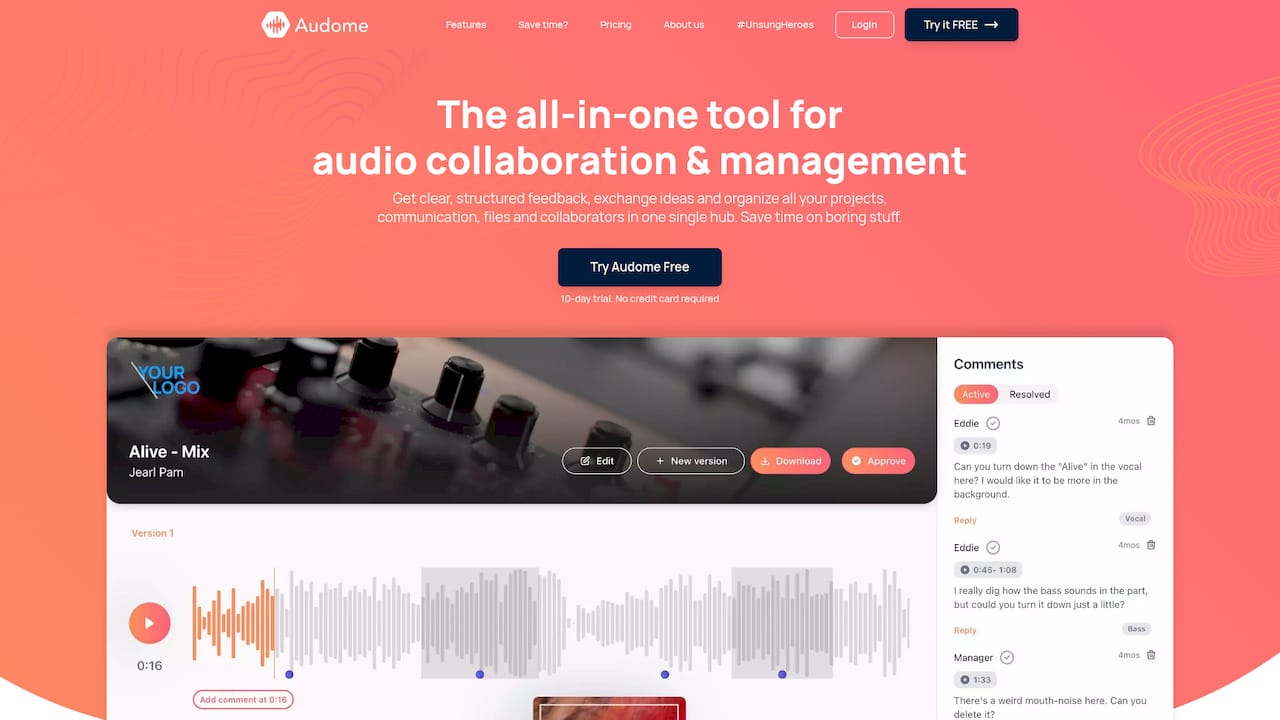
Every high-resolution file up to 96kHz/24-bit lives in one project, so the sample rate and bit depth notes your recap needs are already attached to the file, not retyped from memory. Client feedback lands as timestamped comments directly on the waveform, tied automatically to the version it was left on, which means your revision history writes itself instead of getting reconstructed from an email thread. When a client requests changes past the included rounds, The paid-revision workflow and payment integration handle billing and gate the final download until payment clears, facilitating the acceptance-and-invoice sequence your recap depends on without a separate follow-up.
Some subscription plans offer features including unlimited projects, version tracking, and client portals that do not require login. Check current pricing plans or see the full feature set on the Audome overview page to see whether it fits how your studio delivers.
Sources
The delivery and archive guidance above draws on the AES delivery recommendations, Universal Music Group’s archival asset best practices, and practical checklists from the mix engineer file delivery checklist. For operational templates, see Audome’s producer client workflow guide and, for automation ideas beyond audio, this marketing automation checklist.
- AES delivery recommendations (AESTD1002.2.15-02_1.pdf)
- Universal Music Group stereo audio archival asset best practices
FAQ
What File Format Should a Final Master Recap List?
List Broadcast Wave at the session’s native sample rate and bit depth, never upsampled. The AES delivery recommendations treat Broadcast Wave format as preferred because it carries metadata alongside the audio.
What Is a Safety Master and Why Does the Recap Need One?
A safety master is a backup copy of the final master, ideally on separate media from the primary. AES guidance recommends a primary plus two safeties at equal or better specs, and your recap should state where each one is archived.
How Do I Record Client Approval in a Recap?
Collect it in writing, whether that’s an email reply, a signed checkbox, or an in-platform confirmation. Include a clause stating that no response within a set window (typically five to seven business days) counts as approval, so projects don’t stall indefinitely.
Should the Recap State How Many Revisions Were Used?
Yes. State the rounds included in the original agreement, how many were used, and whether anything beyond that is billable. Audome’s paid-revision workflow can gate additional requests and handle that billing automatically once the included rounds are spent.
What Belongs in the Version Naming Convention?
Use a pattern like ProjectName_v5_20260322 instead of a bare filename called “final.” Mark the actual approved version explicitly in the recap with a FinalApproved tag so there’s no ambiguity months later about which file shipped.