
Revision billing means charging clients for mix, master, or edit rounds that go beyond an agreed cap, instead of absorbing endless tweaks for free. The baseline policy that works for most audio businesses: build 2 to 3 revision rounds into your project fee, then require written approval and payment before starting any round after that. Timestamped feedback tools and payment gating make this enforceable without turning every invoice into an argument.
TL;DR:
- Most audio projects include two to three free revision rounds, but higher budgets like an $800 mix often limit extra rounds to 15 to 25 percent of the original fee per round.
- Flat-fee billing is standard for mixing and mastering due to client familiarity, but hourly billing suits unpredictable revisions, especially in sound design or post-production work.
- Clear, written policies outlining revision counts, overage rates, and scope exclusions in contracts prevent disputes and should be positioned near the signature line for easy clarity.
- Tracking feedback, version numbers, and payment gates through automated workflows like Audome minimizes admin time and enforces payment before delivering final files.
- Charging full price for additional rounds, rather than offering discounts to “good clients,” discourages excessive revisions and maintains project control.
Table of Contents
- Billing Models and Pricing for Extra Revision Rounds
- How to Write Revision Billing Into Your Contracts and Proposals
- What Does a Revision-Tracking Workflow Actually Look Like?
- Client Messages and Billing Checkpoint Scripts
- Handling Disputes, Edge Cases, and Non-Payment
- Why Strict Revision Policies Actually Help Studios
- How Audome Puts Revision Billing on Autopilot
- FAQ
Billing Models and Pricing for Extra Revision Rounds
Two billing models cover almost every situation you’ll run into: flat fee per round, and hourly.
Flat fee is the default for most mixing and mastering work because clients can see the number up front and it matches how they already think about “one more pass.” The industry standard sits at 15 to 25 percent of the original project fee per extra round. On an $800 mix, additional rounds are billed at a rate intended to encourage careful use of included rounds, without specifying exact amounts. On a $2,500 album mix, extra revision rounds are charged at a rate designed to fairly compensate the engineer and moderate excessive revision requests.
Hourly billing works better when revision requests are genuinely unpredictable, like sound design notes that could mean five minutes or five hours of work. Quote a time estimate before you start the clock, not after.
Pro Tip: Never discount the overage rate for a “good client.” Charging full price on round four is what keeps round five from happening.
Project type changes the math:
- Podcasts: 1 to 2 included rounds is standard, since episodes ship on a schedule and drawn-out revisions blow deadlines.
- Single song mixes: 2 to 3 rounds, flat fee overage.
- Albums: 2 to 3 rounds per track, sometimes with a bundled buyout option for artists who want unlimited tweaks on a fixed budget.
- Post-production/sound design: 2 rounds, often hourly, because picture-lock changes ripple through a mix unpredictably.
A capped extension bundle, say, three extra rounds at a discount from the per-round rate, gives high-touch clients a middle ground without training everyone to expect unlimited access.
How to Write Revision Billing Into Your Contracts and Proposals
The policy only works if it’s written down before the project starts, not explained after a client is annoyed.
Your proposal should state the terms in one plain sentence: “This project includes 2 rounds of revisions. Additional rounds are billed at $150 each.” No legal language needed at this stage. Save the detail for the contract.
Your contract clause needs four pieces:
- Definition of a revision round — a consolidated set of notes submitted as one batch, not a running string of texts over several days.
- The included count and overage rate, stated as a number, not “reasonable” or “as needed.”
- Payment schedule — typically a deposit to start, milestone or final payment tied to approval, and extra rounds gated behind payment before work resumes.
- Scope exclusions — what a revision does not cover: song restructures, added stems, new picture-lock edits, or format changes count as new scope, billed separately.
Put the revision clause near the signature or initial line, not buried in boilerplate. Clients skim contracts; they don’t skim the line right above where they sign.
Pro Tip: List what mixing does NOT include (mastering, stem exports, alternate versions) right next to your revision terms. Most scope disputes come from assumptions about what was included, not disagreements about the revision count itself.
Well-structured mixing contracts that spell out deliverables and exclusions hold up far better than a verbal agreement or a one-line email confirmation.
What Does a Revision-Tracking Workflow Actually Look Like?
Policy on paper does nothing if you’re chasing feedback across five apps and losing track of which round you’re on. The operational fix is simpler than most engineers assume:
- Collect one consolidated feedback batch per round. If notes trickle in over three days before the next delivery, that’s still round one, not three.
- Label every delivery with a version and round number (v1_round1, v2_round2) and log the count in your project notes.
- Send a billing checkpoint the moment included rounds are used up, before doing any more work.
- Require written approval on the checkpoint message before starting a paid round.
- Gate the final download behind payment clearing.
That last step is where most freelancers leak money, delivering final files on trust and hoping the invoice gets paid later. Automating the count, the reminders, and the payment gate removes that gap entirely, and it makes the checkpoint feel like a routine system step instead of an awkward conversation you’re forcing.
Audome builds this workflow directly into the platform: clients drop timestamped comments on the actual waveform instead of a vague text like “make the chorus punchier,” version history keeps every round auditable, and Stripe Connect holds the final download behind payment.
| Workflow step | What it prevents |
|---|---|
| Consolidated feedback per round | Piecemeal notes inflating the round count |
| Version/round labeling | Disputes over how many rounds were used |
| Billing checkpoint message | Starting paid work without agreement |
| Written approval before paid rounds | “I didn’t agree to that charge” disputes |
| Payment-gated downloads | Delivering final files before payment clears |
Logging round numbers in project notes builds a record you’ll rarely need in a legal sense, but one that ends most disagreements before they start.
Client Messages and Billing Checkpoint Scripts
The words you use at the checkpoint matter almost as much as the policy itself. Neutral, factual language works better than an apology or a lecture.
Billing checkpoint message:
“You’ve used your 2 included revision rounds. The next round is billed at $150, and I’ll need approval and payment before starting.”
Out-of-scope change script:
“That’s a great note, but restructuring the bridge counts as new scope rather than a revision. I can quote it as a separate round, or fold it into a buyout if you’d rather have unlimited access to structural changes.”
Pushback handling:
“Per the signed agreement, extra rounds are billed at [rate]. I’m happy to proceed once you confirm and payment clears.” No apology, no re-litigating the policy, just a pointer back to what both parties already agreed to.
- Always get a written “yes” (email reply or platform confirmation) before touching a paid round.
- Keep the tone flat and factual. Defensiveness invites negotiation.
- Offer options (pay per round, or a bundle) rather than a single take-it-or-leave-it price.
Handling Disputes, Edge Cases, and Non-Payment
Most conflicts come from three situations, and each has a clean path through it.
- Tweak vs. revision disputes. A tweak is a five-second fader nudge inside an already-approved mix. A revision is new notes on a full pass. Document which one you’re doing in writing, every time, so there’s no ambiguity later.
- Scope creep from a good client. Offer a buyout (unlimited rounds for a flat premium) or a capped bundle instead of quietly absorbing extra work. This protects the relationship without training them to expect free labor.
- Non-payment. Withhold final, full-quality masters until payment clears. Stating this consequence in the contract up front removes the surprise factor and gives you standing if collection becomes necessary.
Pro Tip: Keep time logs and version history even on flat-fee projects. If a dispute ever escalates, a timestamped record of what was delivered and when is worth more than your memory of the conversation.
Why Strict Revision Policies Actually Help Studios
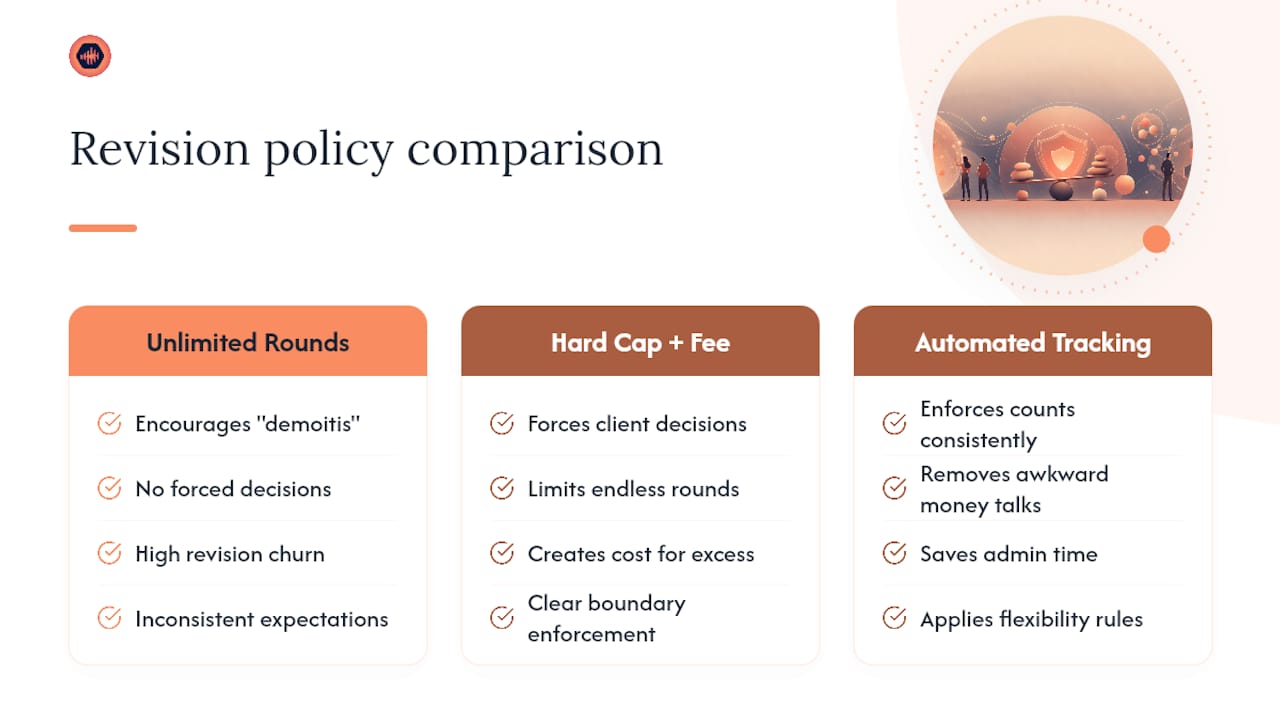
The engineers who resist revision caps usually think they’re being generous. In practice, unlimited rounds don’t produce better mixes, they produce “demoitis”: a client who keeps finding new things to second-guess because nothing forces a decision. A hard cap, paired with a real cost for going past it, gets people to commit their attention to the notes that matter.
That said, rigid enforcement isn’t the goal for every relationship. A long-term client who’s brought you five projects earns more flexibility than a first-time client testing the waters, and you get to decide where that line sits. What shouldn’t be inconsistent is the tracking itself. Automating round counts and payment gates doesn’t just save admin time, it removes the moment where you have to decide, project by project, whether to raise the awkward topic of money. The system raises it for you.
— Kreg
How Audome Puts Revision Billing on Autopilot
Every policy in this article depends on tracking that most engineers never have time to do by hand, and that’s exactly the gap Audome is built to close. Timestamped waveform comments turn vague client notes into a precise, consolidated record per round. Version history logs every delivery automatically, so “how many rounds have we done” stops being a guessing game. And Stripe Connect gates final downloads behind payment, so you’re never handing over a master before the invoice clears.

That combination is the real advantage over stitching together email, Dropbox, and a spreadsheet: the billing checkpoint stops being a conversation you have to initiate and becomes a step the platform enforces on its own. Studios using Audome’s revision cap and payment gating tools report fewer scope arguments simply because the system, not the engineer, is the one holding the line. If you’re ready to stop chasing feedback across four apps and start getting paid for every round you actually work, start a free trial with Audome and set your revision cap on your next project.
FAQ
What Is Revision Billing?
Revision billing is the practice of charging clients for mix, master, or edit rounds beyond a set number included in the base project fee, typically 2 to 3 rounds before overage charges apply.
How Many Free Revisions Should I Include in a Project?
Most audio professionals include 2 to 3 rounds in the base fee, with podcasts often set lower at 1 to 2 rounds due to tighter deadlines.
How Much Should I Charge for an Extra Revision Round?
Flat-fee overage rates typically run 15 to 25 percent of the original project fee per round; hourly billing works better for unpredictable revision scope.
What Counts as One Revision Round?
A revision round is one consolidated batch of feedback submitted before the next delivery, not a running string of separate notes sent over several days.
Should I Discount Extra Revision Rounds for Repeat Clients?
No. Discounting overage rates signals that extra rounds are negotiable, which tends to invite more requests rather than fewer.
How Do I Enforce Payment Before Starting a Paid Revision Round?
Send a billing checkpoint message stating the included rounds are used and the next round’s fee, then get written approval before starting, ideally through a platform like Audome that gates downloads and paid rounds behind Stripe Connect payment.