
Restrict file downloads by streaming previews for client review and unlocking short-lived signed download links only after payment clears or final approval lands. Some platforms include this feature natively; developers can replicate it with Stripe Checkout webhooks feeding a signed-URL system. Either way, the client hears the mix before they ever get a downloadable file.
TL;DR:
- Download restrictions work best when clients access streaming previews during review and only receive the final download after payment or approval, using short-lived signed URLs.
- Payment gating typically relies on webhook verification from Stripe or similar platforms, requiring secure handling of webhook signatures and event idempotency.
- Different workflows suit various project stages, from password-protected streams during pre-release to milestone-based unlocking tied to payments, with each protecting against leaks and disputes.
- Deploying gated downloads can be quick with SaaS platforms, but custom or open-source solutions offer greater control over pricing, revision limits, and auditing, albeit with increased setup time.
- Logging every download attempt and scheduling delivery summaries with clear file details are essential to reducing disputes and maintaining a professional, secure delivery process.
Table of Contents
- How Do Gated Downloads and Signed Links Actually Work?
- What Workflows Actually Fit a Real Studio Project?
- Which Technical Approach Fits Your Studio’s Setup?
- A Step-by-Step Checklist for Locking Down Delivery
- Why Gating Downloads Changes the Client Relationship
- How Audome Builds This In From Day One
- Sources
- FAQ
How Do Gated Downloads and Signed Links Actually Work?
Every gated delivery system runs on the same split: a streaming preview for review, and a separate, restricted path for the final downloadable file. During revisions, clients listen to a waveform stream, sometimes watermarked, that lets them give feedback without ever touching a file they could forward to someone else. Once they approve the mix or the invoice gets paid, the system switches them to the real thing.
The mechanics behind that switch usually follow this pattern:
- A server checks that payment or approval status exists before doing anything else.
- It generates a signed URL pointing to a private storage bucket (commonly Amazon S3 or Cloudflare R2), valid for a short window, often minutes to a few hours.
- The client’s browser downloads directly from that link, which expires and can’t be reused or shared usefully after the window closes.
- Guest clients get access through a single-use email token instead of a full account, so nobody’s forced to sign up just to grab a mix.
Payment gating typically runs through Stripe Checkout. A client pays, Stripe fires a webhook event like checkout.session.completed, and your system marks that project as paid before issuing the tokenized link. The tricky part is handling that webhook correctly. Secure setups verify Stripe’s signature on every event and process it idempotently, meaning a duplicate webhook retry doesn’t accidentally regenerate or reissue a download link that’s already been sent out. Songbox built its entire access and billing workflow around this exact webhook pattern, turning what used to be manual follow-up into something closer to a background process.
Pro Tip: Log every download attempt, not just successful ones. A spike in failed attempts on an expired link is often the first sign someone’s trying to reshare a file that should have been locked down.
What Workflows Actually Fit a Real Studio Project?
Download restrictions only work if they match the stage of the project. Lock everything down too early and you frustrate a paying client. Lock it too late and you’ve already handed over the leverage.
- Pitch and pre-release stage. Keep everything stream-only, behind a password-protected page, with a short expiry window (under two weeks). Send the password through a separate channel, a text or a phone call, never in the same email as the link, since that separation meaningfully cuts leakage risk for pre-release material.
- Revision-heavy projects. Stream-only access during review, with an explicit cap on how many revision rounds are included. The final downloadable file to unlock only after the invoice is paid or the client formally signs off, which also gives you a natural point to enforce revision limits instead of absorbing endless “one more small tweak” requests.
- Milestone-based projects. Split larger jobs into deposit, interim, and balance payments. Tie the download to unlock specifically to the balance payment through a webhook trigger, not the deposit. That keeps the incentive structure honest on both sides.
- Final delivery. Always pair the unlock with a delivery summary listing every file, its format, and its version number. Clear delivery summaries with defined acceptance criteria measurably reduce disputes and speed up final approval, and they give you a paper trail if a client claims they never got a file.
Minimize friction wherever you can. Guest access through email or single-use tokens means a client never has to create an account just to hear their own mix, and WeTransfer’s paid-transfer model delivers files at their original uploaded quality rather than re-encoding them, which matters when you’re gating a 96kHz/24-bit master rather than an MP3 preview.
Which Technical Approach Fits Your Studio’s Setup?
Three realistic paths exist here, and the right one depends on how much developer time you have and how custom your workflow needs to be.
The fastest option is a purpose-built collaboration platform with download gating already wired in. Toggle downloads on or off per project, connect Stripe for payment, and skip the engineering work entirely. The tradeoff is you’re working inside that platform’s feature set rather than building something bespoke.
The custom route means wiring Stripe Checkout directly to a webhook handler that writes a database record and issues a signed URL. This gives full control over pricing logic, revision limits, and delivery rules, but it demands careful engineering. Secure implementations verify webhook signatures, process events idempotently, and issue tokenized links with real expiries rather than static, foreverlasting URLs.
A middle path for developer-minded studios is an open-source signed-URL gateway. The Protected Download Gateway project on GitHub shows this pattern clearly: a private S3-compatible bucket, a server-side route that checks access before issuing anything, and short-lived signed URLs with guest-token support baked in.
| Approach | Speed to deploy | Developer time needed | Audit trail | Client friction |
|---|---|---|---|---|
| Built-in SaaS platform | Fast (same day) | Minimal | Built-in logs | Low, no account needed |
| Custom Stripe + webhook build | Slow (weeks) | High | Depends on build quality | Low if built well |
| Open-source signed-URL gateway | Moderate | Moderate to high | Strong if configured | Low |
| Password-protected page, manual release | Immediate | None | None | Higher, more support requests |
The manual, low-tech approach still has a place for very small studios: password-protect a page, release files by hand once payment lands. It costs nothing to set up but scales badly, since every release becomes a task somebody has to remember to do.
A Step-by-Step Checklist for Locking Down Delivery
Run through this list once, either yourself or with a developer, and most of the download-control gaps that cause disputes disappear.
- Write payment milestones into the contract. Specify what triggers each payment and what happens if a client stalls, plus how many revisions are included before extra fees apply.
- Set your default delivery behavior. Decide upfront whether new projects default to stream-only until payment, and apply that setting consistently.
- Turn on password protection with per-recipient overrides. Send passwords out-of-band, never bundled with the link itself.
- Build or configure webhook handling correctly. Verify Stripe signatures and process every event idempotently before granting access, recording the event before you issue any link.
- Store files in private object storage. Generate short-lived signed URLs with a set expiry and, where possible, a download cap.
- Log every download. Keep a record for support and for your own peace of mind if a client disputes what they received.
- Send a delivery summary and schedule a short final listen before you flip the switch on downloads.
Pro Tip: Set your signed-URL expiry based on time zones, not convenience. A four-hour link sent at 11 p.m. the client’s time is functionally useless by morning; give it enough runway to actually get used.
Why Gating Downloads Changes the Client Relationship
Restricting downloads isn’t about distrust. It’s about removing the awkward parts of the job that have nothing to do with your actual craft. Chasing an unpaid invoice after a client already has the final WAV in hand is a bad position to be in, and gated delivery removes that position entirely by tying the unlock to the payment itself.

The upside compounds. Fewer unpaid deliveries. Clearer revision economics, since a stream-only review period with a defined cap forces decisions instead of endless “just one more tweak” cycles. Clients also tend to perceive a studio with a clean, professional delivery process as more serious, not less accommodating, as long as the review experience itself stays frictionless. Stream-only previews and no-account guest access keep it feeling easy on their end even while the final files stay locked down.
Get the balance wrong in either direction and it costs you. Too rigid, and you frustrate good clients who just want to hear their mix. Too loose, and you’re back to hoping people pay after the fact.
— Kreg
How Audome Builds This In From Day One
Some platforms aim to simplify preventing unpaid downloads by providing features like password-protected pages, per-project download toggles, and integrated payment workflows, so payment gating is built in from the start.
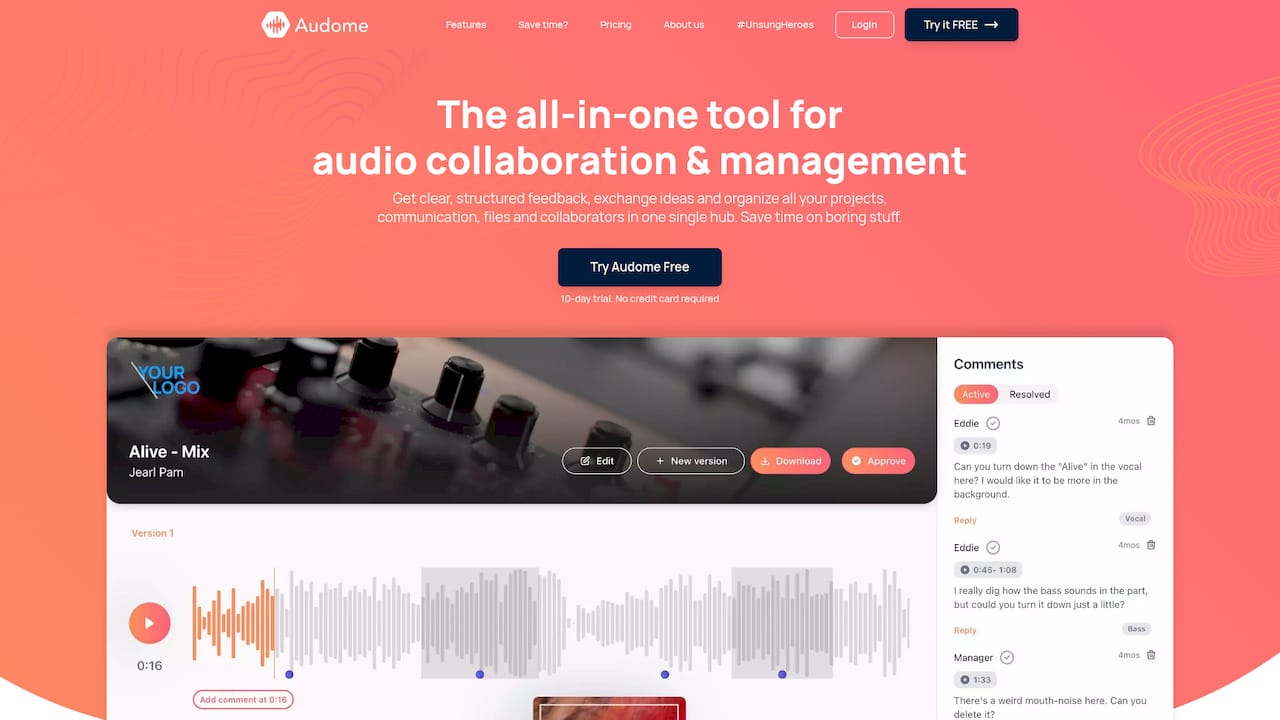
Some platforms provide timestamped feedback on waveforms and version history to keep revisions organized without requiring clients to create an account. Clients can open a link, listen, comment, and approve, while studios maintain ownership of files until unlocking. Revision limits and payment integrations can be configured to automate workflow logic.
If you’re currently stitching together Dropbox, WeTransfer, and a spreadsheet to track who paid for what, visit Audome and start a free trial to see how gated delivery works when it’s built for audio from the ground up.
Sources
- Songbox customer story (Stripe)
- Protected Download Gateway (GitHub)
- Charge for your audio before anyone hits download | WeTransfer
- How to Deliver Digital Downloads After Stripe Checkout (Securely)
FAQ
What Does It Mean to Restrict File Downloads for Audio Delivery?
It means separating streaming review access from downloadable final files, so clients can hear a mix without being able to save or forward it until payment or approval unlocks the real download.
How Do Signed URLs Prevent Unauthorized Downloads?
A signed URL grants temporary access to a file in private storage and expires after a short window, so even if the link leaks, it stops working before it can be reused or shared widely.
Can I Restrict Downloads Without Hiring a Developer?
Yes. Platforms like Audome include password protection, download toggles, and Stripe Connect payment gating built in, so studios can enforce restrictions through settings rather than custom code.
What Happens if a Client’s Download Link Expires Before They Grab the File?
A well-built system lets you regenerate a new signed link on request and logs the original expiration, which is also why download audit logs matter for support and dispute resolution.
Should Revision Limits Be Tied to Download Access?
Yes. Capping revisions and unlocking final downloads only after the client signs off or pays keeps feedback rounds focused and prevents open-ended revision requests from stalling delivery.