
What are the best Samply alternatives for professional audio collaboration?
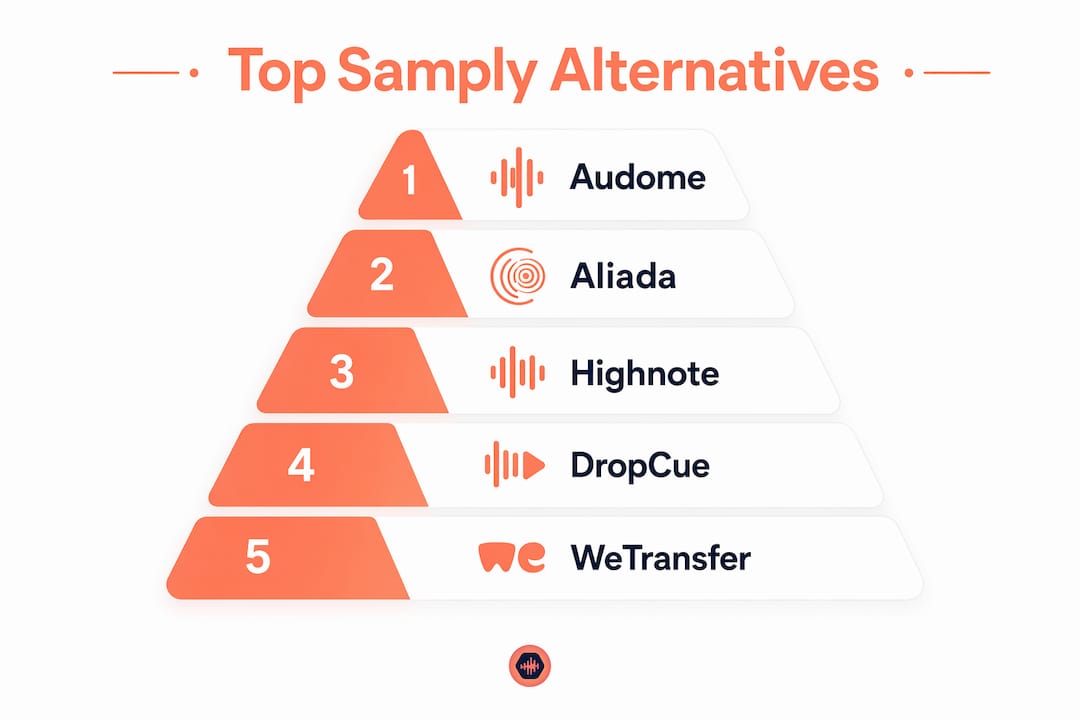
The strongest Samply alternatives for audio professionals right now are Audome, Highnote, Aliada, DropCue, Echoe, Opusonix, Pibox, Filepass, Symfonium, Qobuz, Jellyfin, untitled, Snipd, and WeTransfer. Each one addresses a different gap in Samply’s feedback-first model, from full project management to sync licensing to self-hosted lossless streaming.
Here is a quick orientation by use case:
- Audome — All-in-one platform with lossless audio playback, timestamped waveform feedback, version control, and Stripe-gated downloads for studios managing client revisions
- Highnote — Clean, client-friendly sharing with no-account feedback submission and secure lossless delivery
- Aliada — Version-control-focused collaboration with detailed revision tracking and user role management
- DropCue — Sync pitching platform with searchable catalogs, per-track licensing buttons, and listener analytics; plans start at $5/month for 500 tracks
- Echoe — Feedback-forward tool built for real-time client interaction during audio revisions
- Opusonix — Centralized workspace that keeps files, notes, and feedback in one interface
- Pibox — Device-synced private hub for musicians sharing work in progress
- Filepass — Cloud collaboration with version control and basic audio project support
- Symfonium — Desktop-focused lossless playback with third-party media server integration
- Qobuz — High-fidelity streaming for critical listening, not collaboration
- Jellyfin — Open-source self-hosted media server for tech-savvy engineers
- untitled — Mobile-first audio collaboration with accessible feedback features
- Snipd — Feedback and version tracking app suited to podcasters and spoken-word creators
- WeTransfer — Fast large-file transfer with no long-term storage, best for one-off sends
Why audio quality matters when you leave Samply
Preserving original audio fidelity is non-negotiable for mix and mastering engineers. Re-encoding a 96kHz/24-bit file to a compressed format during upload or playback introduces artifacts that are audible at professional monitoring levels, and those artifacts can send a client’s feedback in the wrong direction entirely.
Audome supports uploads up to 96kHz/24-bit without re-encoding, so what the client hears is what the engineer delivered. Most of the serious Samply substitutes on this list take the same approach: no strict file size limits means you can share a full album session without compressing anything. Symfonium and Jellyfin go further by integrating directly with local media servers, giving engineers playback quality that never touches a third-party cloud encoder. Qobuz is the outlier: it is a streaming service, not a collaboration tool, so it suits critical listening rather than client feedback rounds.
DAW compatibility is a related concern. None of these platforms require a proprietary plugin to play back files, which means ProTools, Logic Pro, Ableton Live, and Studio One sessions export cleanly to any of them as standard audio files.
What collaboration features does Samply leave out?
Samply’s core strength is timestamped waveform comments and A/B version review. That covers the “is this mix done?” loop well. What it does not cover is everything that happens around that loop: project organization, user roles, revision limits, payment gating, and client notifications.
Alternatives like Audome and Aliada fill those gaps directly. Audome adds version history and user permissions alongside its waveform feedback, and its Stripe Connect integration lets studios charge for revisions beyond a set limit or lock final downloads behind payment. Aliada focuses specifically on revision tracking with granular role controls. Echoe and Opusonix both emphasize client engagement, with Opusonix placing comments and assets in the same interface so nothing gets lost in email threads.
Client friction is a real problem with any platform that requires account creation before a client can leave a note. Tools that allow no-account feedback submission see meaningfully higher participation from clients who are not audio professionals and resist signing up for yet another service. Highnote and Audome both support this, which matters when your client is a label A&R or a brand manager, not a fellow engineer.
Pro Tip: Before switching platforms, map your actual bottleneck. If clients go quiet after delivery, the issue is friction at the feedback stage. If revisions spiral, the issue is missing revision limits and payment controls. Different problems point to different tools.
How to choose the right Samply alternative for your workflow
The right choice depends on what Samply is not giving you, not on which platform has the longest feature list.
- Lossless playback: Prioritize Audome, Highnote, Aliada, Symfonium, or Jellyfin. All preserve file fidelity without re-encoding.
- Timestamped feedback: Audome, Highnote, Aliada, Echoe, and DropCue all offer waveform-level comments. Snipd adds this for spoken-word and podcast content.
- Revision and version control: Audome and Aliada lead here. Filepass and Opusonix offer lighter versions of the same capability.
- Sync licensing and catalog management: DropCue is purpose-built for this. No other tool on this list combines searchable catalogs, licensing buttons, and per-recipient analytics in one place.
- Self-hosted or open-source: Jellyfin is the only genuinely open-source option and requires technical setup.
- Simple large-file transfer: WeTransfer handles this faster than any dedicated collaboration platform, with no setup required.
- Security and privacy: Audome and DropCue both offer password protection and controlled permissions, which matters when sharing unreleased material.
- Mobile access: untitled is the strongest option for engineers who review projects on a phone or tablet.
- Pricing sensitivity: DropCue starts at $5/month. Audome publishes Studio and Pro tiers. Jellyfin is free to self-host.
Detailed comparison of the best Samply alternatives
The 14 platforms span a wide range of use cases, from full studio management to single-purpose file transfer.
| Platform | Lossless support | Timestamped feedback | Revision management | Pricing | Best for |
|---|---|---|---|---|---|
| Audome | Yes, up to 96kHz/24-bit | Yes, waveform-level | Full version history, payment gating | Studio and Pro tiers | Mix/master engineers needing full workflow |
| Highnote | Yes | Yes | Basic | Tiered plans | Client-friendly sharing, no-account feedback |
| Aliada | Yes | Yes | Advanced, with user roles | Tiered plans | Engineers focused on revision control |
| DropCue | Yes | Yes | Catalog-level | From $5/month for 500 tracks | Sync licensing and catalog pitching |
| Echoe | Yes | Yes, enhanced formats | Moderate | Tiered plans | Client engagement during revisions |
| Opusonix | Yes | Yes | Integrated assets and notes | Tiered plans | Reducing back-and-forth in team projects |
| Pibox | Yes | Limited | Basic | Free and paid tiers | Musicians sharing work in progress |
| Filepass | Yes | Basic | Version control | Tiered plans | General cloud collaboration with audio |
| Symfonium | Yes | No | No | Paid app | Desktop lossless playback, media server |
| Qobuz | Yes, streaming | No | No | Subscription | Critical listening, not collaboration |
| Jellyfin | Yes, self-hosted | No | No | Free, open-source | Self-hosted private audio streaming |
| untitled | Yes | Yes | Basic | Tiered plans | Mobile-first audio collaboration |
| Snipd | Yes | Yes, spoken-word focus | Version tracking | Tiered plans | Podcasters and content creators |
| WeTransfer | No long-term storage | No | No | Free and paid tiers | Fast one-off large-file transfer |
For engineers running a full revision loop with clients, Audome and Aliada are the most complete options. Highnote wins on simplicity when the priority is a frictionless client experience. DropCue stands alone for sync professionals: its catalog management and licensing tools solve a problem none of the other platforms even attempt. Jellyfin and Symfonium serve a niche audience of engineers who want full control over their playback environment and are comfortable with technical configuration.
WeTransfer belongs on the list because many engineers still use it for delivery, but it is not a collaboration platform. There is no feedback layer, no version history, and files expire. It solves one problem cleanly and nothing else.
How your workflow should drive the platform you pick
The best Samply alternative depends on your professional vertical: a sync composer and a mastering engineer have almost nothing in common in terms of what a platform needs to do. Choosing without defining that first leads to paying for features you will never use while missing the ones you actually need.
Mix and mastering engineers need version control above all else. A client who says “go back to the version from Tuesday” without a clear revision history creates hours of wasted work. Audome’s version tracking and revision management address this directly, as does Aliada’s role-based access model.
Sync licensing professionals have a completely different problem. They are not finishing audio; they are pitching it to supervisors who may be browsing ten libraries at once. DropCue’s branded portfolio links, per-track licensing buttons, and who-listened analytics are built for exactly that moment. No feedback-first tool competes with it on that axis.
The broader trend in 2026 is away from fragmented workflows. Studios that once juggled Dropbox for files, email for feedback, and spreadsheets for revision tracking are moving toward integrated platforms that handle all three. The administrative overhead of stitching together separate tools is a real cost, and it compounds when clients are involved.
Pro Tip: Ask one question before committing to any platform: “Does my client need to create an account to leave feedback?” If yes, expect a meaningful portion of clients to skip the feedback entirely. That single friction point shapes the whole revision cycle.
Audome is built for the full studio workflow
If the platforms compared above feel like partial solutions to a larger problem, that is because most of them are. Audome takes a different approach: it replaces the entire stack of Dropbox, email threads, Discord DMs, and separate project trackers with one workspace built specifically for audio studios.
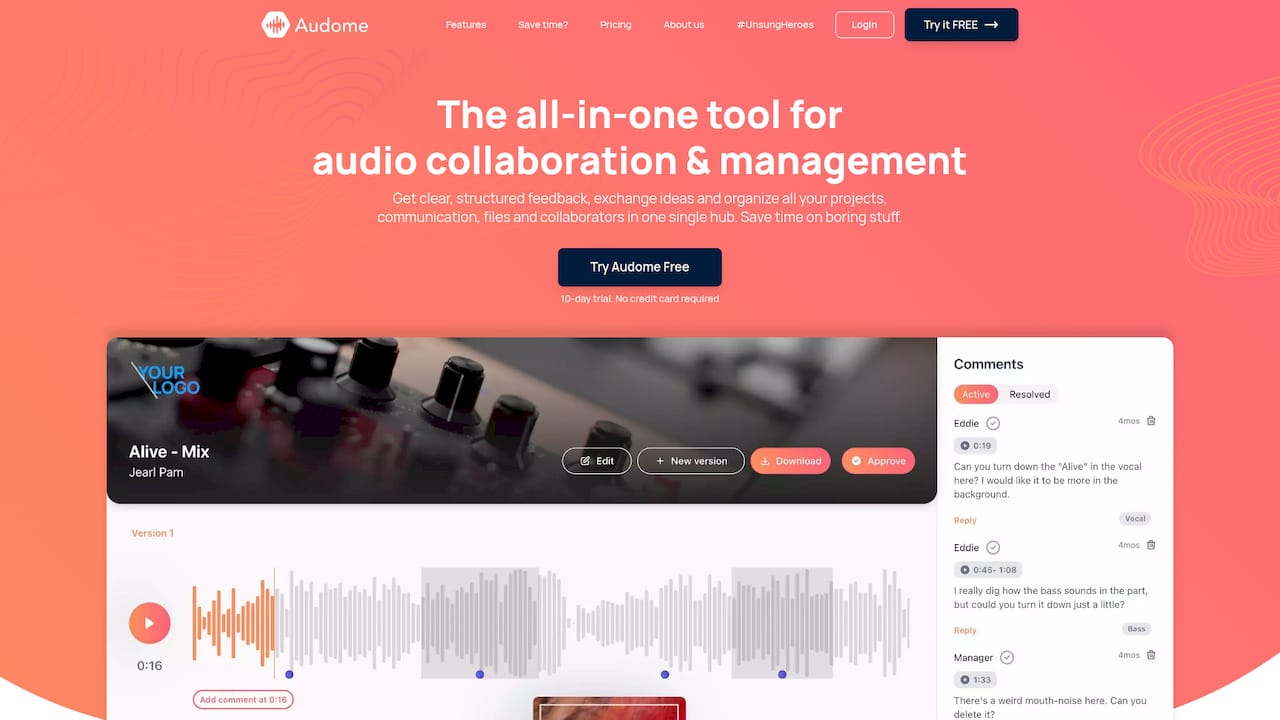
The practical difference is in the business layer. Audome lets you set a revision limit per project, charge clients automatically when they exceed it via Stripe Connect, and lock the final download behind payment confirmation. That is not a feature you will find in a general file-sharing tool. For studios losing money to endless revision cycles or chasing clients for final payment, those controls change the economics of a project. Audome’s platform supports unlimited high-resolution uploads, waveform-level timestamped feedback, and client access without requiring a client account.
FAQ
What is the best Samply alternative for mix and mastering engineers?
Audome is the strongest fit for mix and mastering engineers, offering lossless playback up to 96kHz/24-bit, timestamped waveform feedback, version history, and payment-gated final downloads in one platform.
Which Samply alternative works best for sync licensing?
DropCue is purpose-built for sync pitching, with searchable catalogs, per-track licensing buttons, branded portfolio links, and per-recipient analytics. Plans start at $5/month for 500 tracks.
Do Samply alternatives support lossless audio without re-encoding?
Most dedicated alternatives, including Audome, Highnote, and Aliada, preserve original file fidelity without re-encoding. Many also impose no strict file size limits, so full-resolution sessions upload without compression.
Can clients leave feedback without creating an account?
Audome and Highnote both support no-account feedback submission. Removing the sign-up requirement reduces friction and leads to higher participation from clients who are not audio professionals.
Is there a free Samply alternative?
Jellyfin is free and open-source, though it requires self-hosting and technical setup. WeTransfer offers a free tier for large-file transfers, but it has no collaboration or feedback features.
Key Takeaways
The right Samply alternative depends on your specific workflow: sync licensing, mix revision management, and simple file delivery each require a different tool.
| Point | Details |
|---|---|
| Workflow defines the choice | Sync pros need DropCue’s catalog tools; mix engineers need version control and payment gating. |
| Lossless fidelity is table stakes | Platforms like Audome support 96kHz/24-bit uploads without re-encoding, protecting mastering quality. |
| No-account feedback raises participation | Requiring client sign-ups creates friction that reduces feedback engagement across revision cycles. |
| Pricing varies widely | DropCue starts at $5/month; Audome publishes Studio and Pro tiers; Jellyfin is free to self-host. |
| Audome covers the full studio workflow | It combines lossless playback, timestamped feedback, revision limits, and Stripe-gated downloads in one platform. |