
TL;DR:
- Charging for revisions beyond an agreed number helps freelancers protect their time and maintain fair rates. Clear communication of revision policies in proposals, contracts, and during project milestones ensures clients understand extra charges, reducing disputes. Using appropriate billing methods and enforcement tools like Audome simplifies revision management and sustains professional client relationships.
Charging for revisions means billing clients for any edits that exceed the agreed number of included revision rounds, and knowing exactly when to charge for revisions is the difference between a profitable project and one that quietly bleeds your time. The industry standard is to include 2–3 revision rounds in your project fee, then bill for anything beyond that cap. This policy must appear in your contract before work begins, not as a footnote clients miss, but as a clear line item they acknowledge. Freelance audio professionals and small studio owners who set this boundary upfront protect their margins, reduce disputes, and often get better feedback from clients in the process.
How many revision rounds should you include?
The industry standard includes 2–3 revision rounds in the base project fee, with any additional rounds billed separately. That range exists because project complexity varies. A simple podcast edit with one stakeholder rarely needs more than two passes. A full music production with a label, an artist, and a manager in the room can burn through three rounds before anyone agrees on the kick drum.

Multiple stakeholders multiply revision rounds almost automatically. Every additional decision maker adds a layer of feedback that arrives at different times, often contradicts earlier notes, and restarts the cycle. Setting a cap of two rounds for solo clients and three rounds for multi-stakeholder projects is a reasonable starting point.
Unlimited revisions destroy your effective hourly rate. A project priced at $800 with no revision cap can turn a $60 per hour job into a $15 per hour grind after six rounds of changes. The cap is not about being rigid. It is about staying in business.
Common revision caps in audio and creative fields look like this:
- Podcast editing: 1–2 rounds included; additional rounds billed per episode
- Music mixing: 2–3 rounds included; stems recalls or full restructures billed separately
- Sound design: 2 rounds included; creative direction changes treated as new scope
- Post-production audio: 2–3 rounds included; picture lock changes billed as change orders
What pricing models work best for extra revision rounds?
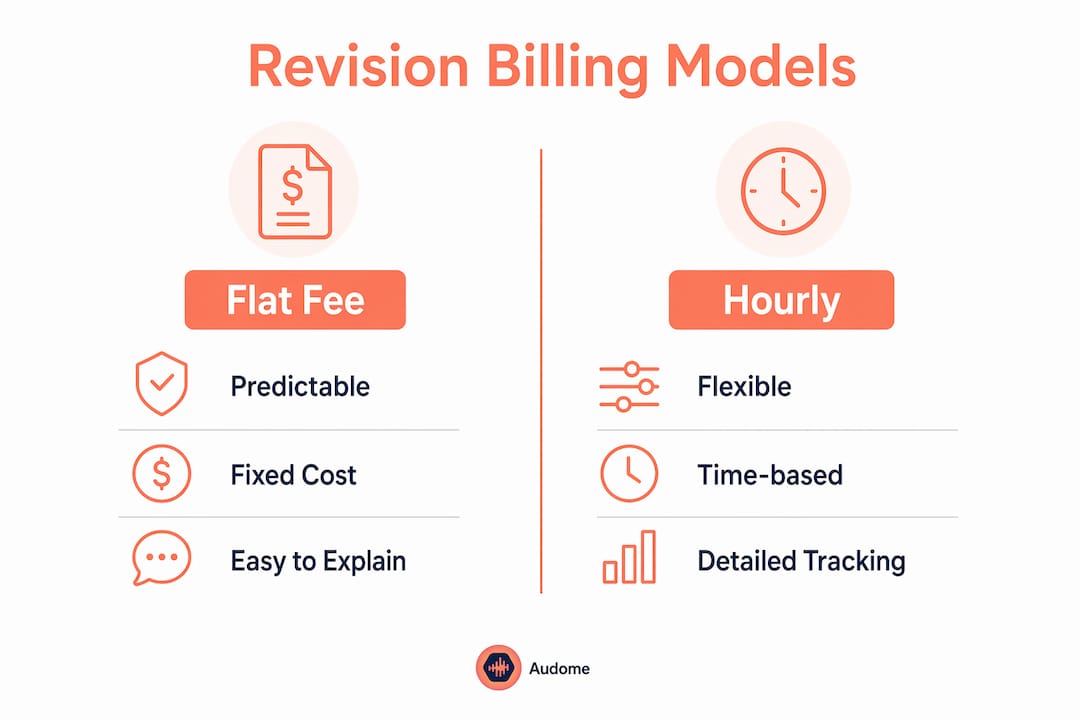
Two models dominate how freelancers bill for extra rounds: flat fee per round and hourly billing. Each fits a different type of project, and choosing the wrong one costs you money.
A flat fee per additional round is typically set at 15–25% of the original project fee. On an $800 mix, that puts each extra round at $120–$200. This model works best when the scope of a revision round is predictable. If you know a round means one consolidated feedback pass and one set of changes, flat fees are clean and easy for clients to understand.
Hourly billing suits unpredictable or iterative project scopes where revision work varies significantly in time and effort. A client who sends 40 timestamped notes on a 30-minute mix is not the same as one who asks for three EQ tweaks. Hourly billing ensures fair compensation when the scope of each round is genuinely unknown.
| Model | Best for | Client experience | Risk |
|---|---|---|---|
| Flat fee per round | Predictable, well-scoped projects | Easy to budget | You absorb overlong rounds |
| Hourly billing | Complex, evolving projects | Transparent but uncertain | Client anxiety over open-ended cost |
One rule applies to both models: never offer volume discounts on extra revision rounds. Discounting the third or fourth round signals that more rounds are acceptable, which incentivizes clients to keep requesting changes rather than consolidating feedback early.
Pro Tip: When using hourly billing, give clients a time estimate before you start the paid round. “This will take approximately 2–3 hours at my rate of $X” removes the anxiety of an open meter and keeps the relationship professional.
How do you communicate revision fees without damaging client relationships?
Clear communication about revision fees starts before the project does, not after a client sends their fourth round of notes. Revision policy must appear in both your Statement of Work and your kickoff presentation to avoid disputes. Burying it in an appendix guarantees a difficult conversation later.
Here is a practical sequence for communicating your revision policy throughout a project:
- In the proposal: State the number of included rounds and the fee for additional rounds in plain language. “This project includes two revision rounds. Additional rounds are billed at $150 each.”
- In the contract: Repeat the policy as a numbered clause, not a footnote. Both parties sign it.
- At the kickoff call: Mention the revision policy verbally. Clients retain information better when they hear it and read it.
- During the project: When delivering each round, note which round it is. “Here is your first revision. One more round is included in your project fee.”
- At the billing checkpoint: Send a billing checkpoint message once the last included round is delivered. Frame it as standard, not punitive.
A billing checkpoint message sounds like this: “You have now used both included revision rounds. Any further changes will be billed at $150 per round. Please confirm before I proceed.” Getting written approval before starting paid work protects you legally and keeps the client informed.
Charging for revisions also changes client feedback behavior in a measurable way. Clients who know each round costs money consolidate their notes, think more carefully before sending feedback, and generally deliver more useful direction. That is a better outcome for both sides.
Pro Tip: Ask clients to consolidate all feedback into one document or message before you open a new revision round. This single habit reduces the back-and-forth that turns a two-round project into a five-round ordeal.
How do you tell a minor tweak from a billable revision?
The distinction between a minor tweak and a full revision is one of the most practical skills in audio revision management. Getting it wrong in either direction costs you. Charging for a two-second level fix damages goodwill. Absorbing a full structural rearrangement for free damages your rate.
Minor tweaks are small, fast, and do not change the creative direction of the work. Billable revisions require meaningful time, judgment, or creative rethinking.
Minor tweaks (typically absorbed):
- Small level adjustments on a single element
- Correcting a typo in a podcast intro
- Trimming a breath or click that was missed
- Adjusting a fade by a second or two
Billable revisions (charge for these):
- Restructuring the arrangement or sequence
- Changing the creative direction after approval
- Re-recording or replacing significant sections
- Applying a new mix approach after a previous one was approved
Audio freelancers absorb minor tweaks but track the time spent on them. That tracking serves a purpose. If a client consistently generates 30 minutes of minor tweaks per project, that time shows up in your effective hourly rate. The next contract with that client should reflect it. Use a simple time log or a platform like Audome that records version history, so you have a clear picture of how much revision work each client actually generates.
Audome’s revision tracking features let you log timestamped feedback against specific versions, which makes it easy to categorize tweaks versus full rounds after the fact.
Practical templates and scenarios for billing revision fees
Real-world revision billing comes down to a few recurring situations. Having a ready response for each one removes the awkwardness and keeps you professional.
Scenario 1: Client hits the included round limit
Send this message before starting any additional work:
“Hi [Name], you have now used the two revision rounds included in your project. I am happy to continue refining the mix. Each additional round is $150. Please reply to confirm, and I will get started.”
Scenario 2: Client sends a major change after approval
“Hi [Name], the changes you have described go beyond the scope of the approved version. I will treat this as a new revision round at $150. Let me know if you would like to proceed.”
Scenario 3: Client pushes back on the fee
Refer them to the contract clause. Do not apologize for the policy. “I understand this is unexpected. The revision policy was included in our agreement at the start of the project. I am glad to answer any questions about it.”
Always confirm the cost and scope of extra rounds before starting paid work. Written approval, even a simple email reply, protects you if a dispute arises later. Audome’s platform supports this workflow directly. Its mix approval process lets clients leave timestamped comments on specific moments in a track, which makes feedback concrete and reduces the vague notes that lead to unnecessary extra rounds.
For freelancing pricing strategy across creative services, the principle is consistent: document the policy, communicate it early, and enforce it without apology.
Key Takeaways
Charging for revisions beyond the agreed scope is the single most effective way for audio freelancers to protect their time, maintain fair rates, and improve the quality of client feedback.
| Point | Details |
|---|---|
| Set a revision cap upfront | Include 2–3 rounds in your base fee and state the overage rate in the contract. |
| Choose the right billing model | Use flat fees for predictable projects and hourly rates for complex, evolving scopes. |
| Communicate at every stage | Repeat your revision policy in the proposal, contract, kickoff call, and billing checkpoint. |
| Distinguish tweaks from revisions | Absorb minor fixes but track time to adjust future pricing for high-revision clients. |
| Get written approval before paid rounds | Confirm scope and cost in writing before starting any billable revision work. |
The uncomfortable truth about revision fees
Most audio freelancers I have spoken with avoid charging for extra revisions because they fear losing the client. That fear is understandable. It is also backwards. The clients who push back hardest on revision fees are almost always the ones generating the most revision work. Charging for extra rounds does not end those relationships. It changes them. Clients who know each round costs money suddenly send clearer, more consolidated notes. They think before they type. The work gets better, and the project closes faster.
The other thing I have noticed is that freelancers who never enforce revision limits attract a specific type of client: one who treats the project as an open-ended subscription to your time. That client will not refer you to anyone worth working with. Setting a clear policy and holding to it signals that you are a professional, not a pushover. The clients worth keeping respect that.
Early communication is the only thing that makes revision fees feel fair to a client. If they see the policy in the proposal, hear it on the kickoff call, and get a heads-up before the last included round is used, the billing checkpoint message lands as a reminder, not a surprise. Surprises are what cause disputes. Preparation prevents them.
— Kreg
Audome makes revision billing easier to manage
Managing revision rounds, client approvals, and billing checkpoints across email threads and shared drives is where good policies fall apart. Audome brings all of it into one place.

Audome’s platform lets you share lossless audio files, collect timestamped feedback, and track version history without requiring clients to create an account. Its paywalled revision feature limits how many rounds clients can access before payment is required, which enforces your policy automatically rather than relying on you to police it manually. The Stripe integration means clients pay before downloading the final file, protecting your work until you are compensated. For freelancers and small studios serious about audio collaboration and management, Audome removes the friction that turns revision billing into a conflict.
FAQ
When should I start charging for revisions?
Charge for revisions as soon as a client exceeds the number of rounds included in the original project fee. Send a billing checkpoint message before starting any additional work.
What is a fair fee for extra revision rounds?
The standard range is 15–25% of the project fee per additional round, or your standard hourly rate for complex projects where revision time is unpredictable.
How do I handle a client who refuses to pay for extra revisions?
Refer them to the signed contract clause that outlines the revision policy. Written approval at the billing checkpoint stage gives you documentation to support the charge.
Should I offer free revisions to keep clients happy?
Include a defined number of free rounds in your base fee, but never offer unlimited free revisions. Unlimited revisions reduce your effective hourly rate and encourage unfocused, low-quality feedback.
How does Audome help with revision billing?
Audome’s paywalled revision feature limits client access to additional rounds until payment is confirmed through Stripe, automating the enforcement of your revision fee policy without requiring manual follow-up.