
TL;DR:
- Streamlined communication simplifies how teams share information, reducing errors and improving project outcomes.
- It minimizes message mutation and fragmentation, leading to faster decision-making and stronger client trust.
Streamlined communication is the process of simplifying and clarifying information flow so teams work faster, make fewer errors, and deliver better results. For creative professionals, whether you mix records, produce podcasts, or score films, this is not a soft skill. 86% of employees cite poor communication as the leading cause of workplace failure. That number means most project breakdowns are not creative failures. They are communication failures. The good news is that fixing communication is far more concrete than fixing talent.
Why streamlined communication is vital for creative project success
Streamlined communication is defined as the practice of simplifying, standardizing, and optimizing how information moves through a team or project. It eliminates unnecessary channels, reduces noise, and keeps everyone working from the same source of truth. The industry term for the underlying problem it solves is Communication Friction Theory.

Communication Friction Theory holds that communication effectiveness declines as the effort to access or act on a message increases. For a mixing engineer juggling client emails, voice notes, Discord messages, and revision requests buried in a shared folder, that friction compounds fast. Every extra step between a client’s thought and your understanding of it costs time and accuracy.
The financial stakes are real. Companies lose an average of $62.4 million per year due to miscommunication. For a freelance producer or small studio, the damage shows up differently: unpaid revision rounds, scope creep, and clients who feel unheard. The root cause is the same.
Pro Tip: Treat your communication setup as part of your production setup. If you would not track vocals through a broken signal chain, do not run client feedback through a broken communication chain.
What causes communication breakdowns in creative teams?
The most destructive force in creative project communication is message mutation. Message mutation occurs when information passes through too many channels and loses its original meaning. A client says “make it warmer” in a voice note. You transcribe it into a task. Your assistant reads the task and applies a different EQ curve than you intended. By the time the revision lands, the original request is unrecognizable.
Fragmentation makes this worse. When feedback lives across email, text, and three different file-sharing platforms, no single person holds the full picture. Fragmented communication scattered across multiple platforms leads directly to cognitive overload. Cognitive overload causes missed details, delayed responses, and decisions made on incomplete information.
The fix is not sending more messages. Reducing communication friction comes from building environments that are easier to access, navigate, and act upon. That means fewer platforms, clearer ownership, and feedback tied directly to the asset being reviewed.
Common sources of communication breakdown in creative workflows include:
- Feedback arriving through multiple unconnected channels with no single record
- Revision requests that lack timestamps, context, or a clear description of the problem
- No defined “next step” after a client review session
- Version confusion caused by files named “final,” “final_v2,” and “final_ACTUAL”
- Approval processes that rely on memory rather than documented sign-off
What are the key benefits of clear communication for creative professionals?
Clear, organized communication produces measurable gains across every part of a creative project. Effective communication reduces conflict, builds trust, motivates collaborators, and leads to higher engagement. For creative teams, those outcomes translate directly into faster turnarounds and stronger client relationships.
Productivity and team alignment
When everyone knows what is expected and where to find the latest information, work moves forward without constant check-ins. Teams stop duplicating effort. Producers stop re-reading old email threads to find the approved reference track. Engineers stop guessing which mix version the client actually approved.
Faster, clearer decision-making
Ambiguity kills momentum in creative projects. Clarity creates momentum; speed without clarity creates mistakes. When a client can leave a timestamped comment directly on a waveform at the exact moment they want a change, the decision is made once and made correctly. No back-and-forth. No interpretation required.
Stronger client satisfaction and trust
Clients who feel heard and informed stay loyal. Clients who feel confused or ignored leave and tell others. Effective communication balances listening, empathy, and clear expression. A culture of respectful, structured feedback is what separates studios that retain clients from those that constantly chase new ones.
The five core benefits of clear communication in creative projects, ranked by impact:
- Reduced revision cycles. Precise feedback means fewer rounds of changes before approval.
- Higher client retention. Clients who trust your process come back and refer others.
- Faster project delivery. Less time spent clarifying means more time spent creating.
- Lower conflict risk. Documented communication prevents “I never said that” disputes.
- Better team engagement. Collaborators who understand the goal produce better work.
Companies with strong communication strategies are 3.5 times more likely to outperform their peers. That advantage does not come from talent alone. It comes from building systems where good information reaches the right person at the right time.
How do you build effective communication strategies for creative projects?
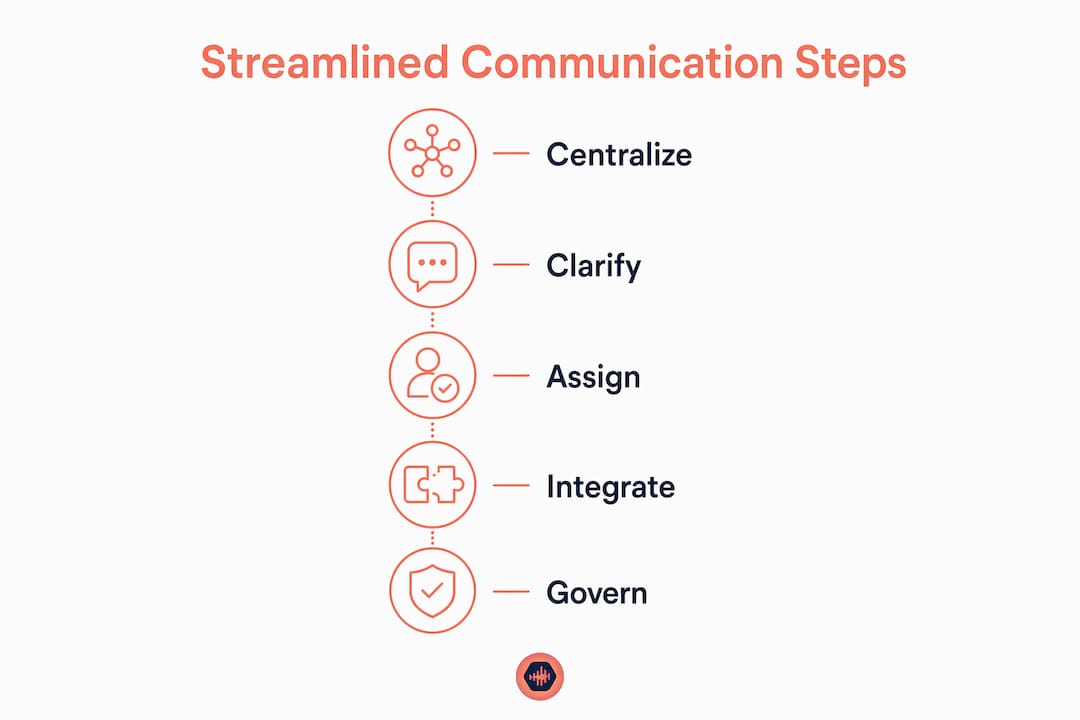
The most effective approach to communication in creative workflows is centralization. Centralizing communication platforms significantly reduces friction and improves team alignment. One platform for files, feedback, and approvals beats five platforms for five separate functions every time.
Define roles and next steps in every interaction
Every interaction must define a clear next step with ownership, a deadline, and a rationale. If a client review session ends without a documented action item, the communication has failed. This is not a project management formality. It is the difference between a project that moves forward and one that stalls in a fog of vague intentions.
Integrate feedback directly with project assets
Feedback that lives inside the asset eliminates message mutation. When a client can comment at 2:34 on a podcast episode and say “remove the breath before this line,” that note is precise, contextual, and impossible to misinterpret. Feedback attached to a feedback collection workflow built around the actual file is worth ten email threads.
Set governance for your communication channels
Governance means deciding in advance which channel handles which type of message. Creative decisions go in one place. File delivery goes in another. Billing questions go somewhere else. Without governance, every channel becomes a dumping ground and nothing gets resolved efficiently.
The table below compares two common approaches to creative project communication:
| Approach | Feedback method | Version control | Client experience |
|---|---|---|---|
| Fragmented workflow | Email, text, voice notes | Manual file naming | Confusing, slow |
| Centralized workflow | In-context, timestamped notes | Tracked automatically | Clear, professional |
Pro Tip: Audit your current communication setup once a quarter. Count how many platforms a single client message touches before it becomes a completed task. If the answer is more than two, you have a friction problem worth fixing.
For creative professionals working in media and communications, the shift toward centralized, structured feedback is not optional. It is the standard that clients now expect.
How does streamlined communication reduce revision abuse?
Revision abuse is a symptom of poor communication, not a client character flaw. When clients do not understand what they are approving, they keep requesting changes. When feedback is vague, engineers keep guessing. The cycle repeats until someone gives up or the relationship breaks down.
Treating communication as part of the workflow, and integrating feedback directly with project files, prevents this cycle. When clients leave precise, timestamped notes on the actual audio, they think more carefully before submitting feedback. The structure of the tool shapes the quality of the input.
Practical steps to reduce revision abuse through better communication:
- Set clear revision limits in writing before the project begins, and explain what counts as a revision
- Use a single platform for all feedback so nothing gets lost or duplicated
- Require clients to consolidate all notes before submitting a revision round
- Document every approval so there is a clear record of what was signed off
- Charge for revisions beyond the agreed limit, and communicate that policy upfront
The client revision management process works best when it is built into the communication structure from day one, not added as a patch after the third unexpected revision round. Transparent policies, delivered through a clear and organized system, protect both the studio and the client relationship.
Understanding how many revisions to include in a project scope is also part of the communication equation. Podcast editors, for example, face a specific version of this challenge, and revision scope decisions directly affect both project profitability and client satisfaction.
Key Takeaways
Streamlined communication is the single most controllable factor in whether a creative project succeeds or collapses into revision chaos and client frustration.
| Point | Details |
|---|---|
| Communication friction is the core problem | Fragmented channels increase cognitive load and cause message mutation across creative projects. |
| Clear next steps prevent project stalls | Every client interaction must end with a documented action, owner, and deadline. |
| Centralization beats fragmentation | One platform for files, feedback, and approvals reduces errors and speeds up delivery. |
| Revision abuse starts with vague feedback | Precise, in-context feedback tied to project assets cuts unnecessary revision rounds. |
| Strong communication builds client loyalty | Clients who feel informed and heard return, refer others, and cause fewer conflicts. |
What I have learned from watching studios communicate badly
The most common mistake I see creative professionals make is confusing activity with communication. Sending ten messages is not the same as communicating clearly. Most studios I have observed are not short on tools. They are short on discipline about which tool does what.
The second mistake is waiting until a project is in trouble to fix the communication structure. By then, the client is frustrated, the engineer is defensive, and every message carries emotional weight it should not have to carry. The time to build a clear communication system is before the first file is shared.
What actually works is deceptively simple: one place for everything, a defined process for feedback, and a rule that every conversation ends with a written next step. Studios that follow this approach spend less time managing clients and more time doing the work they were hired to do. That is not a philosophy. It is a workflow decision.
The tools matter less than the habits. A studio with a disciplined communication culture will outperform a studio with expensive software and chaotic processes every time. Start with the culture. Then find the tool that supports it.
— Kreg
Audome brings order to audio collaboration
Audio professionals who are tired of chasing feedback across five platforms now have a purpose-built alternative. Audome is an all-in-one collaboration platform designed specifically for music producers, mix engineers, mastering engineers, podcasters, and post-production professionals.
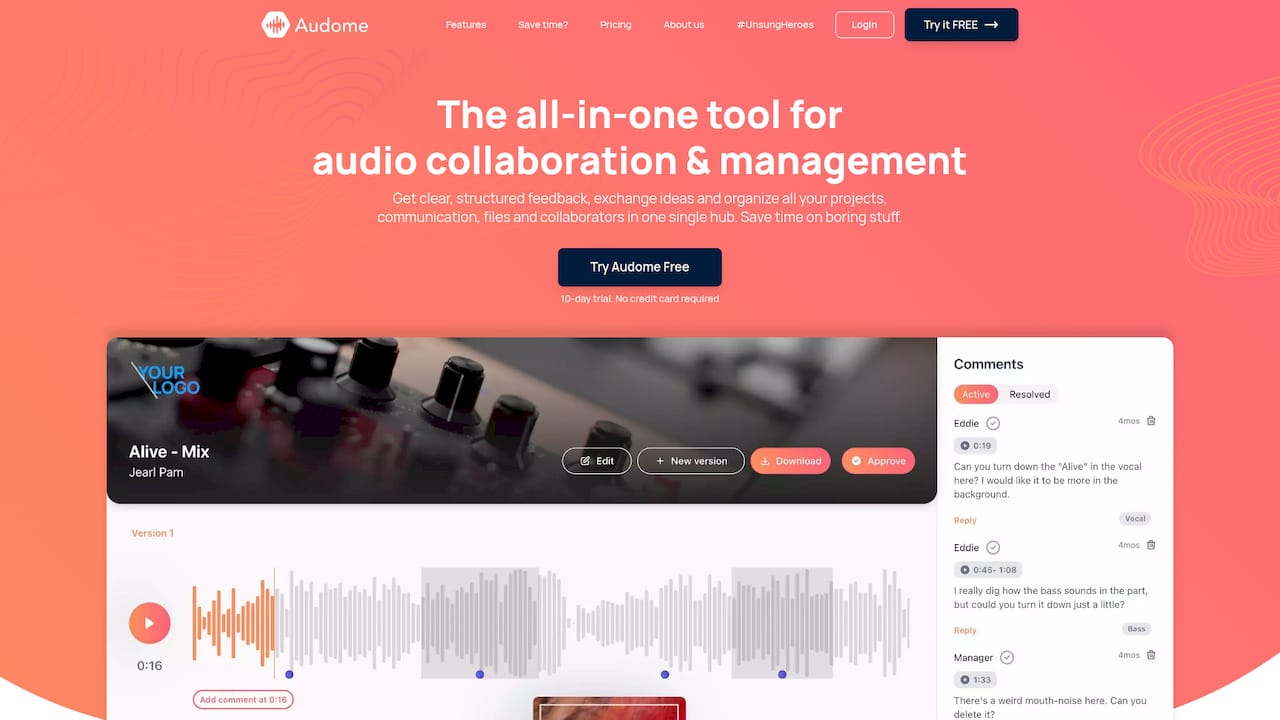
Audome replaces the scattered mess of email threads, shared drives, and messaging apps with a single workspace where clients leave timestamped feedback directly on the waveform, revisions are tracked automatically, and final files are locked behind payment. Studios set revision limits upfront, charge automatically for extras, and deliver a professional client experience without requiring clients to create an account. The result is fewer surprises, faster approvals, and projects that actually close. Explore Audome and see how it fits your workflow.
FAQ
What is streamlined communication?
Streamlined communication is the practice of simplifying and standardizing how information moves through a team, eliminating unnecessary channels and noise to improve decision-making and collaboration.
Why does communication fail in creative projects?
Communication fails most often because feedback is fragmented across multiple platforms, messages mutate as they pass between people, and interactions end without a clear next step or documented action item.
How does clear communication affect teamwork?
Clear communication reduces conflict, aligns team members on roles and expectations, and speeds up decision-making, which directly improves productivity and the quality of creative output.
How can creative professionals reduce revision abuse?
Setting written revision limits before a project begins, requiring consolidated feedback through a single platform, and charging for revisions beyond the agreed scope all reduce revision abuse significantly.
What is Communication Friction Theory?
Communication Friction Theory holds that communication effectiveness declines as the effort to access or act on a message increases. Reducing that friction, through fewer platforms and clearer processes, improves team performance.