
TL;DR:
- Most vocal tuning packages include two to three revisions for minor pitch and phrasing adjustments.
- Exceeding this limit leads to extra charges or premium package offerings, protecting both the tuner’s schedule and income.
Vocal tuning revision limits define how many rounds of edits a tuner delivers within the base project fee before additional charges apply. The industry standard in 2026 is 2–3 rounds of revisions included in a base package, covering minor technical adjustments to pitch, intonation, and phrasing. Anything beyond that falls into premium territory or gets billed separately. Knowing this number protects both the engineer’s time and the client’s budget, and it sets the tone for the entire working relationship before a single note gets tuned.
How many revisions should vocal tuners include?
The answer is 2–3 revisions for most standard vocal tuning packages. This is the number that gives clients enough room to refine the result without turning a single song into an open-ended project. Offering more than 3 revisions without extra charges is generally reserved for premium or unlimited packages, which carry a higher price point to reflect the added labor.
Pitch correction, whether done with Auto-Tune or Melodyne, is time-intensive work. Each revision round requires the engineer to re-examine every phrase, re-tune specific notes, and re-export the session. Two to three rounds gives clients the chance to hear the tuned result, request adjustments, and confirm the final version without burning through the engineer’s schedule.
For vocalists who are new to working with a tuner, 3 revisions tends to be the safer starting point. New clients often need one round just to understand what tuning can and cannot do. Engineers who work with repeat clients or highly prepared vocalists can comfortably offer 2 rounds and rarely hit the limit.
What counts as a revision versus a major change?
A revision covers minor technical adjustments. Think small phrasing tweaks, intonation corrections on specific phrases, or tightening vibrato on a held note. What a revision does not cover is a full re-recording, a key change, or a structural rearrangement of the vocal performance.
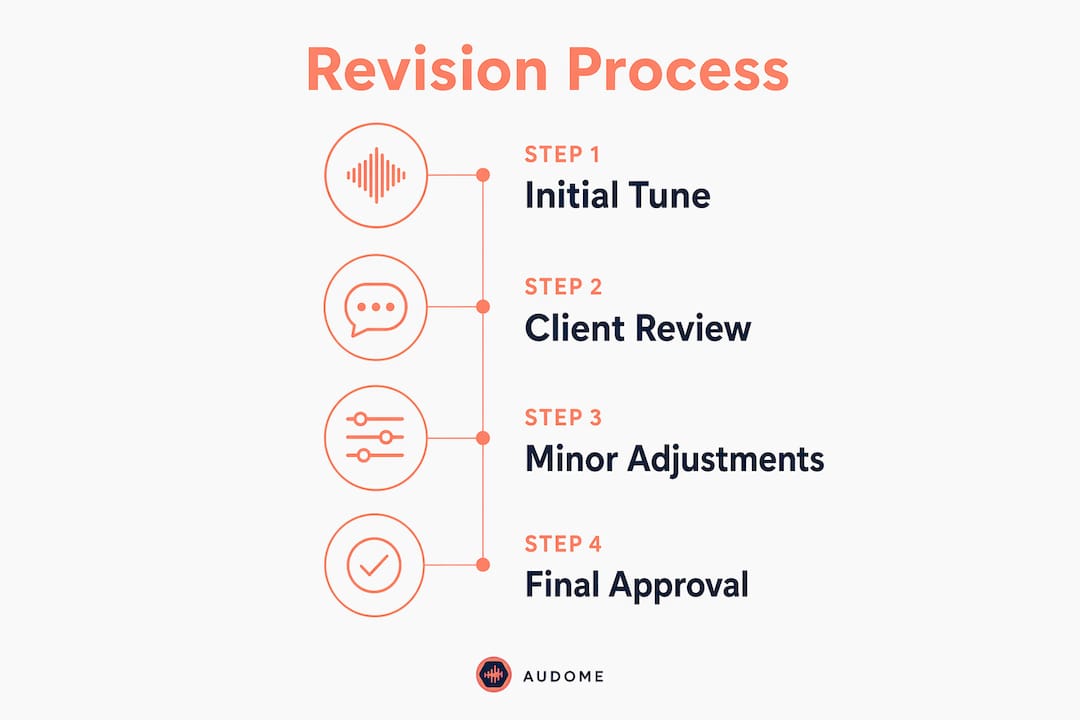
Significant changes outside this scope require additional charges and a separate agreement. This distinction is not arbitrary. Vocal tuning is applied to a fixed performance. If the performance itself needs to change, that is a production decision, not a tuning adjustment.
Here is where the line typically falls:
- Within revision scope: Correcting a flat phrase, smoothing an unnatural vibrato, adjusting the timing of a consonant, tightening pitch on a chorus hook
- Outside revision scope: Re-recording a verse, changing the melody, fixing a performance so poor that pitch correction creates artifacts, altering the arrangement or key
Standardizing this definition protects both sides. Clients cannot use revisions to fix a bad take. Engineers cannot arbitrarily reject feedback that falls within reasonable tuning territory. The definition creates a shared language for the project.
Pro Tip: Put the revision definition in writing before you start. A single sentence in your project agreement, such as “Revisions cover minor pitch and phrasing adjustments to the existing performance,” prevents the most common disputes.
Why limiting revisions protects your workflow and your income
Explicit revision limits serve as a framework for fair compensation and prevent scope creep. Without a cap, a client can request changes indefinitely, and the engineer absorbs that labor at no additional cost. That is not a sustainable business model.
Vocal tuning is particularly vulnerable to scope creep because clients often cannot hear the difference between a tuning issue and a performance issue. They know something sounds off, but they cannot always identify whether the problem is pitch, timing, tone, or the original recording itself. That confusion leads to repeated revision requests that do not actually solve the underlying problem.
Setting revision limits is not about being rigid with clients. It is about being honest with yourself. Every extra round of tuning you deliver for free is time you are not spending on a paying project. Clear limits make your pricing accurate and your schedule predictable. Clients who respect your work will respect your policy.
Unlimited revisions are a real offering in the market, but they belong in premium packages priced to reflect the commitment. Offering them at a standard rate is a fast path to burnout. The vocal editing process for a single song can span several hours per revision round, depending on the complexity of the performance.
How to manage revision requests and client communication
Clear communication before the project starts cuts revision volume significantly. Studios and engineers document revision limits upfront in their agreements, billing extra fees for requests beyond those limits. That documentation is not just legal protection. It is a communication tool that sets client expectations from day one.
Follow these steps to reduce unnecessary revision rounds:
- Define revisions in your agreement. State exactly what a revision covers and what it does not. Use plain language, not legal jargon.
- Educate the client before you start. Explain what pitch correction can fix and what it cannot. A client who understands the process gives better feedback.
- Fix timing before tuning. Addressing timing issues before tuning speeds workflow and reduces artifacts that trigger revision requests. Proper timing alignment makes pitch correction cleaner.
- Require performance approval before tuning. Clients should finalize and approve vocal performances before destructive tuning starts. Reversing tuning edits is difficult and costly.
- Share a reference example. Play the client a before-and-after example of your tuning style. Clients give more focused feedback when they understand what a specific tuning style achieves.
- Collect feedback in one place. Scattered notes across texts, emails, and voice messages create confusion. Centralized, timestamped feedback cuts revision rounds by removing ambiguity.
Pro Tip: Ask clients to submit all revision notes in a single document or message before you open the session. This prevents the “one more thing” pattern that turns a two-round project into five.
Excessive revisions often indicate insufficient preparation or comping of the vocal performance before tuning begins. Pitch correction cannot fix fundamentally flawed source material. If a client keeps requesting revisions and nothing sounds right, the problem is usually the recording, not the tuning.

Customizing revision policies for different project types
Not every project fits the same revision policy. A single indie track recorded in a home studio has different needs than a full album for a label. Your revision limits should reflect the scope, complexity, and budget of each project type.
Here is how revision limits typically break down across service tiers:
| Package tier | Revisions included | Additional revision cost |
|---|---|---|
| Basic | 1 revision | Charged per round |
| Standard | 2–3 revisions | Charged per round |
| Premium | Unlimited | Included in flat rate |
A few factors justify offering more revisions within a standard package:
- The client is a first-time vocalist with limited recording experience
- The project involves multiple songs with consistent style requirements
- The client is working on a high-stakes release where precision matters more than speed
Pricing for additional revisions beyond the standard limit typically runs as a flat fee per round or an hourly rate. A flat fee per revision round is easier for clients to understand and easier for engineers to track. Hourly billing works better for complex projects where revision scope is unpredictable.
For vocalists working with a tuner for the first time, the vocal tuning revision guidelines that matter most are the ones you agree on before the session starts. Changing the terms mid-project creates friction and damages trust. Lock in the policy upfront, and both sides know exactly where they stand.
Knowing when to charge for revisions is one of the most practical skills an audio freelancer can develop. It separates engineers who stay busy from engineers who stay profitable.
Key Takeaways
Vocal tuners who set clear revision limits from the start protect their income, reduce scope creep, and deliver better results for clients.
| Point | Details |
|---|---|
| Standard revision count | Most vocal tuning packages include 2–3 revisions within the base fee. |
| Define revisions clearly | Revisions cover minor pitch and phrasing tweaks, not re-recordings or arrangement changes. |
| Fix timing first | Correcting timing before pitch correction reduces artifacts and cuts revision volume. |
| Require performance approval | Clients must approve the vocal performance before tuning starts to avoid costly reversals. |
| Tier your revision policy | Match revision limits to package price, offering unlimited revisions only in premium tiers. |
Why I think most tuners undercharge for revisions
After working through dozens of vocal tuning projects, the pattern I see most often is not engineers who are too strict. It is engineers who are too vague. They offer “revisions” without defining what that word means, and then they are surprised when a client submits a fifth round of notes on a project priced for two.
The fix is not raising prices. It is getting specific. When you write “2 revisions” in a contract and then explain in plain language what a revision includes, clients stop pushing boundaries. Not because they are forced to, but because they actually understand the process. Most clients are not trying to take advantage of you. They just do not know what they do not know about vocal tuning.
The other thing I have learned is that the engineers with the fewest revision problems are the ones who spend the most time on the front end. They ask for a comped, approved vocal before they open a session. They send a reference clip showing their tuning style. They confirm the key, the vibe, and the delivery before touching a single note. That preparation does not just reduce revisions. It produces better work.
Flexibility matters too. A client who is recording their first single deserves a little more room than a repeat client who sends clean, well-comped vocals every time. Adjusting your policy to the project is not inconsistency. It is good judgment.
— Kreg
Audome makes revision tracking simple for vocal tuners
Managing vocal tuning revisions gets complicated fast when feedback arrives across texts, emails, and voice messages. Audome brings every stage of client collaboration into one workspace, so you spend less time chasing notes and more time tuning.

With Audome, clients leave timestamped feedback directly on the waveform, so you know exactly which phrase they want adjusted. You can set revision limits per project, automatically charge for rounds beyond the included number, and lock final downloads behind payment through Stripe Connect. Version history keeps every iteration organized, and clients never need to create an account to leave feedback. If you want a cleaner revision process and a more professional client experience, Audome is built for exactly that.
FAQ
How many revisions do vocal tuners typically include?
Most vocal tuners include 2–3 revisions in their standard packages. Anything beyond that is usually charged as an additional fee or reserved for premium unlimited packages.
What is considered a revision in vocal tuning?
A revision covers minor adjustments to pitch, intonation, and phrasing on an existing vocal performance. Re-recordings, key changes, and arrangement edits fall outside standard revision scope and require separate agreements.
Should vocal tuners revise tracks if the performance is poor?
Pitch correction cannot fix a fundamentally flawed performance. If the source recording has serious timing or delivery problems, the vocalist should re-record before tuning begins, not use revision rounds to address performance issues.
How should vocal tuners handle revision requests beyond the limit?
Charge a flat fee per additional revision round or bill hourly, depending on the project complexity. Document this policy in the original agreement so clients know the cost before they request extra rounds.
Does fixing timing before tuning reduce the number of revisions needed?
Correcting timing issues before pitch correction makes tuning cleaner and reduces unnatural artifacts. Fewer artifacts mean fewer revision requests, which keeps projects on schedule and within the agreed revision count.