
TL;DR:
- Including only two to three revision rounds in vocal editing contracts protects both the project’s profitability and the client’s satisfaction. Minor revisions cover small adjustments, while major revisions require additional fees and structural changes, preventing scope creep. Managing client feedback carefully and setting clear policies early ensures efficient revisions and high-quality audio production.
Vocal editors should include two to three revision rounds as the standard for any professional project. This range is the recognized industry benchmark in voice-over and vocal editing agreements, and it applies directly to podcast production work. Knowing how many revisions to include protects your time, keeps projects profitable, and sets clear expectations before a single edit is made. The distinction between minor and major revisions is what makes this number work in practice. Get that distinction wrong, and two rounds can quietly become ten.
How many revisions should vocal editors include?
Two to three revision rounds are the most common and accepted standard in professional vocal editing contracts. No official benchmark exists, but this range consistently appears across voice-over and audio production agreements as the practical sweet spot. It gives clients enough room to refine direction without opening the door to endless changes.
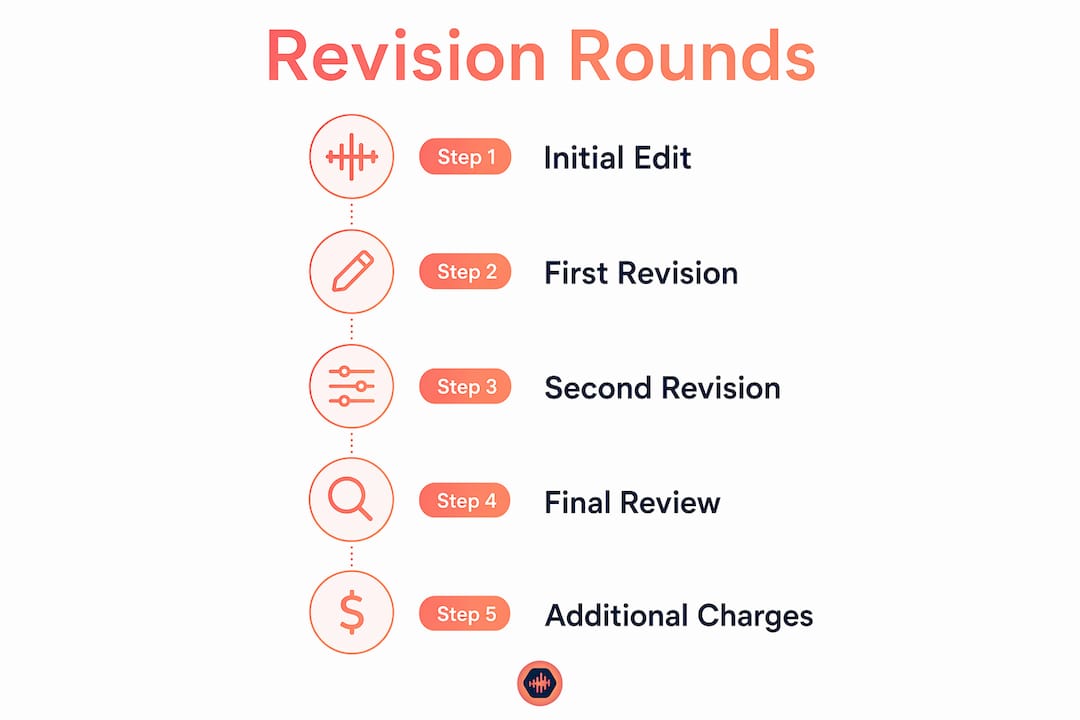
The key is understanding what those rounds actually cover. A revision round is not a blank check. It is a defined opportunity for the client to submit feedback and for the editor to address it. One round equals one consolidated feedback submission followed by one set of edits. Two to three of those rounds, scoped correctly, handles the vast majority of professional vocal projects without scope creep.
The industry term for this structure is a “revision policy,” and it belongs in every service agreement before work begins. Podcast producers who skip this step often find themselves doing five or six passes on a single episode, each one eating into margins that were never budgeted for it.
What counts as a revision in vocal editing?
Not all revisions are equal. Professional service agreements distinguish between minor revisions and major revisions, and the free rounds included in a standard package cover minor adjustments only.
Minor revisions include:
- Adjusting EQ or compression on a specific section
- Removing a breath or mouth noise the client flagged
- Tightening a pause between two sentences
- Correcting a small timing issue in the edit
- Fixing a single mispronounced word via comping
Major revisions are a different category entirely. They involve structural changes that require significant rework.
- Re-editing an entire segment because the script changed
- Rebuilding the mix from a new raw recording
- Changing the overall tone or processing direction after delivery
- Adding or removing large sections of content
Major revisions require additional fees or a new project phase. Treating them as part of a standard included round is where most revision abuse begins. When your service agreement spells out this distinction clearly, clients understand what they are getting and what costs extra.
How industry standards shape revision limits for vocal editors
The two-to-three round standard exists for a practical reason. It balances client satisfaction with the professional reality that editing time has a direct cost. Unlimited revision policies sound client-friendly, but they consistently produce worse outcomes for both parties. Clients who know revisions are unlimited tend to submit vague, piecemeal feedback. Editors who accept unlimited revisions lose control of their schedule and income.

| Policy type | Included rounds | Extra revision cost | Best suited for |
|---|---|---|---|
| Entry-level packages | 1 round | Flat fee per round | Short-form podcast clips |
| Standard packages | 2–3 rounds | Hourly or per-round fee | Full podcast episodes |
| Premium packages | 3 rounds | Hourly rate | Long-form or complex productions |
| Unlimited policies | No cap | None | High-risk for scope creep |
The table above shows how revision limits map to service tiers. Premium packages do not offer unlimited revisions. They offer more included rounds, which is a meaningful difference. Additional rounds beyond the included limit are typically charged per hour or as a defined flat fee, and clients are informed of this upfront.
Pro Tip: State your revision policy in writing before the project starts, not after the first delivery. Clients who agree to terms before hearing the first edit are far less likely to push back when extra rounds require payment.
Setting clear revision limits upfront prevents scope creep and protects both your time and your client relationship. Clear boundaries are a professional expectation, not a sign of inflexibility.
Best practices for managing client feedback and minimizing revision rounds
The number of revision rounds you include matters less than how you manage the feedback inside each one. Editors who handle feedback well rarely need all three included rounds. Editors who let feedback arrive in scattered messages almost always exceed them.
-
Require consolidated feedback. Scattered client feedback delays the revision process. Require all notes for a given round to arrive in a single document or timestamped thread before you begin any edits. One submission per round is the rule.
-
Set a feedback deadline. Clear deadlines for client feedback keep the project timeline on track. A client who takes three weeks to respond should not expect the same turnaround as one who responds within 48 hours.
-
Run a thorough intake process. The most effective way to reduce revision rounds is to align on creative direction before the first edit. Collect the script, reference tracks, tone notes, and any technical requirements at the start. Editors who prioritize first-pass approval through detailed intake reduce revision rounds more effectively than those who simply set stricter limits.
-
Focus the first pass on approval, not perfection. The first delivery should address all major structural and technical elements. Ask the client to confirm the overall direction before diving into fine details. This prevents the situation where a client approves the mix but then changes the entire tone in round two.
-
Use timestamped feedback tools. When clients can mark feedback directly on the waveform at a specific moment, notes become precise and actionable. Vague feedback like “the middle section sounds off” costs editors far more time than “at 2:14, the vocal feels too bright.”
Pro Tip: Send a short feedback guide with your first delivery. A one-page document explaining how to submit notes, what counts as a minor versus major revision, and the deadline for feedback cuts confusion before it starts. Pair this with audio editing techniques that reduce the need for client-driven corrections in the first place.
Risks of excessive revisions and how they affect vocal editing quality
Revision abuse is a real workflow problem, and it does not always come from difficult clients. It often comes from unclear policies and poor feedback management. The consequences go beyond lost time.
-
Authenticity suffers. Excessive editing prioritizes technical perfection at the expense of natural vocal vibe and listener engagement. A vocal performance that has been comped and processed through six rounds often loses the emotional quality that made it worth recording in the first place.
-
Timelines collapse. Every unplanned revision round pushes back other client projects. Podcast producers running multiple shows simultaneously cannot absorb that kind of schedule disruption without consequences.
-
Profitability drops fast. An extra two hours of uncompensated editing on a fixed-price project can erase the margin entirely. Multiply that across several clients and the financial impact becomes significant quickly.
-
Client relationships deteriorate. Ironically, unlimited or poorly managed revisions often produce less satisfied clients. When there is no structure, clients lose confidence in the process and keep requesting changes without a clear endpoint.
-
Revision abuse stems from poor feedback management. Requiring consolidated feedback submissions is the most direct defense against misuse. When clients know they get one submission per round, they think more carefully before sending notes.
Protecting against excessive revisions requires contractual clarity and consistent enforcement. A policy that exists only in your head does not protect you. It needs to be in the agreement, referenced at project start, and applied without exception. For more detail on when extra rounds cross into billable territory, the audio freelancer guide on charging for revisions covers the specifics.
Key Takeaways
Two to three revision rounds, scoped to minor adjustments only, is the professional standard for vocal editing projects and the most effective way to protect both workflow and client relationships.
| Point | Details |
|---|---|
| Standard revision count | Include two to three rounds in every vocal editing agreement as the baseline. |
| Minor vs. major revisions | Free rounds cover minor tweaks only; major structural changes require additional fees. |
| Consolidated feedback | Require all notes in one submission per round to prevent scope creep and delays. |
| First-pass approval focus | A thorough intake process reduces revision rounds more than strict limits alone. |
| Excessive edits hurt quality | Over-editing strips emotional authenticity from vocal performances and harms the final product. |
Why I think revision limits are the most underrated part of your service agreement
Most podcast producers and vocal editors spend hours debating EQ curves and compression ratios. They spend almost no time thinking about revision policy. That imbalance costs them more money and more stress than any technical decision ever will.
I have seen editors with genuinely excellent ears burn out within two years because they never set boundaries on revision rounds. Every project became a negotiation after delivery. The client always had “just one more thing,” and the editor, wanting to keep the relationship, always said yes. The result was not a better product. It was a worse business and a worse creative process.
The two-to-three round standard works because it forces both parties to be intentional. Clients who know they have two rounds think harder about their feedback before submitting it. That produces clearer notes, faster turnaround, and a better final product. The editor who sets this boundary is not being difficult. They are creating the conditions for better work.
The intake process is where the real leverage is. Every revision round you eliminate through better upfront alignment is a round you never have to manage, charge for, or argue about. Editors who treat intake as a formality and revision limits as the primary defense are working harder than they need to. Flip that priority and the number of revision rounds you actually use drops on its own.
For a deeper look at how this plays out across different project types, the mixing engineer revision guide covers the same principles from a production angle worth reading alongside this one.
— Kreg
Audome makes revision management part of the project from day one
Vocal editors and podcast producers who use Audome stop chasing feedback across email threads, Discord messages, and shared drives. Audome brings every revision round into one workspace, where clients leave timestamped feedback directly on the waveform and editors track every version without confusion.

Audome lets you set the number of free revision rounds included in a project, automatically charge clients for additional rounds through Stripe Connect, and lock final downloads until payment clears. That means your revision policy is not just a line in a contract. It is built into the delivery process itself. Clients get a clear, professional experience. You get paid for every round beyond the agreed limit. Visit Audome to see how it fits your vocal editing workflow.
FAQ
How many revision rounds is standard for vocal editing?
Two to three revision rounds is the recognized standard in professional vocal editing and voice-over agreements. This range covers most client needs without creating scope creep.
What is the difference between a minor and major revision?
A minor revision covers small adjustments like removing a breath, tightening a pause, or fixing a single word. A major revision involves structural changes like re-editing a full segment or rebuilding the mix from a new recording.
Should vocal editors charge for revisions beyond the included rounds?
Additional rounds beyond the included limit are typically charged per hour or as a flat fee per round. Clients should be informed of this policy in writing before the project begins.
How do I reduce the number of revision rounds clients request?
A thorough intake process and a requirement for consolidated feedback submissions reduce revision rounds more effectively than strict limits alone. Aligning on creative direction before the first delivery is the most reliable method.
Can unlimited revisions work for podcast vocal editing?
Unlimited revision policies consistently produce worse outcomes. Clients submit vague, piecemeal feedback, and editors lose control of their schedule and income. A capped policy with clear scope definitions serves both parties better.