
TL;DR:
- LANDR offers fast, low-cost mastering suited for demos and high-volume releases, while human engineers provide higher quality and creative input for important projects.
- Proper preparation of clean, well-balanced mixes is essential for both approaches to achieve good results.
How do human mastering engineers and LANDR actually compare?
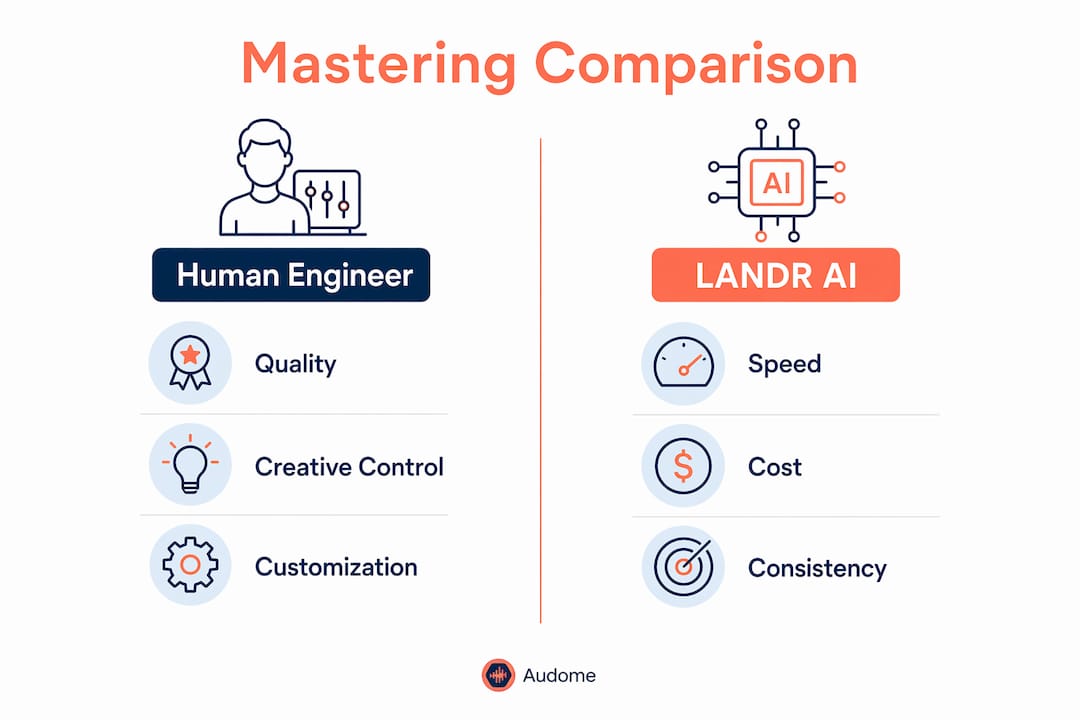
The short answer: LANDR wins on speed and cost; a human mastering engineer wins on quality, nuance, and creative input. Which one you need depends almost entirely on what the release is worth to you.
| Dimension | Human Mastering Engineer | LANDR |
|---|---|---|
| Cost | $20–$70+ per track (budget to mid-range) | $39/month for unlimited WAVs (Pro plan) |
| Turnaround time | Days, including revisions | Seconds to minutes |
| Audio quality and nuance | Genre-aware, artistically tailored | Consistent, usable; less nuanced |
| Creative input | Full: notes, revisions, intent-based decisions | None: algorithm processes the file |
| Workflow and collaboration | Back-and-forth with engineer; revision cycles | Upload, download, done |
| Ideal use cases | Final releases, complex mixes, vinyl, important projects | Demos, high-volume releases, tight budgets |
| Best for | Artists who need the release to be as good as it can be | Producers releasing frequently at low cost |
A few things worth knowing upfront:
- LANDR’s economics make the most sense when you’re releasing a lot of tracks and cost per track needs to stay low.
- Human mastering is the right call when the release matters: a debut single, an album, anything going to labels or playlists.
- AI mastering works best on clean, well-balanced mixes in mainstream genres. It struggles with complex dynamics, dense low end, and genre-specific decisions.
- Neither approach replaces proper mix preparation. Both will expose a bad mix.
Table of Contents
- What mastering actually is, and how LANDR approaches it differently
- Detailed comparison: cost, quality, and creative control
- How to prepare and deliver your tracks for mastering
- What mastering professionals say about AI versus human mastering
- FAQ
- What producers actually experience: outcomes in practice
- Where LANDR’s AI mastering falls short
- Privacy and security when using AI mastering services
- Audome keeps your mastering workflow organized
- Key Takeaways
What mastering actually is, and how LANDR approaches it differently
Mastering is the final stage of audio production: taking a stereo mix and preparing it for distribution across streaming platforms, vinyl, CD, or broadcast. A human mastering engineer adjusts EQ, dynamics, stereo imaging, and loudness, then checks the result against reference tracks and the intended playback format. The job is as much editorial as technical.
Veteran mastering engineer Ian Shepherd describes it as “Photoshop for audio,” where even small, subtle changes accumulate into a result that sounds dramatically more finished. That analogy holds because skilled retouching requires judgment, not just tools.
LANDR works differently. You upload a WAV file, the algorithm analyzes it, applies loudness normalization, EQ, and limiting based on machine learning trained on thousands of professionally mastered tracks, and returns a mastered file in seconds. No human listens to it. You get macro controls (style, volume matching, reference mastering) on the Pro and Advanced plans, but the underlying chain is a black box.
The common misconception is that AI mastering is “almost as good” for everything. It isn’t. Where it falls short:
- It cannot interpret artistic intent. If a mix is supposed to feel lo-fi and claustrophobic, LANDR doesn’t know that.
- It cannot catch mix problems before they’re committed to a release: excessive low end, harsh frequencies, a vocal sitting too low.
- It cannot handle vinyl mastering, which requires specific EQ curves, stereo imaging decisions, and headroom management for the cutting lathe.
- It cannot revise based on feel. “Make it feel a bit more open” is a real note that produces a real change with a human engineer.
What LANDR does well: it produces a usable, consistent result on a clean mix in a common genre, fast and cheaply. For a demo or a low-stakes release, that’s often exactly what you need.
Detailed comparison: cost, quality, and creative control
Cost and pricing structures
Human mastering typically costs $20–$70+ per track, depending on the engineer, while LANDR Pro is $39/month for unlimited mastering in WAV format. If you’re releasing only a few tracks per year, the annual cost of a LANDR Pro subscription is around $470, which may not be more economical than paying per track for human mastering. LANDR’s pricing becomes more cost-effective the more tracks you master.

Turnaround time
LANDR processes tracks quickly, while a human engineer typically requires more time including revisions. For a producer who needs a demo ready before a meeting tomorrow, LANDR is the only realistic option.
Audio quality and nuance
For a clean, well-balanced mix in pop, straightforward indie, or electronic music, LANDR produces a result that won’t embarrass you. The gap between “usable” and “great” becomes most obvious when you A/B your AI-mastered track against a professionally mastered record in the same genre.
LANDR’s algorithm tends toward a genre-average target: it normalizes your track toward what “mastered” sounds like in aggregate. As one audio educator put it, LANDR is good at sitting a mix into the “average” for a genre, which is exactly what you want if you’re fitting in, and exactly what you don’t want if you’re trying to stand out.
Human engineers adapt to genre-specific needs, complex dynamics, and release formats. Jazz, classical, heavy music, and hip-hop with dense low end all require decisions that go beyond what current AI tools can reliably make. Abbey Road’s Christian Wright has noted that reliably recognizing musical style from a sound file alone is “much, much harder than it might sound.”
Creative input and customization
This is where the gap is widest. LANDR’s co-founder Justin Evans acknowledged it directly, telling Sound On Sound: “The critical insights a mastering engineer can give in a conversation with a musician… that is something that even the best AI in the world wouldn’t try.”
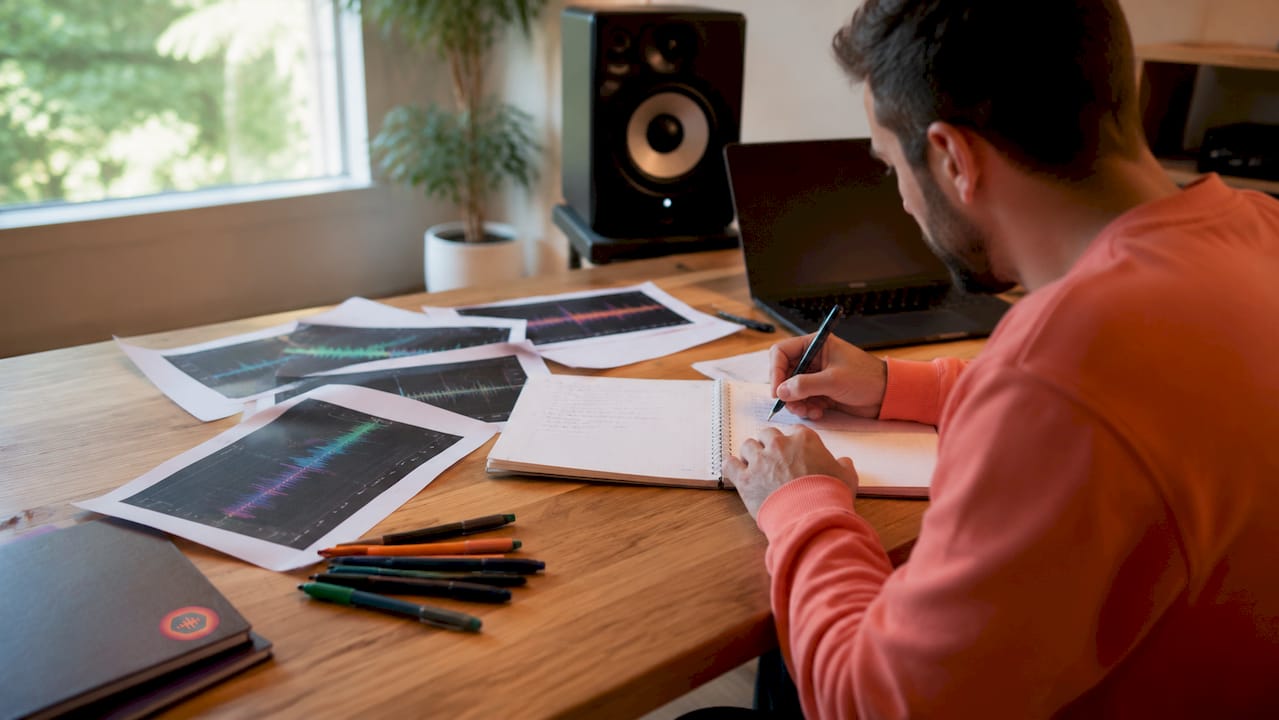
A human engineer is a creative consultant. They can tell you your kick is fighting the bass, your vocal is sitting 2 dB too low in the chorus, or that the mix needs to go back for adjustments before mastering. LANDR processes whatever you give it.
Workflow and collaboration
With a human engineer, you exchange notes, get a master back, listen, and request revisions. That loop takes time but produces a result shaped by actual communication. With LANDR, you upload and download. There’s no back-and-forth, no creative dialogue, and no one catching problems before they go live.
How to prepare and deliver your tracks for mastering
Good preparation matters regardless of which route you take. A poorly prepared mix will produce a poor result from both LANDR and a human engineer.
Key preparation steps:
- Leave headroom. Your mix should peak around –6 dBFS with no limiting on the master bus. This is the single most common mistake producers make when sending to AI mastering.
- Deliver lossless files. WAV or AIFF at 24-bit, 44.1kHz or higher. Never send MP3s for mastering.
- Include a reference track. A commercially released song in the same genre gives both LANDR and a human engineer a target to work toward.
- Send stems when needed. For a human engineer working on a complex mix, stems (grouped instrument buses) give them more flexibility to address specific problems without sending the mix back.
- Document your intent. Tell your engineer what the track is supposed to feel like, what genre conventions apply, and where it’s being released. LANDR can’t use this information, but a human engineer will.
When working with a human engineer, managing revisions clearly from the start prevents scope creep and keeps the project on track. Scattered feedback across email, text, and voice notes is one of the most common sources of miscommunication in mastering workflows.
Pro Tip: Never put a limiter on your master bus before sending to mastering, whether you’re using LANDR or a human engineer. A mix with limiting already applied leaves no headroom for the mastering stage and consistently produces worse results.
Audome is built specifically for this handoff. Producers and engineers can upload high-resolution audio files (up to 96kHz/24-bit), collect timestamped feedback directly on the waveform, manage version history, and keep all client communication in one place, without requiring clients to create an account.
What mastering professionals say about AI versus human mastering
The professional consensus is nuanced, not dismissive. Most working engineers acknowledge that AI mastering has a legitimate role, just not the one LANDR’s marketing sometimes implies.
Abbey Road’s Sean Magee makes the point differently: there is no single correct way to EQ a voice or a bass. A skilled engineer might approach the same element three different ways on three consecutive days, and all three could be right for those specific projects. An algorithm trained on aggregate data cannot replicate that kind of contextual judgment.
The stigma around automated mastering has softened considerably, as AI tools now provide a good baseline for independent artists, enabling creative momentum without requiring mastering expertise (see AI-Powered Music Pitching: A Guide for Independent Artists). AI tools now provide a good baseline for independent artists, enabling creative momentum without requiring mastering expertise. The practical view among many producers: use LANDR for demos and client approval versions, reserve human mastering for final releases. That split workflow is common and makes financial sense.
Where Audome fits into this picture is on the collaboration side. When a producer is working with a human mastering engineer, keeping feedback organized, tracking versions, and managing revision limits through a dedicated platform like Audome reduces the back-and-forth friction that slows most mastering projects down.
FAQ
Is LANDR the best AI mastering service available?
LANDR is the most widely used AI mastering platform, but services like eMastered and Aria offer more manual control over mastering parameters. LANDR’s strength is speed and simplicity; it’s the right choice if you want a fast, low-friction result without adjusting settings.
What genres benefit most from human mastering?
Complex, dynamic, or genre-specific music benefits most: jazz, classical, heavy music, and hip-hop with dense low end. Human engineers adapt to genre conventions and release formats, including vinyl, in ways AI mastering currently cannot.
What DAWs do mastering engineers typically use?
Professional mastering engineers commonly work in Sequoia, WaveLab Pro, and Pyramix, which offer specialized spectral editing, precise metering, and critical listening workflows that general-purpose DAWs don’t prioritize.
Will AI mastering replace human mastering engineers?
Not for high-stakes releases. LANDR’s own co-founder has said that the creative insights a mastering engineer provides in conversation with an artist are something “even the best AI in the world wouldn’t try.” AI mastering fills a real gap for volume and speed; it doesn’t replicate the editorial judgment of an experienced engineer.
How should you decide between human and AI mastering?
Ask how much the release matters. Demos, high-volume releases, and low-stakes projects are good candidates for LANDR. A debut single, an album, or anything going to labels, sync placements, or playlist pitching warrants a human engineer.
What producers actually experience: outcomes in practice
The most consistent pattern from producers who use both: LANDR works well when the mix is already clean and the release is low-stakes. When the mix has problems or the release matters, the difference is audible.
One A/B test documented in the VI-CONTROL community compared an AI master and a human master of the same orchestral mock-up. In one test, the AI-mastered version was louder than the human engineer’s master and required manual adjustment to better suit the genre’s typical loudness. The human-mastered version was described as more pleasurable to listen to, with better low-end balance.
The takeaway isn’t that AI mastering always fails. It’s that AI mastering optimizes toward a target it was trained on, and that target may not match your track’s needs. For mainstream pop or electronic music with a clean mix, the result is often perfectly usable. For orchestral, jazz, or anything with complex dynamics, the algorithm’s assumptions tend to work against the music.
Producers who release frequently often split the workflow: LANDR for demos and internal previews, human mastering for the records they’re actually promoting. That approach keeps costs manageable without compromising the releases that matter. Pairing that workflow with a tool like Audome for organized client collaboration keeps the human mastering side of the process from becoming a communication bottleneck.
Where LANDR’s AI mastering falls short
LANDR’s limitations are structural, not just a matter of the technology maturing. Several are worth knowing before you commit a release to it.
It applies a one-size approach. The algorithm targets a genre-average sound. Any artistic decision that falls outside those parameters gets corrected toward the mean. A mix engineered to sound deliberately wide, or deliberately compressed and lo-fi, may come back sounding more conventional than intended.
It doesn’t flag mix problems. One of the most valuable things a human mastering engineer does is catch issues before they’re locked in: a vocal that’s sitting too low, a harsh frequency in the upper mids, a kick that’s fighting the bass. LANDR processes whatever you give it without comment.
It can’t revise based on subjective feedback. “Make it feel warmer” or “I want more air in the top end” are real notes that produce real changes with a human engineer. You cannot give those notes to an algorithm.
It over-compresses some material. Users sending mixes with limiting already on the master bus consistently report poor results. Even without that mistake, LANDR’s loudness targets can flatten dynamics in ways that work against certain genres.
It has no vinyl workflow. Vinyl mastering requires specific EQ curves, careful stereo imaging, and headroom management for the cutting lathe. LANDR doesn’t offer this.
Privacy and security when using AI mastering services
Uploading your music to any cloud-based service means your files leave your local environment. For most independent producers, this is a reasonable trade-off. For artists with unreleased material under label agreements or sync deals, it’s worth reading the terms carefully.
LANDR’s terms of service state that users retain ownership of their music. The platform uses uploaded files to process masters and, in aggregate, to improve its algorithm. If you’re working on commercially sensitive material, confirm with your label or publisher whether uploading to a third-party AI service is permitted under your agreement.
For producers working with human mastering engineers through platforms like Audome, files stay within a password-protected project workspace. Download controls and version tracking mean you control exactly who can access each file and when, which matters when a release isn’t public yet.
Audome keeps your mastering workflow organized
Whether you’re sending tracks to a human mastering engineer or reviewing LANDR outputs with a client, the collaboration layer is where most projects lose time.
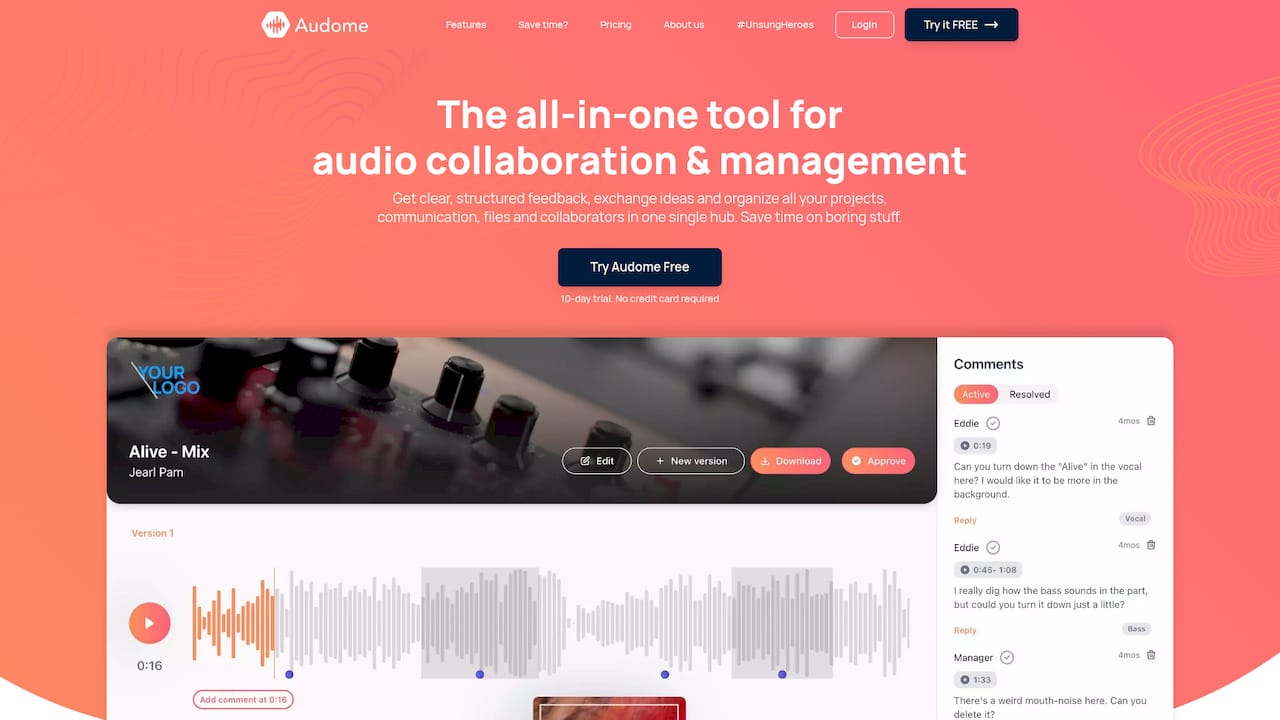
Audome is built for exactly this part of the process. Producers and engineers can upload lossless audio files, collect timestamped feedback directly on the waveform, track versions, and manage revision limits, all without requiring clients to create an account. Stripe Connect integration means you can require payment before final files are released, which removes the most common friction point in professional mastering workflows.
If you’re running a mastering business or managing multiple projects at once, Audome replaces the scattered combination of Dropbox, email, and text messages with one organized workspace. Start your free trial at Audome and see how much time you recover on the collaboration side of every project.
Key Takeaways
For releases that matter, human mastering delivers the artistic depth and mix feedback that AI cannot replicate; LANDR is the right tool for demos, high-volume releases, and any project where speed and cost outweigh nuance.
| Point | Details |
|---|---|
| Cost comparison | Human mastering typically costs $20–$70+ per track; LANDR Pro costs $39/month for unlimited WAVs. |
| Turnaround time | LANDR processes tracks in seconds; human engineers typically take multiple days including revisions. |
| Creative input | Human engineers catch mix problems and respond to artistic intent; LANDR processes the file without context. |
| Mix preparation | Both approaches require clean mixes peaking around –6 dBFS with no limiting on the master bus. |
| Audome’s role | Audome organizes the human mastering workflow: timestamped feedback, version control, and payment gating in one workspace. |