
TL;DR:
- Audome is the best alternative for full studio workflow, combining timestamped feedback, version control, and payment tools. Fidbak and Bounce Boss serve as direct feedback and collaboration substitutes without payment options. Most platforms support client access without accounts, but only Audome offers integrated billing and revision limits.
What are the best alternatives to Stacktune for audio collaboration?

Strong Stacktune alternatives include Audome, CloudFuze, Wavve, IFTTT, Musicspace, Fidbak, and Bounce Boss. Each one targets a different slice of the professional audio workflow, from waveform-level timestamped feedback to client-facing file delivery and payment collection. If you need a direct replacement that covers the full studio lifecycle, including revision limits, pay-to-download, and client access without account creation, Audome is the closest match. If your priority is simpler file hosting or social audio sharing, the other options each have a lane.
Stacktune is built around level-matched playback and automatic mix alignment, features that differentiate it from generic cloud storage for music professionals. The alternatives below match or extend those capabilities in different directions.
| Platform | Core strength | Client account required | Payment integration | Free trial |
|---|---|---|---|---|
| Audome | Full studio workflow, revision limits, pay-to-download | No | Yes (Stripe Connect) | Yes |
| CloudFuze | Cloud-to-cloud file migration and storage | Yes | No | Yes |
| Wavve | Audiogram creation and social audio sharing | Yes | No | Yes |
| IFTTT | Workflow automation between apps | Yes | No | Yes |
| Musicspace | Music portfolio and EPK hosting | No | No | Yes |
| Fidbak | Audio collaboration and file sharing | No | No | Yes |
| Bounce Boss | Remote audio collaboration for engineers | No | No | Yes |
Fidbak and Bounce Boss are the most direct functional substitutes for Stacktune’s feedback-and-versioning core. Audome goes further by adding business-layer controls that Stacktune does not offer. CloudFuze, Wavve, and IFTTT serve adjacent needs rather than replacing Stacktune outright.
1. Audome: full studio workflow with built-in payment controls
Audome is the most complete Reason Studios DAW alternative for working studios and freelance engineers. It handles the entire client-facing workflow in one place: upload unlimited high-resolution audio up to 96kHz/24-bit, collect timestamped waveform feedback, track version history, and deliver final files through a pay-to-download gate powered by Stripe Connect.
The feature that separates Audome from every other platform on this list is revision control tied to billing. Studios set a free revision limit per project; once the client exceeds it, Audome automatically charges for additional rounds. Clients never need to create an account, which removes the single biggest friction point in client delivery. Password-protected project pages and download controls keep files secure until payment clears.
Audome suits freelance producers, mixing and mastering engineers, commercial recording studios, podcast production companies, and audio post-production facilities. Pricing is not publicly listed on the main site; a free trial is available.
2. CloudFuze: cloud migration and centralized file management
CloudFuze is primarily a cloud-to-cloud migration and file management tool. It connects services like Google Drive, Dropbox, OneDrive, and Box, letting studios consolidate scattered project files from multiple storage accounts into one location. That makes it useful during a platform transition rather than as an ongoing collaboration hub.
For audio professionals, CloudFuze solves a specific pain point: moving years of archived sessions and client files from one storage service to another without manual downloading and re-uploading. It does not offer waveform playback, timestamped feedback, or payment integration. Client access requires an account on the destination platform.
CloudFuze offers a free trial. It fits studios that need to reorganize their storage infrastructure, not those looking for a client-facing feedback and delivery platform.
3. Wavve: turning audio into shareable social content
Wavve converts audio files into animated video clips for social media. Upload an audio segment, choose a waveform animation style, add a background image and text, and export a video ready for Instagram, TikTok, or YouTube. It is built for podcasters and musicians who want to promote releases without hiring a video editor.
Wavve does not offer project management, version control, or client feedback tools. It sits at the promotional end of the audio workflow rather than the collaboration end. For a mixing engineer delivering stems to a client, Wavve adds no value. For a podcast producer promoting an episode, it fills a real gap.
A free plan is available with watermarked exports. Paid plans remove the watermark and unlock longer clip lengths. Client account creation is required.
4. IFTTT: automating repetitive tasks across audio apps
IFTTT (If This Then That) is a general-purpose automation platform that connects apps through conditional triggers. An audio professional might use it to automatically back up new Dropbox uploads to Google Drive, post a tweet when a SoundCloud track goes live, or send a Slack notification when a client emails a revision request.
The platform does not handle audio files natively and has no playback, feedback, or version control features. Its value for studios is purely in reducing manual administrative tasks that surround a project, not in managing the project itself. IFTTT integrates with hundreds of apps, so the specific use cases depend entirely on which tools a studio already uses.
A free tier covers basic automations. Pro plans unlock multi-step workflows and faster trigger speeds. An account is required for both the studio and any collaborators using shared automations.
5. Musicspace: music portfolio and EPK hosting
Musicspace is a portfolio platform for musicians and producers. It lets you build an electronic press kit (EPK), embed audio players, list credits, and share a professional profile with labels, sync supervisors, and booking agents. Think of it as a LinkedIn-style presence built specifically for music industry professionals.
Collaboration features are minimal. Musicspace does not support version control, client feedback, or payment collection. Its strength is presentation: a clean, music-industry-specific profile that looks more credible than a generic website builder. Clients and industry contacts can listen to tracks without creating an account.
For a mixing engineer who wants a polished public-facing portfolio alongside a separate collaboration tool, Musicspace fills the front-end presentation gap. It does not replace Stacktune’s project management functions.
6. Fidbak: dedicated audio collaboration and file sharing
Fidbak is one of the closest functional alternatives to Stacktune. It offers remote audio collaboration features built specifically for audio professionals: file sharing, client feedback collection, and project organization without requiring clients to create an account. The interface is designed around the feedback loop between engineer and client rather than general file storage.
Fidbak supports timestamped comments on audio files, which puts it ahead of generic cloud storage for revision management. Version history is available, letting engineers and clients track changes across multiple rounds. The platform suits freelance engineers and small studios that want a cleaner client experience than email threads provide.
Pricing details are not publicly listed in full. A free tier is available. Fidbak does not include payment integration or revision billing controls, so studios that need those features will hit a ceiling quickly.
7. Bounce Boss: remote collaboration built for mix engineers
Bounce Boss targets mixing and mastering engineers specifically, offering a workspace designed around the back-and-forth of remote sessions. Engineers upload mixes, clients leave feedback, and the platform tracks revisions in an organized queue. The interface is minimal by design, keeping the focus on the audio rather than project management overhead.
Like Fidbak, Bounce Boss does not require clients to create an account to leave feedback, which keeps the client experience frictionless. Version control is built in. The platform does not include payment processing, so engineers using Bounce Boss still need a separate invoicing solution for billing clients.
Bounce Boss is a solid choice for engineers who want a purpose-built feedback tool without the broader business features. A free trial is available. Pricing tiers are not publicly listed in full.
Detailed feature and pricing comparison
The platforms above differ most sharply on three axes: whether they support waveform-level feedback, whether they include payment integration, and whether clients need an account to participate.
| Platform | Timestamped feedback | Version control | Payment integration | Client account required | Mobile app | Scalability |
|---|---|---|---|---|---|---|
| Audome | Yes | Yes | Yes (Stripe Connect) | No | Not publicly listed | Unlimited projects and collaborators |
| CloudFuze | No | No | No | Yes | Yes | Enterprise-grade |
| Wavve | No | No | No | Yes | Yes | Individual to small team |
| IFTTT | No | No | No | Yes | Yes | Individual to team |
| Musicspace | No | No | No | No | Not publicly listed | Individual |
| Fidbak | Yes | Yes | No | No | Not publicly listed | Small studio |
| Bounce Boss | Yes | Yes | No | No | Not publicly listed | Small to mid studio |
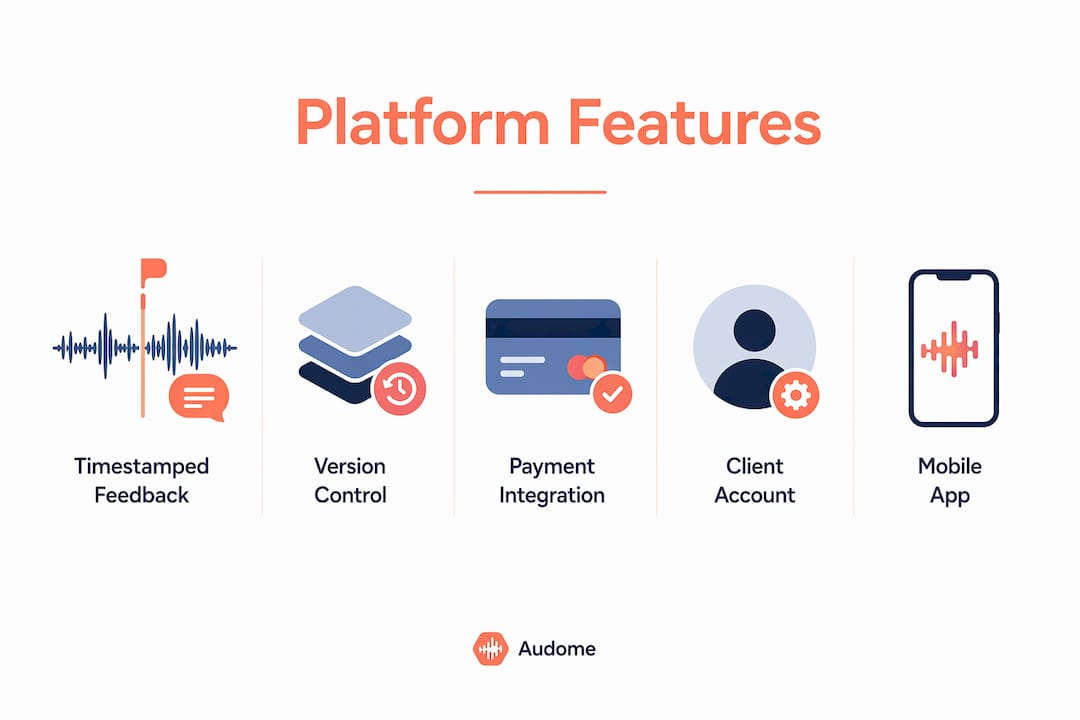
Security varies across the group. Audome uses password-protected project pages and download controls tied to payment status, meaning a client cannot access the final file until Stripe confirms the transaction. CloudFuze applies enterprise-grade encryption during migration transfers. Wavve and IFTTT follow standard SaaS security practices but are not built around sensitive professional file delivery.
Pro Tip: When evaluating any platform, test the client-side experience before committing. Create a test project and walk through it as your client would. A tool that confuses clients generates more email threads than it replaces.
User feedback on Fidbak and Bounce Boss consistently highlights the clean interface and low friction for clients. Audome users point to revision billing and pay-to-download as the features that changed how they run their studios, reducing the back-and-forth over “just one more small change.”
How to choose the best audio collaboration platform for your studio
The right platform depends on where your current workflow breaks down. Most engineers lose time in one of three places: chasing scattered feedback across email and text, managing endless revision rounds without clear boundaries, or waiting on payment before delivering final files.
Start with your feedback workflow. If clients are sending notes like “around the two-minute mark, the snare feels too loud,” you need waveform-level feedback with timestamps. Fidbak, Bounce Boss, and Audome all support this. Generic cloud storage does not.
Assess your version control needs. Studios juggling multiple rounds of revisions across several clients simultaneously need a platform that tracks every version clearly. Audome and Bounce Boss both handle this well. If you are a solo producer working on one project at a time, a lighter tool may be enough.
Factor in payment and client boundaries. This is where most platforms fall short. Fidbak and Bounce Boss handle feedback and versioning but leave billing to a separate tool. Audome integrates revision limits and payment directly into the project, so the platform enforces your business rules automatically rather than relying on you to chase invoices manually.
Key criteria to weigh before choosing:
- Does the platform support timestamped comments directly on the waveform?
- Can clients access and leave feedback without creating an account?
- Does version history show clearly which file is the current approved version?
- Is there a pay-to-download gate or payment integration?
- What are the file size and resolution limits? (Audome supports up to 96kHz/24-bit)
- Does the platform scale if you take on more clients or add team members?
- Is customer support responsive, and is there documentation for onboarding clients?
Pro Tip: Studios that set explicit revision limits inside their collaboration platform report fewer scope-creep disputes than those who rely on contract language alone. The platform enforcing the limit removes the awkward conversation entirely.
Mobile access is increasingly important as clients often leave feedback from phones. Platforms that provide a good mobile experience reduce response lag. IFTTT, CloudFuze, and Wavve have mobile apps. Audome, Fidbak, and Bounce Boss do not publicly list dedicated mobile apps; check availability if mobile support is critical.
Why specialized audio tools outperform generic file sharing for professionals
Generic file-sharing services like Dropbox and Google Drive were not built for audio feedback. They store files well, but they cannot tell a client where in a track to leave a comment, and they have no concept of a “revision round.” The result is feedback scattered across email threads, voice memos, and text messages, with no clear record of what was approved and when.
Dedicated audio collaboration platforms solve this by placing timestamped comments directly on the waveform. A client clicks the spot in the track where the vocal feels buried, types a note, and the engineer sees exactly which moment needs attention. No interpretation required, no “around the chorus” ambiguity.
Level-matched playback is another feature generic storage cannot replicate. When a client compares two versions of a mix at different loudness levels, the louder one almost always sounds better, regardless of actual mix quality. Platforms with level-matched comparison normalize playback volume between versions, so feedback reflects the actual mix rather than the louder file winning by default.
Feedback scattered across emails, text messages, and DMs is one of the most common sources of miscommunication in professional audio workflows. Centralizing it on a single platform with a clear revision trail eliminates most of that confusion before it starts.
Pay-to-download delivery adds a layer of financial protection that generic storage cannot provide. Studios using password-protected delivery portals with payment gates report fewer instances of clients downloading final files before settling invoices. The platform enforces the business rule; the engineer does not have to.
The shift from generic file sharing to specialized platforms is not about features for their own sake. It is about removing the administrative overhead that pulls engineers away from the work they are actually paid to do.
Key Takeaways
Audome, Fidbak, and Bounce Boss are the strongest direct substitutes for Stacktune’s core feedback and version control functions, with Audome adding payment integration that the others lack.
| Point | Details |
|---|---|
| Timestamped feedback is the baseline | Any platform replacing Stacktune should support waveform-level comments; generic cloud storage does not. |
| Client account friction costs you | Platforms that require clients to register before leaving feedback slow down every revision round. |
| Payment integration changes your business | Revision billing and pay-to-download gates reduce scope creep and unpaid delivery without awkward conversations. |
| Level-matched playback protects mix quality | Without it, clients evaluate loudness instead of the actual mix, skewing every round of feedback. |
| Audome covers the full studio workflow | Audome combines timestamped feedback, version control, revision limits, and Stripe Connect payments in one platform. |
The real cost of scattered feedback in professional audio
Most engineers underestimate how much time they lose to feedback management rather than actual mixing. The problem is not that clients give bad feedback. It is that the feedback arrives in five different places, refers to timestamps that do not match the current version, and contains approvals that are impossible to verify later when a client claims they never signed off.
Platforms like Fidbak and Bounce Boss solve the collection problem well. Feedback lands in one place, tied to the waveform, with a clear revision trail. That alone is a meaningful upgrade from email. But they stop short of solving the business problem: what happens when a client wants a sixth revision on a project that included three? The engineer either absorbs the cost or has an uncomfortable conversation that could have been avoided entirely.
The platforms that integrate revision billing into the feedback loop change the dynamic completely. The client sees the revision count in the same interface where they leave feedback. When they hit the limit, the platform prompts payment before the next round begins. No awkward email. No chasing invoices. The boundary is built into the tool.
There is also a subtler benefit. When clients know that additional revisions cost money, they tend to consolidate their notes more carefully before submitting. Feedback quality improves because the client has a financial incentive to be specific the first time. That is a workflow efficiency gain that no amount of better file organization can replicate.
The audio collaboration platform market in 2026 has matured enough that there is no reason to run a studio on generic cloud storage and hope clients figure out how to leave useful feedback. The specialized tools exist, they are priced accessibly, and the ones that include payment integration pay for themselves quickly.
Audome fits the workflow this article is about
If you came here looking for a Stacktune substitute that handles the full client-facing studio workflow, Audome is built for exactly that. It replaces the patchwork of Dropbox, WeTransfer, email threads, and separate invoicing tools with a single workspace where projects live from first upload to final paid delivery.
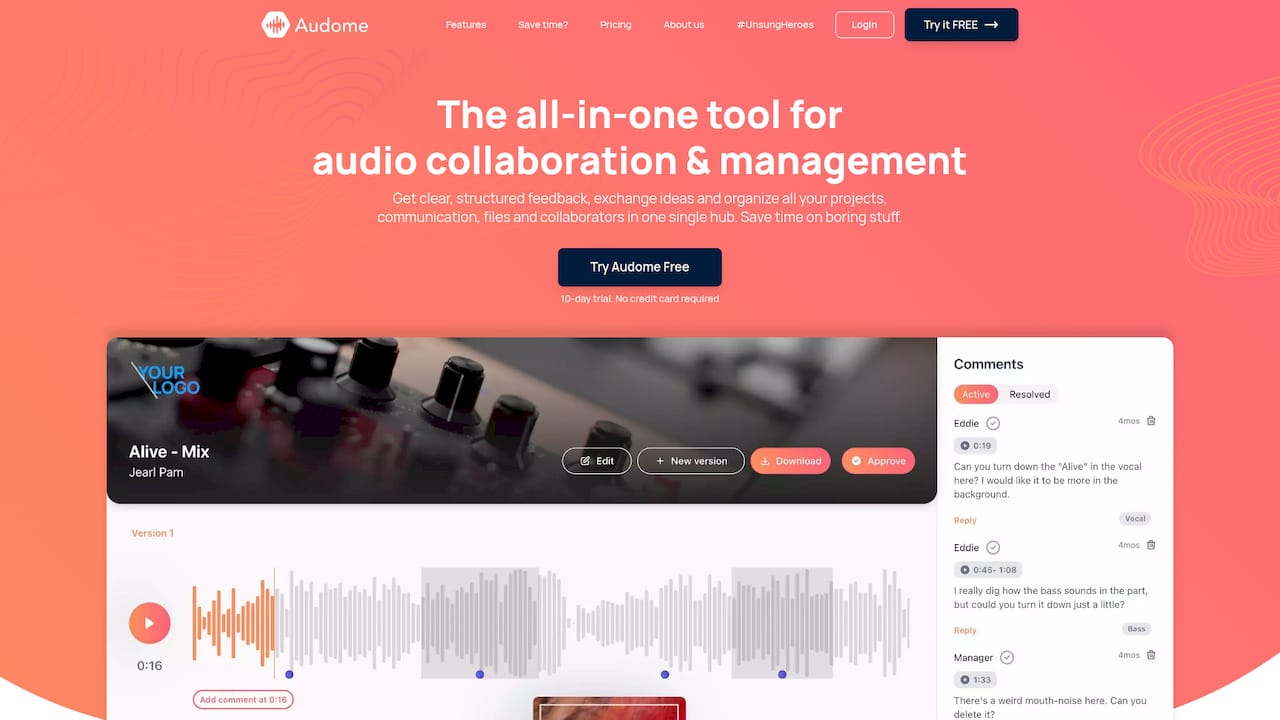
Clients access projects without creating an account. Feedback lands directly on the waveform with timestamps. Version history is automatic. When a client exceeds the free revision limit you set, Audome charges them through Stripe Connect before the next round begins. Final files stay locked until payment clears. For mixing and mastering engineers, podcast producers, and commercial studios that want to spend less time managing files and more time on the work, Audome’s platform is the practical next step. Start a free trial and set up your first project in under ten minutes.
FAQ
What is the best alternative to Stacktune for professional audio feedback?
Audome is the strongest all-around substitute, offering timestamped waveform feedback, version control, and integrated payment collection in one platform. Fidbak and Bounce Boss are solid options if payment integration is not a priority.
Do Stacktune alternatives require clients to create an account?
Audome, Fidbak, Bounce Boss, and Musicspace all allow clients to access projects and leave feedback without registering. CloudFuze, Wavve, and IFTTT require client accounts.
Which audio collaboration platforms include payment integration?
Among the platforms covered here, Audome is the only one that includes built-in payment processing through Stripe Connect, including pay-to-download delivery and automatic billing for additional revision rounds.
How do specialized audio platforms differ from generic file sharing?
Dedicated platforms support waveform-level timestamped comments and level-matched playback, which generic storage services like Dropbox and Google Drive do not offer. Those two features alone eliminate most of the miscommunication that happens during client revision rounds.
Is there a free trial available for these Stacktune alternatives?
Audome, CloudFuze, Wavve, IFTTT, Fidbak, and Bounce Boss all offer free trials or free tiers. Confirm current trial terms directly with each platform, as availability can change.