
A project archive policy has to answer three questions before a client ever asks them: what you’re keeping, how long you’re keeping it, and who pays when someone wants it back. Full session folders are commonly kept for a couple of years, with finals and stems retained for a longer period. Everything should be flattened to Broadcast Wave Files at 48kHz/24-bit minimum so it opens years later regardless of what plugins have gone extinct. Retrieval past the retention window is a billable service, not a favor, and the version a client actually approved is the one that ends up in the archive.
TL;DR:
- Full session files should be kept for 24 months, with finals and stems stored for at least five years, and retrievals are billable services.
- Archives must include every original file, printed stems, a detailed notes file, signed agreements, invoices, and a consistent folder structure.
- Flattened Broadcast Wave Files at 48kHz/24-bit or higher are recommended for long-term storage to ensure format longevity.
- Retrieval costs cover staff time and verification, with a standard flat fee and additional charges for complex restorations.
- Automated tools like Audome enforce policy compliance, track version history, and manage billing for archive retrievals seamlessly.
Table of Contents
- What Should a Project Archive Actually Contain?
- Which File Formats Actually Survive Long-Term Storage?
- How Long Should You Keep Client Project Files?
- Building a Storage Strategy That Won’t Fail You
- How Does Revision Tracking Connect to the Archive?
- What Should You Charge to Retrieve an Archived Project?
- Why a Written Archive Policy Changed How We Think About Storage
- How Audome Enforces Your Archive Policy Automatically
- Sources
- FAQ
What Should a Project Archive Actually Contain?
Most studios lose restorability not because they deleted something but because they only kept half of it. A reopened session six years from now is only as good as the files sitting next to it, and Universal Music Group’s archival asset guidelines make clear that clean folder structure and labeling matter as much as the audio itself.
Your archive folder should include:
- The consolidated DAW session with every original client-supplied file inside it, not linked externally
- Printed stems, both raw and processed, plus the final approved mix as a flattened BWF
- A plain-text notes file listing DAW version, plugin names and versions, tempo map, and routing or bus structure
- The signed agreement, final invoice, and a written record of client approval
- A consistent naming convention and folder hierarchy so anyone on your team can find the right version without opening the session first
Skip the plugin list and you’re betting the client’s next rework on a synth that might not exist in three years. That’s a bad bet, and consolidating your working files before archiving is the cheapest insurance you’ll ever buy.
Which File Formats Actually Survive Long-Term Storage?
Session files rot. Plugins get discontinued, DAW versions stop opening old projects, and a proprietary format from 2019 is a gamble by 2029. The AES Delivery Recommendations address exactly this problem by recommending studios flatten session elements into Broadcast Wave Files rather than relying on native session formats for long-term storage.
48kHz/24-bit is the floor, not the target. The AES standard recommends sample rates and bit depths equal to or better than the original master, up to 96kHz/192kHz and 24 bit or higher, plus a primary master and two secondary backups.
What to print for archive:
- Raw, unprocessed tracks exactly as recorded
- Processed buses and stems at final mix level
- Full mix variants: main mix, instrumental, TV mix, and a cappella where applicable
If a label or client contract calls for higher sample rates, deliver at that spec and note it in your Media ID Label documentation, a practice AES specifically calls out for tracking archive assets over time. Consistent file naming with embedded metadata beats a clever folder name every time someone else has to find the file in a hurry.
How Long Should You Keep Client Project Files?
There’s no universal law dictating retention windows for audio projects, but a workable default has emerged among studios that treat archiving as a cost center instead of an afterthought. Production Expert’s guidance on studio archiving recommends limiting full session retention and charging for anything beyond it.
A reasonable structure looks like this:
- Full sessions (all tracks, plugin states, project files): 24 months for independent work
- Finals and stems only: retained for several years, sometimes longer for label or sync-licensed projects
- Extended archive beyond those windows: available as a paid add-on, billed annually or per-retrieval
That’s the kind of clause that belongs directly in your service agreement, not buried in an FAQ page nobody reads. Record which retention tier the client selected at project close, not after they’ve emailed asking for a 2021 session. Put the responsibility in writing too: if a client wants a guarantee beyond your stated window, that’s a separate, paid arrangement, and the contract should say so plainly.
Building a Storage Strategy That Won’t Fail You
Retention windows mean nothing if the storage backing them fails silently. The 3-2-1 backup rule, three copies, two different media types, one offsite, adapts cleanly to a studio’s workflow once you tier it by project age.
A practical version breaks into three tiers. ProducerGrid’s archival strategy frames it as active, warm, and cold:
- Active (0 to 90 days): full plugin state, live on your working drive
- Warm (90 days to 2 years): stems, project files, and a plugin-version snapshot, often on a NAS or secondary local drive
- Cold (2+ years): stems and finals migrated to cloud cold storage like Amazon S3 Glacier or Backblaze B2, with the project file included as a bonus rather than a guarantee
Pro Tip: Run a test restore on one archived project every quarter. A backup you’ve never tried to open isn’t a backup, it’s a hope.
Verification matters as much as the copies themselves. Checksums, a manifest listing every file in the archive, and the Media ID Label documentation AES recommends all give you a way to confirm nothing corrupted silently during migration. Put one person on your team in charge of the migration calendar, because “someone will get to it eventually” is how studios lose a decade of client work.
How Does Revision Tracking Connect to the Archive?
An archive is only useful if it holds the version the client actually signed off on, not whatever was open in your session last. That means your revision workflow and your archive policy have to speak the same language. Timestamped feedback tied to a revision log gives you an audit trail that maps directly onto archive metadata.
In practice:
- Name every version consistently:
ProjectName_v3_20260214, with a one-line change note attached - Log each round of feedback against the version it addresses, not the project as a whole
- When a version gets approved, move it into your finals folder and tag it with
approved_byandapproved_date - Separate creative-direction reworks (a new mix balance) from technical tweaks (a level fix) in your policy language, since they often carry different revision-fee rules
Skip this step and you’ll eventually restore the wrong mix for a client who’s certain they approved a different one.
What Should You Charge to Retrieve an Archived Project?
Pulling a project from cold storage isn’t free, even if the storage itself is cheap. It takes staff time to locate, verify, and reopen files that have been sitting untouched for years, and your pricing should reflect that labor, not just the storage bill.
A standard retrieval package covers an archive pull, checksum verification, one restore into working storage, and one alternate deliverable. The workflow behind it runs in order:
- Locate the manifest for the requested project
- Verify checksums against the original archive record
- Restore the files to warm storage
- Open the session in your DAW to confirm it loads correctly
- Deliver the requested stems or mix to the client
Charge a flat fee for standard retrievals and bill hourly only when the request involves rebuilding a session with missing plugins or corrupted files. When a client emails asking for an old project, respond with your retrieval fee and expected turnaround up front, before you start pulling anything.
Why a Written Archive Policy Changed How We Think About Storage
The biggest shift wasn’t technical. It was realizing that indefinite retention was a hidden cost we’d never priced into anything. Once we set defined windows, full sessions for 24 months, finals for five years, storage stopped creeping upward every quarter.
The second benefit showed up in client conversations. A written retrieval fee means nobody’s surprised when a two-year-old request comes with a price tag attached. And ironically, turnarounds got faster, because a documented manifest and consistent naming meant we weren’t hunting through unlabeled folders every time an old project resurfaced.
— Kreg
How Audome Enforces Your Archive Policy Automatically
A written policy only works if the tools around it actually enforce it, and that’s usually where studios fall down. You draft the retention windows, then six months later you’re digging through Dropbox folders with no idea which version the client approved.
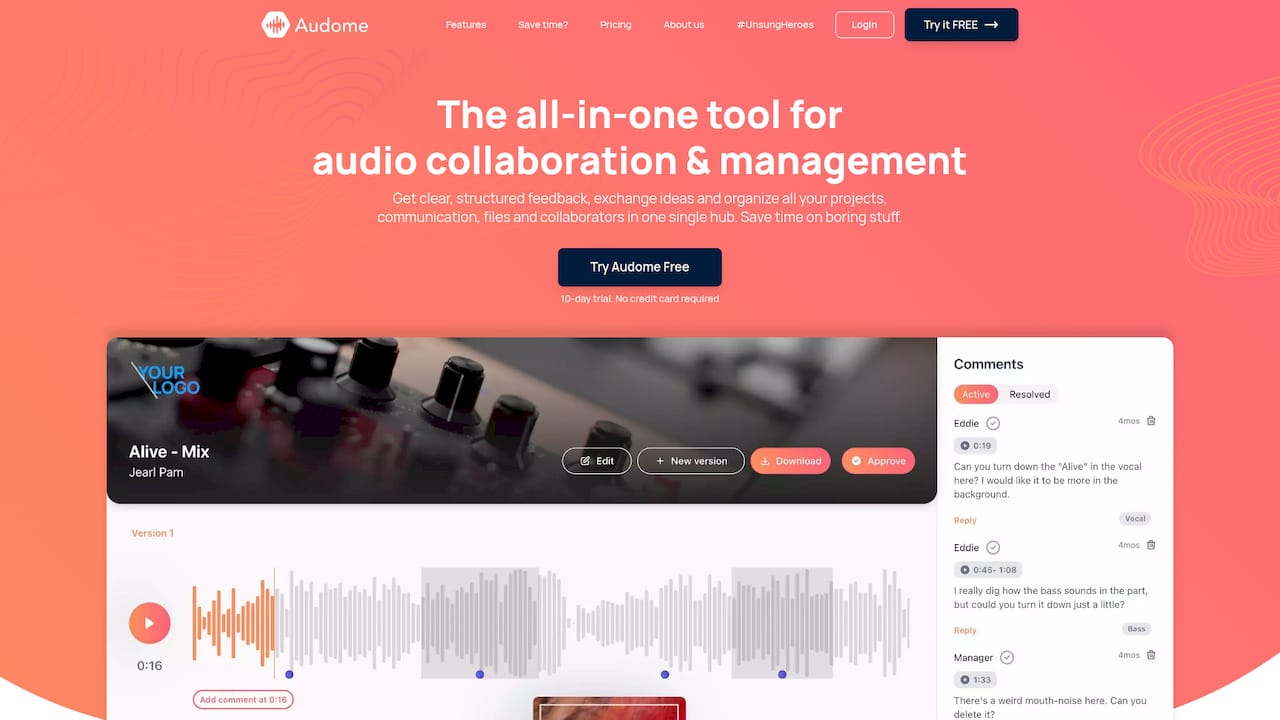
Audome maps directly onto the policy structure covered above. Version history tracks every revision automatically, so the approved mix is never a guess. Timestamped comments live directly on the waveform, which means your audit trail is built in rather than bolted on afterward. Password-protected project pages and download controls keep finals locked until a client has paid, and Stripe Connect handles billing for extra revisions or archive retrievals without a separate invoice thread.
A workable setup looks like this: two free revision rounds included per project, full sessions archived for 24 months, and any retrieval request beyond that window routed through a paid, locked download that unlocks once payment clears. Check the pricing and feature overview to see how the trial works for your studio’s project volume.
Sources
For studios drafting or refining a formal archive policy, these sources cover the technical and operational ground in more depth:
- UMG stereo audio archival asset best practices
- Archiving mix sessions: a mix engineer guide (Trackbloom)
- DAW project archival strategy — ProducerGrid
FAQ
What is a project archive policy?
It’s a written studio policy stating exactly which files you keep after a project closes, how long you keep them, and what retrieval costs if a client asks for them later.
How long should I keep client session files?
A common default is 24 months for full sessions and 5 years for finals and stems, with extended retention offered as a paid add-on beyond that.
What file format should I use for long-term archiving?
Flatten sessions to Broadcast Wave Files at 48kHz/24-bit minimum, per AES Delivery Recommendations, with sample rates and bit depths equal to or better than the original master or client contract requirements.
Who pays for archive retrieval?
The client, typically through a flat retrieval fee stated in your service agreement, since pulling and verifying archived files takes real staff time even when storage costs are low.
Can software help enforce an archive policy?
Yes. A platform like Audome ties version history, timestamped approvals, and paid download unlocks together, so retention rules and retrieval fees get enforced automatically instead of managed by memory.