
A revision is a change that alters the substance, structure, or intent of a piece of work, not just its surface polish. If a request changes what the piece says, how it’s organized, or what it’s trying to accomplish, it counts as a revision. If it only fixes typos, tightens phrasing, or nudges color values by a shade, that’s editing, and it’s a different job with different pricing rules.
Here’s the one-line verdict you can use today: if the change requires you to reconsider your original approach, it’s a revision; if it just requires you to clean up what you already built, it’s an edit. The Writing Center at UNC frames revision as an act of “seeing again,” rethinking arguments and reorganizing presentation before anyone touches a comma. That framing holds up far beyond academic essays. It applies to a logo redesign, a podcast remix, or a website’s navigation structure just as cleanly as it applies to a college paper.
Key Takeaways
A revision changes the structure, concept, or intent of a work, while an edit polishes execution without altering the original vision.
| Point | Details |
|---|---|
| Definition to remember | A revision alters structure, argument, or intent; an edit polishes existing work without changing its meaning. |
| Use the five-question checklist | Structure, rework scope, ripple effects, brief alignment, and new material needed decide if a request is billable. |
| Track versions and timestamps | Named versions and timestamped feedback turn vague disputes into fast, documented fixes. |
| Set revision limits in contracts | Flat allowances, hourly rates after allowance, or change-order fees each fit different project types. |
| Use a dedicated tool for audio work | Audome lets studios set revision limits, collect timestamped waveform feedback, and auto-bill extra rounds through Stripe Connect. |
Table of Contents
- What Is Considered a Revision? Definition and Scope
- Revision vs. Rewrite vs. Redraft vs. Edit: What’s the Difference?
- What Do Revisions Look Like in Real Projects?
- How Do You Know If a Change Counts as a Revision?
- How Should You Track and Manage Revision Rounds?
- When Are Revisions Included, and When Should You Charge More?
- A Case Study: Managing Audio Revisions With Version History
- Why Revision Deserves Respect, Not Dread
- Try Audome for Cleaner Revision Boundaries
- Further Reading and Primary Sources
- Sources
- FAQ
What Is Considered a Revision? Definition and Scope
Revision comes from the Latin revisere, to see again. That’s not a trivia fact. It’s the whole point. A revision asks you to look at the work with fresh eyes and change something fundamental about how it’s built or what it communicates. Editing, by contrast, keeps the vision intact and just sharpens execution. Grammarly’s breakdown of the writing process draws the same line: revising reshapes ideas and organization, while editing fine-tunes grammar and punctuation.
Not every revision carries the same weight, though. It helps to think in three tiers.
- Minor revision: A small adjustment that touches one section or asset without changing the overall direction. Swapping a paragraph’s placement, adjusting a color palette within an established brand system, or re-leveling one track in a mix.
- Moderate revision: A change that ripples across multiple sections or assets. Restructuring an article’s argument order, redesigning a page layout while keeping the same content, or re-editing a podcast segment for pacing.
- Major revision: A change to the core concept, thesis, or creative direction. Rewriting the thesis of an essay, scrapping a design concept for a new one, or re-recording a vocal take because the emotional direction shifted.
For scopes of work, precise language prevents disputes before they start. Try something like: “Minor revisions include adjustments to existing content that don’t require new material or structural rework. Moderate revisions involve reorganization or partial rebuilds affecting more than one section. Major revisions involve a change in core concept, direction, or thesis and are billed separately.” That single paragraph, dropped into a proposal or contract, does more to prevent scope creep than any amount of verbal reassurance. Middlebury’s writing guidance backs this tiered thinking, noting that revision targets macro-level improvements like structure and argument, while editing stays at the sentence level.
Revision vs. Rewrite vs. Redraft vs. Edit: What’s the Difference?
These four words get used interchangeably by clients and inconsistently by professionals, which is exactly why confusion shows up in every revision negotiation. Here’s how to separate them cleanly.
- Revision: A targeted change to structure, content, or intent within the existing work. Example: moving the thesis of a report from the conclusion to the introduction.
- Rewrite: Producing substantially new text or material for a section or the whole piece while keeping the original assignment. Example: cutting an entire chapter and writing a replacement from scratch.
- Redraft: Starting a new full version of the work, often after a major direction change. Example: a designer scraps a logo concept entirely and builds a second, unrelated concept from a blank canvas.
- Edit: Correcting and polishing without changing meaning, structure, or intent. Example: fixing subject-verb agreement errors and swapping “utilize” for “use” throughout a document.
The Bryn Mawr repository on revision as re-seeing treats revision as an iterative, sometimes recursive process, one that can loop back through drafting more than once. That’s useful context for clients who assume revision means “one clean pass.” It often means several passes, especially on longer or more conceptual work.
When a client says “just a quick revision,” here’s a client-facing line that sets expectations fast: “Happy to revise. Since this affects [structure/thesis/layout], it falls under our revision scope rather than a quick edit. Let’s confirm what changes and I’ll get you a timeline.” That sentence does real work. It validates the request, names the category, and moves the conversation toward a plan instead of a guessing game.
What Do Revisions Look Like in Real Projects?
Abstract definitions only get you so far. Here’s what revision actually looks like once you’re in the middle of a project, broken out by field.
Writing. A revision might mean reordering the argument in an essay so the strongest point leads, cutting a redundant section entirely, changing the piece’s intended audience (say, from technical readers to general readers), or restructuring a narrative’s timeline. A simple edit, by contrast, is fixing comma splices or swapping passive voice for active voice. The Bryn Mawr research specifically names changing a thesis and reorganizing layout as textbook revision examples. Reordering a section takes 20 to 40 minutes; rewriting a chapter can eat a full afternoon.

Graphic design. Revising a design means changing the concept, layout grid, or visual hierarchy, not just swapping a font weight. If a client asks to move the logo, restructure how information flows on a page, or try an entirely different color story that changes the brand feel, that’s a revision. Adjusting kerning, resizing an image slightly, or correcting a misaligned margin is an edit. A layout restructure can run two to four hours; a font-size tweak takes ten minutes.

Web and UX. Rebuilding a navigation structure, changing the user flow through a checkout process, or redesigning a homepage’s information architecture are revisions. Fixing a broken link, adjusting button padding, or correcting a typo in a call-to-action button are edits. Most initial web scopes include one structural revision round; a second full navigation rebuild almost always triggers extra billing.
Audio production. Re-mixing a track because the client wants a different genre feel, re-recording a vocal take for tone, or restructuring a podcast episode’s segment order are revisions. Nudging a single fader level, trimming dead air at the start of a file, or fixing one clipped word are edits. A full re-mix can take two to six hours depending on track count; a level nudge takes minutes. Producers who set clear revision limits upfront avoid the ambiguity that turns a ten-minute request into an unpaid two-hour session.
Video. Changing the edit’s pacing structure, swapping the narrative order of scenes, or reworking the color grade concept are revisions. Trimming a few frames off a cut, adjusting audio sync by a fraction of a second, or fixing a caption typo are edits. A pacing overhaul often means a new editing session; a sync fix is usually done in the time it takes to export.
Across every field, the pattern repeats: one structural revision round is standard in most initial scopes. A second or third round, or any request that touches the core concept again, is where extra billing conversations typically start.
How Do You Know If a Change Counts as a Revision?
When a client message lands in your inbox and you’re not sure whether it’s a revision or a two-minute edit, run it through five questions.
- Does this change affect the structure, argument, or flow of the work?
- Does fulfilling this request require reworking multiple sections or assets, not just one?
- Will this change ripple into other parts of the project that are already finished?
- Was this type of change discussed or scoped in the original brief?
- Does completing this request require producing new material, not just adjusting existing material?
Two or more “yes” answers means you’re looking at a revision, not an edit. One “yes” combined with several “no” answers usually means it’s a fast fix you can knock out for free or fold into standard support.
Here’s the decision flow in practice:
- If the change was explicitly included in your revision allowance and doesn’t touch core structure, accept it as included.
- If the change is small but wasn’t discussed in the brief, flag it and ask for clarification before doing the work.
- If the change touches the core concept, thesis, or direction, propose it as a paid change order.
Three snippets you can copy and send today:
Accepting as included: “This falls within your included revision round. I’ll have the updated version to you by [date].”
Requesting negotiation: “This touches [structure/concept], which goes beyond what we scoped initially. Can we hop on a quick call to figure out the best path?”
Proposing a paid change order: “This is a great direction, but it’s outside the current scope since it changes [the layout/thesis/mix approach]. I can quote this as an additional revision at [rate] or a new phase. Which works better for you?”
Writing these out ahead of time means you’re not improvising boundaries in the middle of a stressful client thread, which is exactly when people cave and work for free.
How Should You Track and Manage Revision Rounds?
Vague revision tracking is where most disputes are born. If you can’t point to what changed between version 2 and version 3, you can’t defend a bill or a deadline.
Start with naming conventions that actually mean something. Instead of “final_v2_reallyfinal,” use a pattern like ProjectName_v3_2026-03-14 so the version number and date are visible at a glance. Keep a single source file per asset type. When five people have five different “latest” versions of the same file scattered across email attachments and shared drives, someone will eventually revise the wrong one. Add short change notes to every version, even just one line: “v3: restructured intro, cut section 4, added client’s requested tone shift.”
Feedback methods should match the medium:
- Annotated PDFs or markup tools for design work, so comments sit directly on the visual element they reference.
- Timestamped comments anchored to the waveform for audio, so “fix this” points to an exact second instead of a vague “somewhere in the middle.”
- Timecodes for video feedback, tied to frame or second markers.
- Inline comments for documents, attached to the specific sentence or paragraph in question.
Timeline rules matter just as much as the tracking format. A good rule of thumb: if a requested change would take longer than your originally scoped revision window, or if it requires new material rather than adjustment of existing material, it’s a new phase and needs a new estimate. Don’t let “just one more small thing” quietly become three additional days of unbilled work.
Pro Tip: Before starting a major revision, step away from the work for at least a few hours, ideally a full day. Writing-center research on the revision process consistently recommends this distance because it’s the only way to spot structural problems your brain has gotten too close to see clearly.
Version tracking isn’t just for large teams. A freelance mixing engineer managing revision rounds benefits from the exact same discipline as an agency managing five clients at once: name your versions, timestamp your feedback, and write down what changed and why.
When Are Revisions Included, and When Should You Charge More?
Most professional pricing models handle revisions one of four ways, and picking the right one for your work protects your margin without alienating clients.
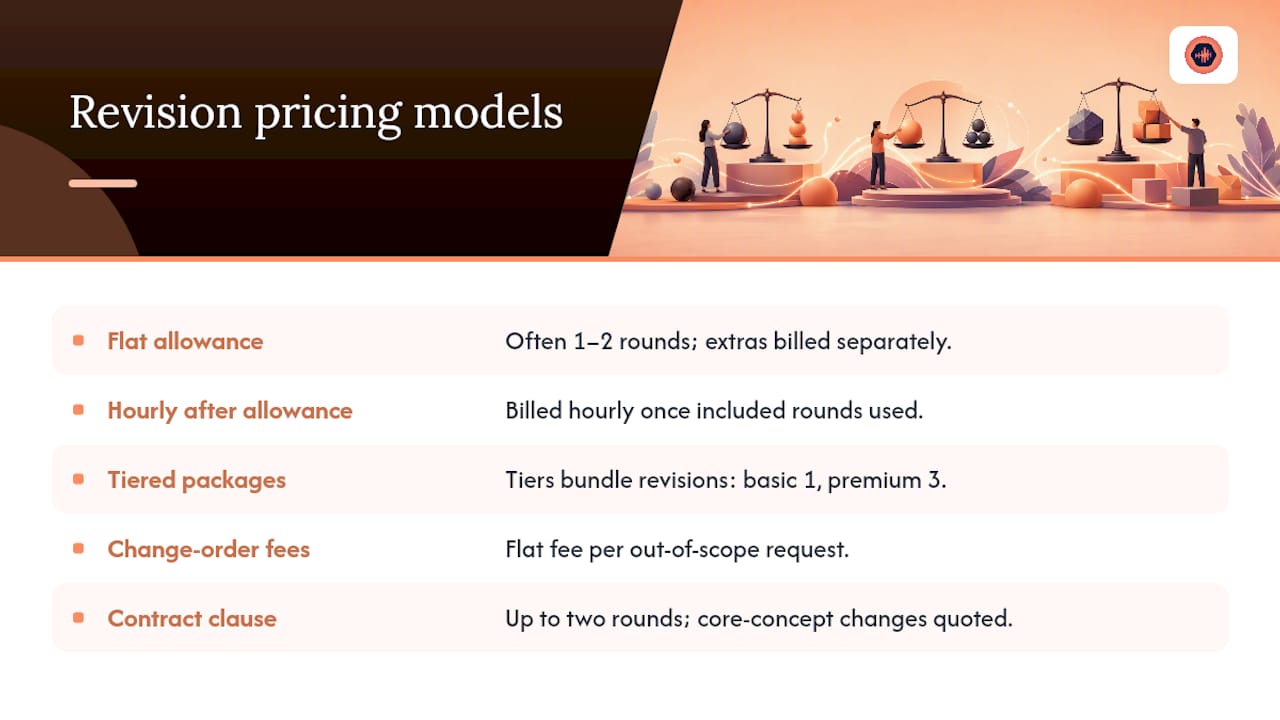
A flat revision allowance includes a set number of rounds (often one or two) in the base price, with anything beyond that billed separately. This works well for well-defined projects like a logo package or a single podcast episode edit. An hourly rate after allowance kicks in once the included rounds are used up, charged at your standard hourly rate for anything additional. This suits work where scope is harder to predict, like a website redesign. Tiered packages bundle different revision counts into different price points (a basic tier with one revision, a premium tier with three), which works cleanly for productized services. Change-order fees are flat fees charged per out-of-scope request, useful for one-off major changes like a full creative direction pivot midway through a project.
Contract language should specify both what’s included and what triggers extra billing. Sample clause: “This agreement includes up to two rounds of revisions limited to adjustments within the original creative direction. Requests that alter the core concept, structure, or scope of the project will be quoted separately as additional work.” That single clause, sitting in a signed contract, saves more arguments than any amount of after-the-fact explaining.
Ballpark numbers help clients understand why some changes cost more than others. A minor tweak, like adjusting one color or trimming a few seconds of audio, usually takes under 30 minutes and is reasonably included at no extra charge. A moderate revision, like restructuring a section or re-mixing two tracks, often runs two to four hours and is where hourly billing typically starts. A major revision, like a full redesign concept or a re-recorded vocal session, can mean a full day or more of work and should be quoted as close to a new project.
Pro Tip: Quote revision limits in rounds, not hours, whenever possible. Clients understand “two revision rounds” far more intuitively than “four hours of revision time,” and rounds are easier to track without an argument over your timesheet. Producers working in podcast editing often find that a two-round limit, clearly stated upfront, cuts down on the “just one more small change” spiral almost entirely.
Templates You Can Copy: Revision Request Form and Changelog
A revision request template forces clarity before work starts. Require these fields from clients: what specifically should change, why the change is needed, the desired outcome in one sentence, any reference attachments, and the deadline for the updated version. A request that says “make it pop more” without these fields isn’t actionable, and asking for them upfront saves a dozen follow-up messages later.
On your side, keep a revision log for every project with these columns: version number, timestamp, who requested the change, estimated hours to complete it, and whether it was billed as included or extra. This log becomes your evidence if a client later disputes an invoice or claims a change was supposed to be free.
Require the completed request form before starting any revision beyond a trivial fix. It’s a five-minute ask that prevents hours of rework from vague instructions. Store your revision log alongside project files, not buried in an old email thread, so it’s ready the moment you need to defend a bill or resolve a disagreement about scope.
A Case Study: Managing Audio Revisions With Version History
A mixing engineer working on a six-track EP once got a note from a client that just said “the vocals feel off, can we fix that.” Without any timestamp or specific reference, that note could mean anything: EQ, reverb, timing, performance, arrangement. The engineer had already gone through two full mix passes trying to guess what “off” meant, burning hours that were never billed because the request seemed, on paper, like a small ask.
The fix wasn’t more guessing. It was timestamped feedback tied directly to the waveform, so the client could drop a comment at the 1:42 mark instead of describing the whole song in vague terms. Combined with version history showing exactly what changed between mix 3 and mix 4, the engineer could point to the specific, narrow fix that resolved the note and show it took 20 minutes, not another full pass.
When feedback lives on the exact second of audio it refers to, “the vocals feel off” turns into “the reverb tail on the second verse is too long,” and a vague dispute becomes a five-minute fix.
The measurable difference showed up fast:
- Client approvals came back within a day instead of stretching across a week of back-and-forth messages.
- Disputes over what was “included” dropped because every version had a timestamp and a note attached to it.
- Billing decisions for extra revision rounds became easy to justify, since the log showed exactly what had changed and when.
Why Revision Deserves Respect, Not Dread
Every writer who’s ever cut their favorite paragraph knows the sting of revision, and also the relief when the piece gets better because of it. That’s not punishment. That’s the work actually happening. The first draft, the first mix, the first layout, is rarely the discovery. The second and third pass usually is.
When a client bristles at a revision note, I’ve found this reframe works better than any defense of scope: “This isn’t me saying it’s wrong. It’s me seeing something I couldn’t see the first time through.” That’s the writing-center idea of revision as a threshold concept in one sentence: you don’t fully understand a piece of work until you’ve stepped back and looked at it again.
Try Audome for Cleaner Revision Boundaries
Everything covered here, version tracking, timestamped feedback, clear revision limits, gets a lot harder to enforce when your workflow is scattered across email, text messages, and file-sharing links. Audome is built specifically to close that gap for audio professionals: every project lives in one workspace where clients leave timestamped comments directly on the waveform instead of vague notes like “the vocals feel off.”

You can set a fixed number of included revision rounds per project and let Audome automatically bill clients through Stripe Connect once they’ve used them up, so you’re not the one having the awkward “that’s outside scope” conversation every time. Version history stays attached to the project automatically, so if a client disputes what changed between mix 3 and mix 4, the record is already there. Clients never need to create an account to leave feedback or download final files once payment clears.
If you’re tired of chasing vague feedback across four different apps, start with Audome and set up your first project with a defined revision limit today.
Further Reading and Primary Sources
For the academic definition of revision, start with The Writing Center at UNC. For a dictionary-level shorthand useful in contracts, check the Cambridge Dictionary entry on revision. For workflow and pricing guidance specific to audio production, see Audome’s guide to setting revision limits.
Sources
- Revising drafts – The Writing Center (UNC)
- Revision as a process of re-seeing (Bryn Mawr repository)
- Revision, editing and proofreading — what’s the difference?
- What is revising? | Grammarly
FAQ
What is considered a revision in writing?
A revision in writing is any change to structure, argument, thesis, or organization, such as reordering sections or rewriting a thesis statement. Sentence-level fixes like grammar and punctuation are editing, not revision.
What is an example of a revision?
Moving an essay’s strongest argument to the introduction, redesigning a webpage’s navigation structure, or re-mixing a song’s genre feel are all revisions because each changes the work’s core structure or direction.
Does minor revision mean accepted?
Not automatically. “Minor revision” in academic peer review typically means the work is accepted pending small changes, but in client work, “minor” describes scope, not approval status. Always confirm what’s still required before calling a project finished.
What is a revision rule?
A revision rule is a written guideline, often in a contract or scope of work, that defines how many revision rounds are included and what triggers additional billing. A clear revision rule, like “two rounds included, additional rounds billed hourly,” prevents scope disputes before they start.