
“Unlimited projects” means an audio collaboration platform does not cap how many client workspaces you can create at once. If you juggle multiple clients, the practical move is to pick a platform built for audio work that pairs unlimited project workspaces with pro features like timestamped feedback and high-resolution uploads. We built Audome around exactly that need.
TL;DR:
- Unlimited projects eliminate the need to juggle multiple accounts or folders, saving time on searching and file management.
- Platforms should support high-resolution files up to 96kHz/24-bit and include security controls like password protection and download restrictions.
- Tracking revisions and billing within the same system reduces project delays and ensures more accurate, cleaner payments and project closure.
- Clear protocols for revision limits and payment gating prevent scope creep and help maintain profitability across multiple simultaneous projects.
- Audome offers unlimited high-resolution uploads, timestamped waveform feedback, automated version history, and integrated payment and access controls.
Table of Contents
- Why unlimited projects matter for professional audio workflows
- Scalable project workflows: how to organize dozens of simultaneous projects
- Manage revisions and billing at scale
- Security, file formats, and delivery controls for pro audio
- Checklist: what to require from a collaboration platform when you need unlimited projects
- How Audome implements unlimited projects and supports studio workflows
- Author perspective: when unlimited projects becomes essential
- Start a trial or view Audome pricing
- FAQ
- Sources
Why unlimited projects matter for professional audio workflows
Switching between Dropbox, email, and a project tracker costs more than it looks like. Office professionals already spend more time searching for files than doing actual work, and for a producer juggling stems, notes, and reference mixes across five apps, that same hunt can eat into billable hours’ session after session.
Producers can lose significant time per session hunting for files and feedback threads scattered across fragmented tool stacks. Multiply that across a dozen active clients and the lost time adds up fast.
A platform with unlimited projects removes the artificial ceiling that pushes you toward juggling multiple accounts or folders just to keep working. The practical payoff shows up in a few places:
- Centralized feedback means clients leave notes in one place instead of three.
- Accurate version history prevents you from mixing an old stem into a final master.
- Faster client approvals come from clarity, not chasing people across apps.
- A professional delivery experience makes clients trust the process and come back.
Scalable project workflows: how to organize dozens of simultaneous projects
Running twenty active projects without a system is how deadlines slip. A repeatable structure keeps every project predictable, whether it is your first or your fiftieth client this quarter.
- Build a project template with standard folders for stems, session exports, reference mixes, and client notes, so every new project starts identical.
- Use a strict naming convention, such as ClientName_TrackTitle_Date, so files are searchable without opening them.
- Standardize what belongs in each project: raw stems, a rough mix, a reference track, and a notes file, nothing extra.
- Version everything explicitly: v1, v2, v1-final, and tie every piece of feedback to the specific version it addresses.
- Batch your admin work: pick one or two review days per week instead of checking revision requests constantly.
- Centralize feedback on the waveform itself, so a note like “too bright at 1:42” lives exactly where it applies.
Pro Tip: Lock your naming convention before your tenth active project, not after; renaming a backlog of files costs more time than it saves.
Our project collaboration workflow guide walks through a full template studios can adapt directly, and our remote collaboration tips cover the communication side of the same problem.

Manage revisions and billing at scale
Unlimited projects only help if revisions do not spiral. A clear policy protects your time and your income at once.
- Set a fixed number of included revisions per project, commonly two or three, stated up front.
- Charge a flat per-revision fee once a client exceeds that limit.
- Require explicit written approval before you unlock final files, which avoids reopened requests after a project is marked closed.
- Gate final downloads behind payment using an integration like Stripe Connect, so the deliverable only unlocks once the invoice clears.
Pro Tip: Put your revision count and fee in writing on the project page itself, not just in an email thread nobody rereads.
Tracking billable revisions inside the same platform where feedback happens keeps the whole approval flow visible: a client requests a change, you mark it against their revision count, and once they approve the final version, payment unlocks the download. Studios that enforce this kind of explicit approval tend to see fewer reopened projects and cleaner billing records.
Security, file formats, and delivery controls for pro audio
High-resolution audio deserves handling that matches its value. Masters delivered at up to 96kHz/24-bit preserve the detail a client paid for, so any platform you rely on needs to support those formats without compressing or re-encoding files behind the scenes.
Security controls matter just as much as fidelity:
- Password-protected project pages keep unreleased work away from anyone without the link.
- Download controls let you decide exactly when a client can pull the final file.
- Role-based permissions separate who can comment from who can approve or download.
- Regular backups and clear retention policies protect you if a client disappears mid-project for months.
Real-time collaboration tools built for live communication, the kind used in broadcast intercom systems, rely on decentralized routing and adaptive codecs to keep latency low. That approach fits live sessions, but most studio feedback works better asynchronously, where a client reviews a waveform on their own schedule rather than over a live connection.
Checklist: what to require from a collaboration platform when you need unlimited projects
Before committing to any tool, run it against a short list.
- Unlimited projects and unlimited collaborators, with no per-project fee hidden behind a plan tier.
- Timestamped feedback directly on the waveform, not buried in a separate chat thread.
- Automatic version history that never requires manual file renaming to track changes.
- Password-protected project pages with download and payment controls built in.
- Project templates and batch export options that cut repetitive setup work.
- Role permissions and a client flow that does not force clients to create an account.
Red flags include storage caps disguised as “unlimited,” feedback tools that live outside the file itself, and any platform that charges extra per collaborator once you pass a handful of clients. Those limits quietly recreate the fragmentation you are trying to escape.
How Audome implements unlimited projects and supports studio workflows
We built Audome to match that checklist directly. Our platform supports unlimited high-resolution uploads up to 96kHz/24-bit, along with unlimited projects and collaborators on every studio plan.
Inside each project, we give you:
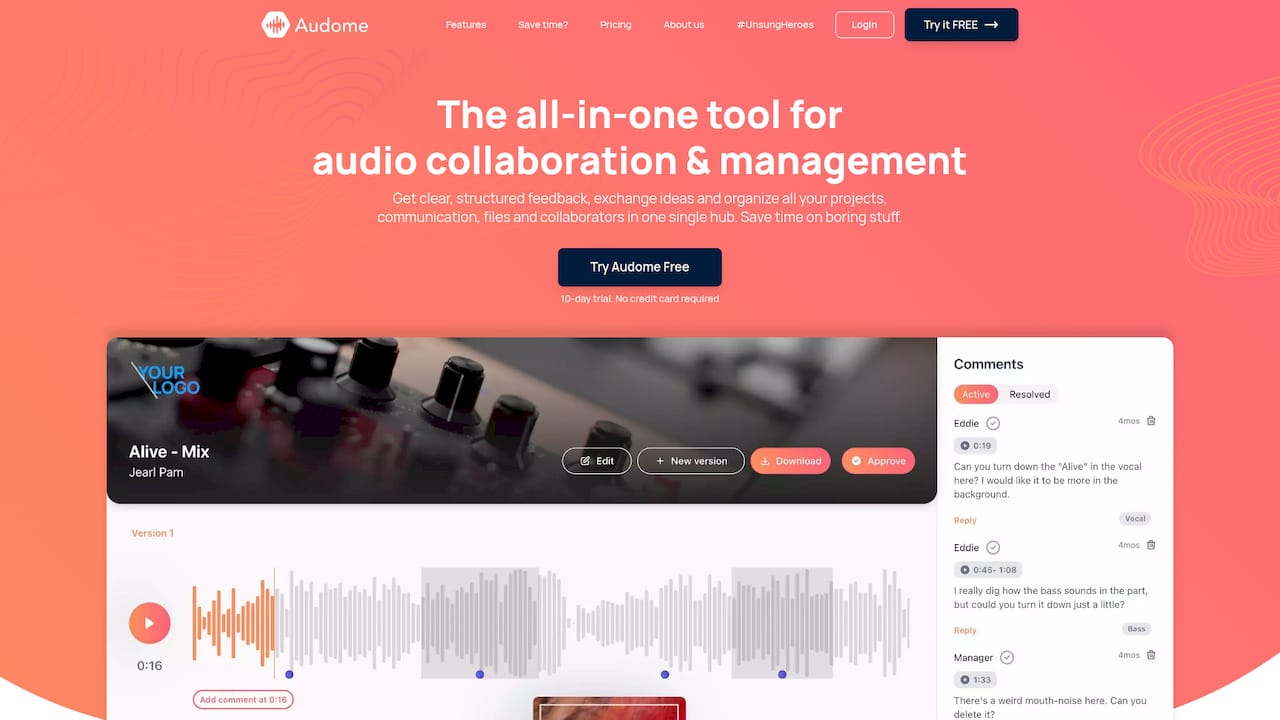
- Timestamped feedback directly on the waveform.
- Automatic version history, so nothing gets overwritten by accident.
- Password-protected project pages with download controls.
- Stripe Connect integration to gate final downloads behind payment.
- Revision limits with automatic billing for anything beyond the included count.
A typical workflow looks like this: create a project from a template, upload stems, collect timestamped feedback from the client, track revisions against the included limit, and require payment through Stripe Connect before the final file unlocks.
Author perspective: when unlimited projects becomes essential
In practice, fragmentation starts costing real money around three to five concurrent projects, the point where tracking feedback across apps eats into billable hours. If you are near that threshold, trial a platform with two or three active projects first and enforce one revision policy before migrating everything else.
— Kreg
Start a trial or view Audome pricing
If the checklist above sounds like what your studio is missing, we built Audome to cover it directly: unlimited projects, high-resolution support up to 96kHz/24-bit, timestamped feedback, and revision billing through Stripe Connect, all in one workspace instead of five.
- Studio plans start at $12.50 per month or $150 per year.
- Pro plans run $48 per month or $576 per year.
- Plans include unlimited projects and collaborators.
Compare the details on our pricing page or look through full feature specifics on the Audome product page before you commit.
FAQ
What does “unlimited projects” mean on a platform like Audome?
It means there is no cap on how many client workspaces you can create at once, each with its own files, feedback, and version history. On our pricing page, every Studio and Pro plan includes unlimited projects and collaborators by default.
How many concurrent projects should trigger a switch to a dedicated platform?
Around three to five concurrent projects is where most studios start feeling the drag of fragmented tools on billable time. Below that threshold, simpler setups can still work, but coordination costs rise quickly past it.
Can a collaboration platform handle 96kHz/24-bit master files?
A platform built for professional audio should support uploads up to 96kHz/24-bit without compressing or re-encoding the file. That resolution is supported across projects on the platform.
How do I stop clients from requesting unlimited free revisions?
Set a fixed number of included revisions per project, charge a flat fee for anything beyond that limit, and require written approval before unlocking the final file. Tracking this inside the same tool where feedback happens keeps the policy visible and enforceable.
What does Audome cost?
Our Studio plan costs $12.50 per month or $150 per year, and our Pro plan costs $48 per month or $576 per year. Full plan details are listed on our pricing page.
Sources
- More than 50% of office pros spend more time searching for files than on work
- Gen-IC Virtual Intercom: A deep dive into cloud-based real-time communications