
A client brief is a one-page alignment document that states the objective, deliverables, timeline, budget, success criteria, and decision owners. A simple, short brief built from core fields works better than a long one nobody reads. The checklist below is copy-ready: paste it into your next project and fill in the blanks, following detailed specs like those in FPV Drone Videography: Cinewhoops, Cameras & Workflow.
TL;DR:
- A clear, one-page brief should specify objective, deliverables, timeline, and signoff because these elements are essential for project alignment.
- Filling the brief with answers from discovery inputs prevents unnecessary drafting, and updating it regularly ensures ongoing accuracy.
- Exact file formats, revision limits, and signoff methods are critical details that prevent misunderstandings early in content delivery.
- Optional fields like budget and stakeholders can be left blank internally but are vital for client projects to avoid disputes.
- Using workflow tools like Audome enforces brief commitments through direct client feedback, revision limits, and automatic payment triggers.
Table of Contents
- Client brief template: the standard sections
- How to build the brief from discovery inputs
- Common mistakes and how to fix them
- When to update the brief
- Templates and examples you can copy or download
- A studio-ready brief example built on real workflow habits
- The value of short, living briefs
- Audome: a workflow tool that enforces what the brief promises
- FAQ
- Sources
Client brief template: the standard sections
A practical client brief fits on one page and answers nine questions. Each section needs only a sentence or two, not paragraphs.
- Project name: a short, searchable title for the work.
- Objective: the outcome the client will measure, phrased in their terms rather than yours.
- Audience: who the final deliverable is for and what they expect from it.
- Deliverables: the exact files, formats, and counts you will hand over.
- Timeline & milestones: key dates, including draft review and final delivery.
- Budget & payment: total cost, payment schedule, and what triggers each invoice.
- Success metrics / KPIs: how both sides will know the project worked.
- Stakeholders & responsibilities: who approves what, and who does the work.
- Acceptance & signoff: the specific action that marks the project as done.
Education-focused templates, like the sample client brief used in capstone courses, show why explicit sections matter: a description field, defined standards, and a built-in evaluation step keep a project from drifting. That structure works outside the classroom too, though professional briefs usually need tighter objectives and sharper success metrics than an academic template provides.
Two lengths cover most projects:
- One-page brief: condensed fields, one line each, built for small projects or repeat clients who already trust your process.
- Detailed brief: expanded prompts under each heading (sample questions, reference links, technical specs) for first-time clients or complex scopes.
Always fill in objective, deliverables, timeline, and signoff. Budget and stakeholder fields can stay optional for internal or very small jobs, but skipping them on client-facing work invites disputes later.
How to build the brief from discovery inputs
You already have most of the brief’s content before you sit down to write it. A client questionnaire maps to the audience and objective fields. Sales notes map to budget and scope. A signed contract maps to deliverables and timeline. The work is mapping, not drafting from scratch.
- Gather inputs: pull the questionnaire, sales call notes, and contract into one place.
- Paste answers into fields: match each answer to its matching brief section instead of summarizing from memory.
- Flag unknowns and assign owners: mark any blank field and name the person who needs to fill it before kickoff.
- Circulate for 24-hour signoff: send the draft to the client and internal lead with a short deadline so it doesn’t stall.
Keep the finished brief in your project workspace rather than an email thread, and record the date and the owner of the latest version.
Pro Tip: Copy the intake language from a structured project workflow directly into your discovery call notes so the brief writes itself afterward.
Common mistakes and how to fix them
Most briefs fail for one of four predictable reasons.
- Too long or unfocused: readers skim past a dense document. Fix it by using the one-page template and bolding the objective so it’s the first thing anyone sees.
- No signoff or owner: without a single decision maker, feedback loops never close. Fix it by naming one owner and writing explicit acceptance criteria.
- Vague deliverables: “a finished mix” means different things to different people. Fix it by listing exact file formats, counts, and specs, such as stems, a final mix, and sample rate for audio work.
- A static document nobody updates: a brief written once and forgotten drifts from reality fast. Fix it with a simple edit log and a visible “last updated” date.
When to update the brief
Update the brief when kickoff wraps, when scope changes, when a major milestone shifts, or when a contract gets amended. A minor change gets amended in place with a note in the edit log; a substantial scope change deserves a new brief rather than a patched one.

Publish the current version in the project workspace and tell stakeholders when a version changes, so nobody is working from an outdated copy.
Templates and examples you can copy or download
Paste this skeleton directly into a Google Doc or Word file and fill in each line:
Project name / Objective / Audience / Deliverables / Timeline / Budget / Success metrics / Stakeholders / Acceptance criteria.
For audio and creative projects, the deliverables section needs more precision than most templates include:
| Field | What to specify |
|---|---|
| File formats | WAV, MP3, stems |
| Sample rate | 44.1kHz, 48kHz |
| Deliverable type | Stems vs. final mix |
| Revision allowance | Number of included rounds |
| Acceptance step | Client approval method |
Freelancers typically fill every field themselves and get client signoff by email. Agencies usually split the work: account managers fill objective and budget, producers fill deliverables and timeline, and a single lead signs off on behalf of the team.
A studio-ready brief example built on real workflow habits
A compact audio brief might read: deliverables are a stereo mix and four stems at 48kHz, two revision rounds included, and signoff triggered by a client reply marked “approved.” Structured fields like these cut back-and-forth because nothing is left to interpretation, a pattern echoed in guidance on structured client workflows for audio pros and in notes on setting sane revision limits.

The value of short, living briefs
Teams that keep a brief short and actually update it tend to spend less time re-explaining scope mid-project. Harvard Business Review’s framing of customer-value-focused objectives captures why: an objective written in the client’s own measurable terms gives everyone one thing to check progress against. The clearest proof point to watch for is fewer revision rounds and a faster path to signoff.
— Kreg
Audome: a workflow tool that enforces what the brief promises
A brief states your deliverables, revision policy, and signoff step, but nothing stops a client from ignoring them once the files start flying over email and chat. That’s the gap we built a workflow tool to close: a workspace where the brief’s rules are built into the delivery process itself, not just written down and hoped for.
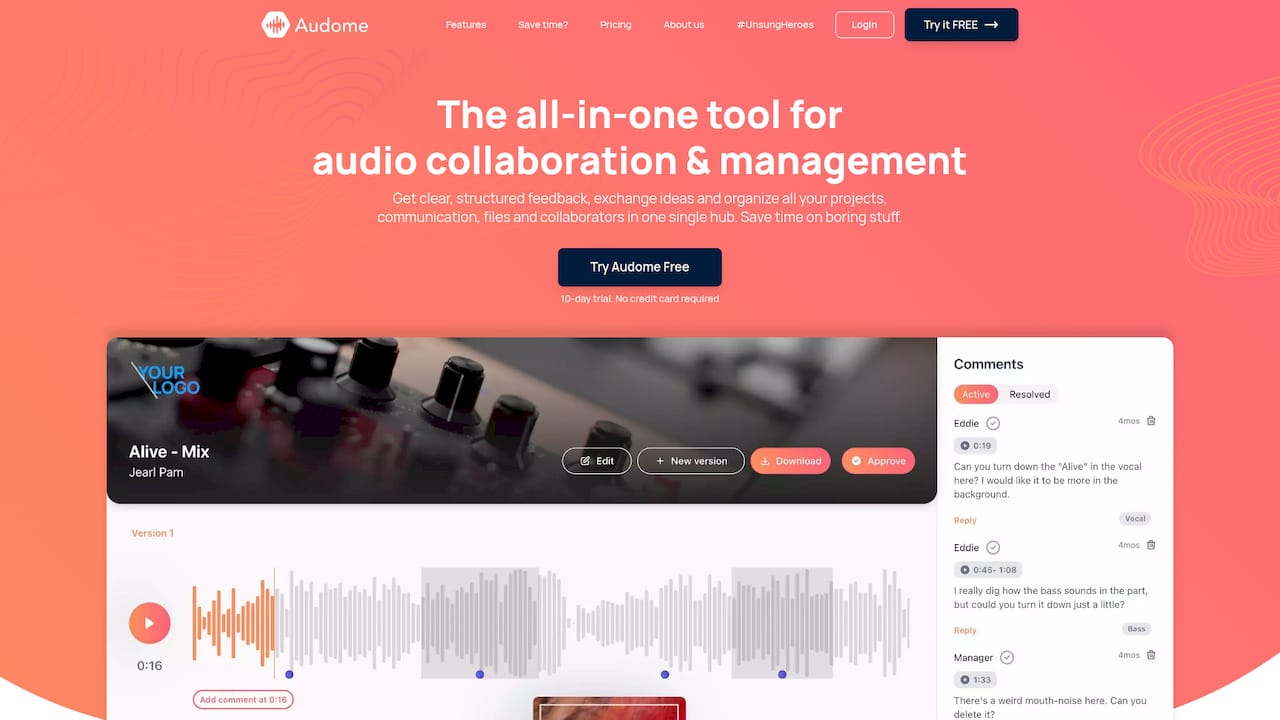
- Clients can give feedback directly on the waveform with timestamps, making notes precise and tied to moments in the track.
- No client login is required, creating a frictionless experience that a brief promises but email threads rarely deliver.
- Revision limits can be set to match brief specifications, with the option to bill additional rounds automatically through payment integration.
- Final downloads can be locked until payment clears, so acceptance and payment terms in the brief are enforced automatically rather than chased down.
If you want your brief’s deliverable specs and revision policy to hold up in practice, check Audome’s pricing and see which plan fits your studio.
FAQ
What is a client brief?
A client brief is a short document that states a project’s objective, deliverables, timeline, budget, and who signs off on completion. It exists to align the client and the team before work starts, cutting down on mid-project confusion.
What are the 5 parts of a design brief?
Definitions vary, but a common version covers the objective, target audience, deliverables, timeline, and budget. Many practical templates add a sixth or seventh field for success metrics and signoff to make the brief actionable rather than descriptive.
What is the format of a brief?
Most effective briefs fit on a single page, organized under clear headings like objective, deliverables, and timeline, with one or two lines under each. Longer “detailed brief” versions expand each heading with prompts or questions for complex projects.
What is a brief example?
A brief example might state an objective like “launch a podcast trailer that drives subscriptions,” list deliverables as an edited trailer in WAV and MP3, set a one-week timeline, and name the producer as the signoff owner. The OER Commons sample client brief offers a template structure you can adapt for non-academic projects.
How often should a client brief be updated?
Update a brief whenever kickoff finishes, scope changes, or a milestone shifts, recording the date and who made the change. A substantial change in scope is usually cleaner to handle with a new brief rather than editing the old one repeatedly.
Sources
- Sample Client Brief Template (for project and capstone courses)
- The value of keeping the right customers — HBR