
Stakeholder feedback management is the discipline of capturing input from every stakeholder group, reading it as it arrives, ranking it by frequency and severity, and telling people what changed as a result. The one habit that separates programs that work from ones that quietly fail: pick a single channel this week and start tracking responses by stakeholder group instead of lumping everyone into one pile. Audome and similar platforms exist precisely to make that tracking automatic rather than a spreadsheet chore.
TL;DR:
- Tracking feedback by stakeholder group reveals critical issues that departmental averages can hide, ensuring targeted action on pressing concerns.
- Mapping stakeholders by power, interest, and proximity helps determine who to engage regularly versus occasionally, optimizing resource allocation.
- Responding promptly to every comment, even with a decline, and closing the feedback loop maintains stakeholder trust and ongoing participation.
- Automated platforms like Audome streamline timestamped comments, version tracking, and owner assignment, reducing manual effort and increasing response efficiency.
- A weekly quick triage and a monthly in-depth review of themes prevent feedback backlog and ensure timely decision-making on stakeholder concerns.
Table of Contents
- What Is Stakeholder Feedback Management, and Why Does It Matter for Projects?
- How Do You Identify and Group Stakeholders for Tracking?
- What Are the Best Ways to Gather Feedback From Stakeholders?
- How Do You Analyze and Prioritize Stakeholder Feedback?
- How Do You Close the Loop With Stakeholders?
- How Do You Measure Whether Stakeholder Feedback Is Working?
- How Does a Feedback Platform Put This Playbook Into Practice?
- The One Habit That Actually Moves the Needle
- Manage Feedback Without the Spreadsheet Chaos
- Sources
- FAQ
What Is Stakeholder Feedback Management, and Why Does It Matter for Projects?
Ignored feedback does more damage than no feedback at all. Once stakeholders realize their comments vanish into a shared inbox with no reply, they stop bothering to respond, and unread input actively trains people to disengage rather than sit neutral. That erosion compounds. A project team that misses this pattern in month one often finds response rates cut in half by month six, not because stakeholders lost interest in the outcome, but because they lost faith the process was listening.
The upside runs the other direction. Teams that read comments as they come in catch scope misalignment and budget concerns while they’re still cheap to fix, not after a milestone review locks in the damage. Trust here isn’t a soft metric. HBS Online’s research on stakeholder engagement frames it as the mechanism that determines whether people share real concerns or just tell you what you want to hear.
Averages mislead precisely because they flatten this. A satisfaction score of 8 out of 10 across 40 stakeholders can hide a subcontractor group scoring the project a 3, and that group’s frustration might be the one thing that actually derails delivery.
- Unread feedback reduces future participation, not just current satisfaction.
- Group-level scores catch problems that pooled averages bury entirely.
- Early detection of misalignment is cheaper than late-stage correction.
- Trust, once damaged by silence, takes longer to rebuild than to maintain.
How Do You Identify and Group Stakeholders for Tracking?
You can’t manage feedback you haven’t organized. Before collecting anything, map who you’re hearing from and why their voice carries the weight it does.
- Plot stakeholders on power, interest, and proximity to the issue. A contractor directly affected by a schedule change matters more on that topic than an executive sponsor three levels removed, even if the sponsor has more formal authority.
- Decide which groups you’ll track persistently versus check in with occasionally. Not every stakeholder needs a standing feedback thread; some just need a single milestone check.
- Define the metadata fields you’ll capture with every response. At minimum: role, project phase, and channel used. Without this, you can’t split results by segment later.
- Assign an engagement level per group, inform, consult, or collaborate, and set expectations for what output each level produces. A group you merely inform shouldn’t be expected to generate the same depth of input as one you’re actively collaborating with.
- Prioritize inclusion deliberately. Removing barriers like translation gaps or inconvenient meeting times matters, because guidance on inclusive stakeholder engagement shows that skipped voices tend to be the ones with the most at stake.
Skipping this mapping step is why so many feedback programs end up drowning in comments they can’t sort by who actually said what.
What Are the Best Ways to Gather Feedback From Stakeholders?
No single method works for every stakeholder group, and forcing one, usually a long survey, onto everyone is how response rates collapse. Match the method to the moment.
In-context micro surveys work well right after a deliverable review, when the experience is fresh and the ask is small. Scheduled pulses, quarterly or at each project phase gate, catch drift that a single point-in-time survey would miss entirely. Interviews earn their cost with high-influence stakeholders where nuance matters more than scale. Workshops surface disagreements a survey would flatten into a neutral average. Open comment channels catch the concern nobody thought to ask about directly.
The design of each interaction matters as much as the channel. Pair one quantitative metric, a 1 to 5 rating, a yes or no, with one targeted open prompt asking why. Always capture the segment metadata from the mapping step, or the response becomes unusable data you can’t act on later.
- Keep every ask short enough to finish in under two minutes.
- Offer an anonymous option for sensitive topics like budget concerns or leadership friction.
- State plainly what you’ll do with the input before you ask for it.
- Use plain, direct wording; plain-language guidance consistently improves both response rates and answer quality.
Pro Tip: Ask one open question per interaction, not three. Stakeholders answer the first question thoughtfully and rush the rest, so a single well-placed prompt beats a crowded form every time.
How Do You Analyze and Prioritize Stakeholder Feedback?
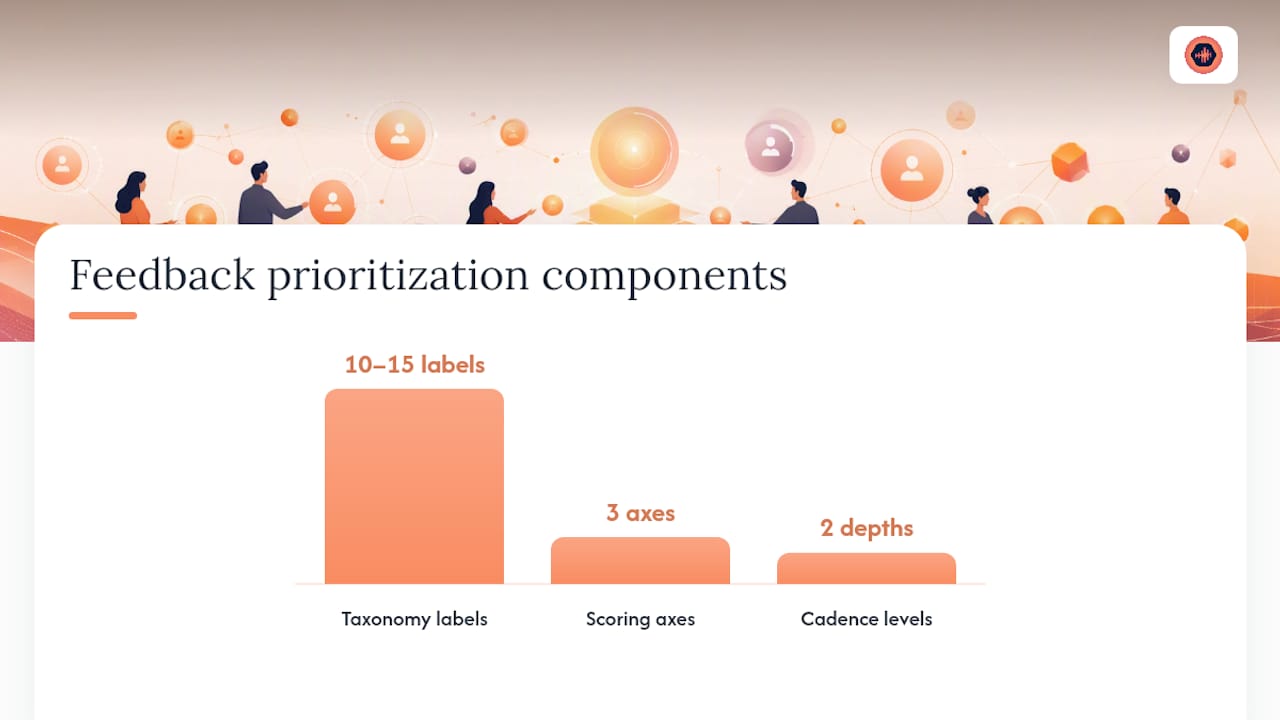
Collecting responses is the easy half. The value shows up when you consolidate everything into one place and code it against a shared taxonomy, something in the range of 10 to 15 labels with clear definitions, so “budget concern” means the same thing whether it came from a survey or a hallway conversation.
Once themes are coded, count distinct accounts, not messages. A stakeholder who raises the same concern three times in three emails is one voice, not three, and treating it otherwise skews your priorities toward whoever emails most often. Split those counts by stakeholder group before you score anything.
Score each theme on three axes: how often it appears, how severe the consequence is if ignored, and how much that stakeholder segment matters to the project’s success. A low-frequency complaint from a critical vendor can outrank a high-frequency complaint from a peripheral group.
- Consolidate every source, survey, interview notes, chat threads, into one working table.
- Code against a fixed taxonomy so themes stay comparable across time.
- Count accounts by segment, not raw message volume.
- Score frequency, severity, and segment value together, not in isolation.
Then make an explicit written call on each theme: fix it, explain why it won’t be fixed, or decline it outright. The highest-return cadence for this work pairs a light weekly triage pass to catch spikes with a deeper monthly or quarterly pass for actual ranking and decisions. Automated sentiment tools help you triage volume, but they can’t make the fix-or-decline call for you.
How Do You Close the Loop With Stakeholders?
Closing the loop means two separate communications, not one. The inner loop is a personal reply to the individual or group that raised a specific concern. The outer loop is a public summary shared with everyone, showing what changed, what didn’t, and why. Effective engagement plans treat both as mandatory, not optional follow-up.
- Set a timeline for each loop and hold it. Inner-loop replies within a week; outer-loop summaries on a fixed cadence, monthly works for most projects.
- Assign an owner to every raised concern, not just a category. A theme with no named owner is a theme that quietly dies.
- Track status alongside the theme: open, in progress, resolved, or declined with reason.
- Fold outstanding items into your regular planning cycle so they don’t live in a separate, forgotten tracker.
- Use short, consistent reply templates so responses go out fast instead of getting rewritten from scratch each time.
Treating feedback as a gift, even when the answer is no, matters more than most teams assume. Research on managing stakeholder feedback found that acknowledgment alone, independent of whether the request was granted, is what keeps participation from declining over time.
Pro Tip: Build a governance checklist that asks one question every week: “Is any raised concern sitting without an owner or a status update?” That single check catches most collect-and-forget failures before they calcify.
How Do You Measure Whether Stakeholder Feedback Is Working?
The metrics that actually prove a program works aren’t the ones most dashboards default to. Sentiment scores and satisfaction averages feel like progress but hide exactly the group-specific problems this whole approach exists to surface, since aggregated averages can mask an issue that’s existential for one segment while the overall number looks fine.
Track these instead:
- Share of themes addressed (fixed, explained, or declined with reason) versus left open
- Median time from raised concern to first reply
- Participation rate by stakeholder group, tracked over time, not just once
- Trust trend, combining a qualitative read with quantitative scores
| Report element | What it shows | Reporting cadence |
|---|---|---|
| Top 5 themes by stakeholder group | Where attention is concentrated and by whom | Monthly |
| Percent addressed per theme | Whether decisions are actually being made | Monthly |
| Representative quotes | Context numbers alone can’t convey | Monthly |
| Participation rate by group | Whether engagement is growing or eroding | Quarterly |
An executive one-pager built from this table beats a live dashboard nobody opens between meetings.
How Does a Feedback Platform Put This Playbook Into Practice?
Picture a real workflow: a mix engineer’s client leaves a timestamped comment at the 1:42 mark of a track, flagging the vocal as too loud. That comment attaches automatically to the project’s revision history, gets tagged by client account, and lands in a weekly triage pass alongside every other open note. The engineer replies inline, adjusts the mix, and the version history shows exactly what changed and when. A platform like Audome is built around exactly this loop, threaded feedback that reads by client rather than by scattered message, timestamped comments that remove ambiguity about what “too loud” even meant, and version tracking that shows the fix without a client re-explaining the request from scratch.
- Capture the comment with a timestamp and account metadata the moment it’s made.
- Code it into the weekly triage pass instead of letting it sit in a separate inbox.
- Assign an owner and a status before the week closes.
- Reply inline (inner loop) and note the resolution in version history (outer loop).
Revision limits play a governance role too: capping free rounds and charging for additional revisions pushes clients toward more decisive, higher-quality feedback instead of an endless trickle of small asks.
The One Habit That Actually Moves the Needle
Most of what gets written about stakeholder management is process theater, matrices and plans that look thorough on paper but never touch how a Tuesday actually goes. The single highest-return habit is simpler and less glamorous: read every comment the day it arrives, sorted by who sent it, and close the loop even when the answer is no.
Two rules I’d hold non-negotiable. Count distinct accounts, not messages, when you’re scoring how much a theme matters, since one persistent voice will otherwise drown out three quieter ones with a real problem. And always reply, because a stakeholder who hears “no, and here’s why” stays more engaged than one who hears nothing at all.
— Kreg
Manage Feedback Without the Spreadsheet Chaos
If you’re running this playbook manually across email threads, text messages, and shared drives, the tracking-by-group step is the first thing to slip. Audome is built to make that step automatic instead of aspirational: every comment lands timestamped on the waveform, threaded by client, so reading feedback by stakeholder group happens by default rather than by heroic effort at the end of the week.
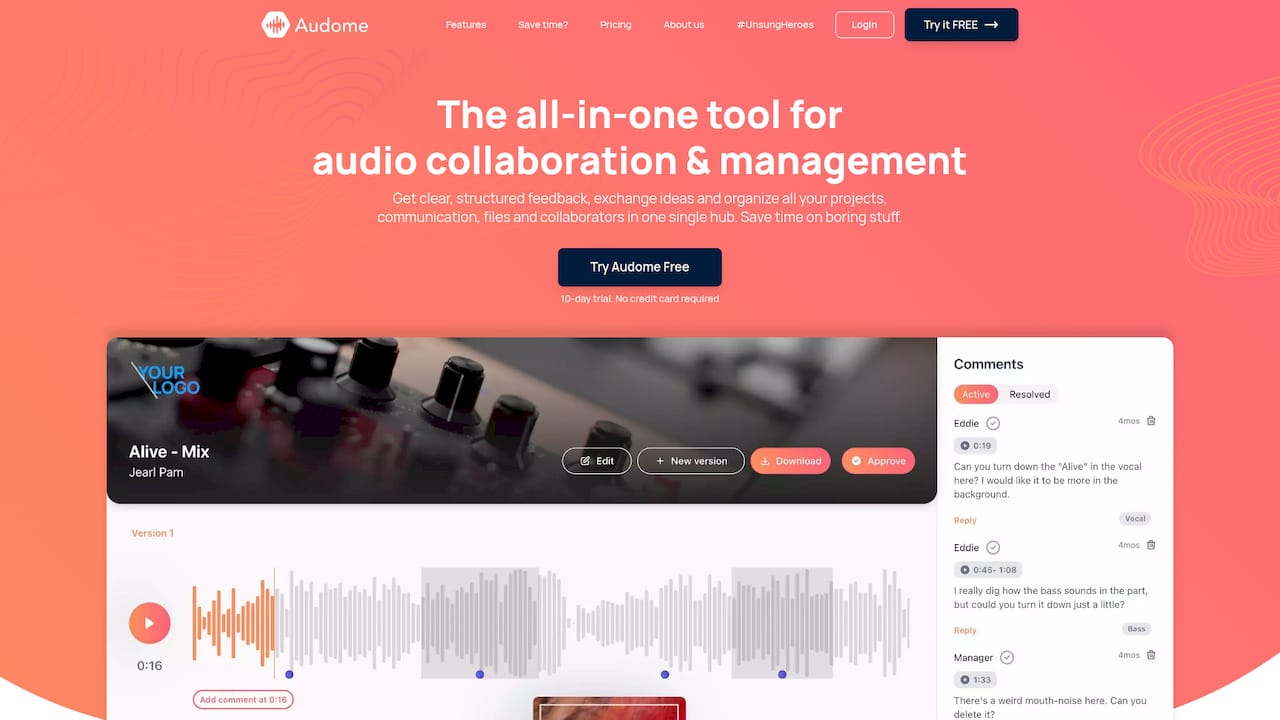
The feature mapping is direct. Threaded feedback replaces the “read by group” step from this guide. Timestamped comments replace the vague, hard-to-act-on note. Version history and paid revision limits replace the “reduce revision abuse” governance problem outright. If you’re a freelance engineer, studio owner, or post-production team currently chasing feedback across four different apps, this is the fit. Start with the Audome free trial, or read the feedback collection workflow breakdown to see the process end to end before you commit.
Sources
- How to build effective stakeholder management & engagement — HBS Online
- Customer feedback analysis: Methods, framework & examples (2026)
FAQ
What Are the 4 C’s of Stakeholder Management?
Definitions vary across sources, but a common version centers on communication, consultation, collaboration, and commitment, the idea being that engagement moves through increasing levels of stakeholder involvement rather than staying stuck at one-way updates.
How Do You Manage Stakeholder Feedback Effectively?
Capture input with clear segment metadata, read it by stakeholder group as it arrives rather than in a quarterly batch, score themes on frequency and severity, and close the loop by telling people what changed and what didn’t. Platforms like Audome handle the threading and timestamping automatically so the tracking step doesn’t depend on someone remembering to update a spreadsheet.
What Are the 4 Phases of Stakeholder Management?
Most frameworks describe identification, planning, engagement, and monitoring as the four phases, moving from mapping who matters to actively collecting and acting on their input over the life of a project.
How Often Should You Review Stakeholder Feedback?
Run a light triage pass weekly to catch spikes or urgent blockers, paired with a deeper monthly or quarterly pass for full theme ranking and decisions; this cadence keeps response times fast without demanding constant full analysis.
What’s the Biggest Mistake Teams Make With Stakeholder Feedback?
Collecting input without a plan to read and respond to it. Unread feedback trains stakeholders to stop participating, which is worse for a project than never having asked in the first place.