
Setting boundaries as a mixing engineer comes down to six non-negotiables: a written scope of deliverables, a defined revision limit, a deposit plus payment gate, a stated turnaround timeline, communication hours, and a named approver for all feedback. Get those six in place and most client problems disappear before they start.
Here’s what you can do in the next 24 hours:
- Send a contract before touching a single file. No contract, no session.
- Require a 50% deposit upfront and make it non-refundable.
- State your revision count in writing (two rounds is a common and enforceable standard).
- Announce your response hours in your onboarding email (e.g., Monday through Friday, 10 AM–6 PM).
- Request consolidated feedback — one document, one round, no trickle-in notes.
- Name a single approver on the client side before kickoff.
- Specify your file format requirements (stems labeled, 24-bit WAV, 48kHz minimum) before they send anything.
- Lock final delivery behind payment — no exceptions.
Pro Tip: On the first call, ask: “Who has final say on approvals?” If the client hesitates or names three people, you’ve just identified your biggest scope-creep risk before the project starts.
Key Takeaways
Setting professional boundaries as a mixing engineer requires written policies, enforced payment terms, and a workflow that makes those policies automatic rather than optional.
| Point | Details |
|---|---|
| Six non-negotiable boundaries | Scope, revision limit, deposit + payment gate, turnaround timeline, communication hours, and named approver. |
| Two revision rounds is standard | Define “round” as one consolidated set of notes; bill additional rounds at your hourly rate before starting them. |
| Deposit before work, payment before delivery | A 50% non-refundable deposit and a payment gate on final files eliminates the most common billing disputes. |
| Named approver prevents scope creep | Requiring one designated feedback contact stops committee-driven revision cycles before they start. |
| Audome automates enforcement | Platform features including payment gates, revision limits, and timestamped feedback replace manual policy enforcement. |
Table of Contents
- Why setting boundaries as a mixing engineer protects your income and sanity
- What goes in your contract, invoice, and revision policy
- Scripts and templates you can use today
- A simple onboarding workflow that makes boundaries automatic
- How to respond when clients push back or ignore your policies
- How workflow tools can enforce your boundaries automatically
- Why boundaries saved my career
- Audome makes these boundaries easier to enforce from day one
- Sources
- FAQ
Why setting boundaries as a mixing engineer protects your income and sanity
Every boundary a mixing engineer sets maps to a real failure mode when it’s absent. This isn’t about being difficult. It’s about running a sustainable business.
Scope and deliverables. Without a written list of exactly what you’re delivering (number of songs, stems or no stems, instrumental versions, format), clients assume everything is included. A clear scope clause listing songs, formats, and excluded services like editing, new production, or re-recording is the single most effective tool against scope creep.
Revision limits. Open-ended revisions are the fastest way to lose money on a project. Defining what a revision round means and requiring batched feedback protects both your time and your creative energy. Two included rounds with additional billing for extras is a structure that is commonly used and effective.
Payment terms. No deposit means the client has nothing at stake. You do. A deposit creates commitment on both sides. A payment gate on final delivery means you never hand over the finished mix and then chase an invoice.
Turnaround timelines. Clients without a stated deadline will assume you’re available to turn things around overnight. A written timeline sets expectations and gives you a legitimate reason to charge rush fees when they ask for faster delivery.
Communication windows. Setting professional availability and response windows signals professionalism and reduces the “always-on” dynamic that leads to burnout. Clients who text at midnight aren’t being malicious — they just don’t know you have hours unless you tell them.
File delivery standards. Receiving unlabeled, poorly organized sessions wastes your prep time and creates billing disputes when you charge for cleanup. State your requirements before they send anything.
Availability and personal limits. Professional boundaries govern the business relationship. Personal boundaries govern the human one. The two overlap when a client is also a friend — which is where most engineers get burned. Friendship doesn’t suspend payment terms. Write it down anyway.
Named approver. Requiring a named approver upfront prevents committee-driven scope creep and the conflicting notes that come from five people reviewing a mix independently. One person speaks for the project. That’s it.
These boundaries live in four places: your contract, your onboarding email, your project portal, and your invoice. Each one reinforces the others.
What goes in your contract, invoice, and revision policy
A contract doesn’t need to be 12 pages. It needs to cover the right things. Here’s the checklist:
- Scope and deliverables: Song count, formats, stems, instrumentals, and what’s explicitly excluded
- Revision definition: What counts as a revision round vs. a new request
- Included revision rounds: Number of free rounds (commonly two)
- Deposit amount: Percentage, non-refundability, and when it’s due
- Payment schedule: When each payment is triggered (deposit, mid-project, final delivery)
- Approval window: How long the client has to respond before the mix is considered approved
- File format and labeling requirements: Bit depth, sample rate, naming conventions
- Turnaround estimate: Business days from receipt of approved files and deposit
- Rush fee: Rate and minimum notice required
- Kill fee / cancellation: What percentage is owed if the client cancels mid-project
- Ownership and credit: Who owns the final mix, and whether you can use it for portfolio
- Confidentiality: Whether the project is embargoed until release
Copy-ready clause examples
Revision policy:
Deposit and payment gate:
Approval deadline:
Rush fee:
Kill fee:
File format requirement:
For invoices, add a line like: “Payment due within [X] days of invoice date. A 1.5% monthly late fee applies to balances unpaid after 30 days.” Tie invoice triggers to revision rounds, not just final approval — treating a revision round as a deliverable and invoicing after rounds rather than after final approval avoids the approval-delay trap.
On the named approver: include a line in your contract that reads, “All feedback must be submitted by [Name], the designated project approver. Notes from other parties will not be incorporated without written authorization from the approver.”
Scripts and templates you can use today
Onboarding email template
Subject: [Project Name] — Next Steps and Project Details
Hi [Client Name],
Excited to work on this. Here’s what we need to get started:
Deliverables: [List exactly what you’re mixing — e.g., 3 songs, stereo mix + instrumental for each]
Timeline: I’ll deliver the first mix within [X] business days of receiving your files and deposit.
Deposit: Please pay the 50% deposit at [payment link] to confirm your booking.
Revisions: Two rounds of revisions are included. Additional rounds are billed at $[X]/hour.
Files: Please send 24-bit WAV stems, labeled [Artist][Song][Instrument], to [upload link].
Approver: Please confirm who will be submitting feedback for this project.
Response window: I’m available Monday through Friday, 10 AM–6 PM [timezone]. I’ll respond to messages within one business day.Once the deposit is received and files are uploaded, we’re off.
[Your name]
Revision request reply (when a client sends trickle-in notes)
When a requested change is out of scope
Polite “we need to stop” script
One-liners for micro-boundary moments
For late-night texts: “Got this — I’ll pick it up tomorrow morning during work hours.”
For “just one tiny change” after revisions are exhausted: “We’re past the included rounds, so this would be billed at $[X]. Want me to send a quick invoice for that?”
For free stems requests: “Stems aren’t included in this package. I can add them for $[X] if you need them.”
A simple onboarding workflow that makes boundaries automatic
Boundaries only work if they’re built into your process, not bolted on after a problem appears. Here’s a repeatable intake flow:
- Screening call or questionnaire. Ask: budget, timeline, who approves, how many songs, any hard deadlines, and whether they’ve worked with a mixing engineer before. Listen for red flags (see Section 6).
- Send proposal. Include scope, deliverables, revision count, timeline, and pricing. Give a response deadline.
- Send contract. Use the clause examples above. Require a signature before any files are shared.
- Collect deposit. Do not begin work until the deposit clears. This is non-negotiable.
- Collect files. Share your file spec sheet. Only accept files that meet your format requirements. If they don’t, quote a prep fee before touching them.
- Confirm approver. Get the name in writing before the first mix goes out.
- Set milestone dates. First mix delivery date, revision round deadlines, and final delivery date. Put them in the contract or a follow-up email.
- Open project in your collaboration tool. Upload the session, set revision limits, and enable the payment gate for final delivery.
Your onboarding form should collect: full name, billing contact, approver name, delivery format preference, any hard release deadlines, permission to use the work in your portfolio, and how they found you.
The rule is simple: don’t start until the deposit is posted, and don’t release final files until the balance is paid. For a deeper look at how audio project management structures these workflows, the principles apply directly here.
How to respond when clients push back or ignore your policies
Some clients test limits. Here’s how to read the signs early and respond without burning the relationship.
Red flags to watch for
- Immediate discount negotiation before you’ve even discussed the project
- Refusal to name a single approver (“everyone on the team will weigh in”)
- Repeated scope changes without acknowledging extra cost
- Late approvals that push your schedule without apology
- Disrespectful tone in early communications
The most reliable early warning sign is how a client talks about money in the first conversation — immediate discount demands or offers to pay after delivery are predictors of trouble, not one-time asks.
Escalation steps
- Pause work. Don’t keep mixing while a dispute is unresolved.
- Request consolidated feedback in writing before continuing.
- Restate scope and charges calmly: “Here’s what we agreed on, and here’s what this new request would cost.”
- Offer a buyout or extra-round quote. Give them a clear path forward with a number attached.
- Finalize the invoice for work completed and stop new work if the client won’t engage.
Sample phrases by stage
Clarifying question: “Before I continue, can you send me all your notes in one message so I can address everything at once?”
Boundary restatement: “We’ve used both included revision rounds. Any additional changes are billed at $[X]/hour — want me to send a quote?”
Cost quote: “Adding that element would take approximately [X] hours at my rate of $[X]/hour. I can invoice that separately if you’d like to proceed.”
Termination message: “I’m going to close out this project at the current stage. Here’s your final invoice for work completed. I wish you the best with the release.”
Working with friends
Written agreements aren’t a sign of distrust — they’re a sign of respect. Keep creative feedback conversations separate from payment conversations. When a friend asks for a discount, you can say: “I keep my rates consistent for everyone — it’s how I stay in business. I’d love to work with you at my standard rate.” That’s not cold. That’s professional.
How workflow tools can enforce your boundaries automatically
The gap between a policy written in a contract and a policy actually enforced is where most disputes live. The right collaboration platform closes that gap.
Here’s what the relevant tooling does:
- Password-protected project pages keep files private and prevent unauthorized access or downloads
- Download controls mean clients can’t pull final files until you release them
- Version management tracks every mix iteration so there’s never a dispute about which file is current
- Timestamped waveform feedback replaces scattered email notes with precise, time-coded comments directly on the audio
- Automated revision limits enforce your policy without an awkward conversation — the platform simply stops accepting new rounds when the limit is reached
- Payment gates via Stripe require payment before the final download unlocks
- No client account required removes friction from the client side while keeping your controls intact
A concrete workflow using Audome looks like this: you onboard the client, upload the first mix to a password-protected project portal, and set two included revision rounds in the platform. The client leaves timestamped feedback directly on the waveform. After round two, the platform flags any additional requests as billable. When the project is approved, the final download is locked behind a Stripe payment. The client pays. The file releases. No chasing invoices, no “I thought that was included” conversations.
Centralizing your project communication this way also creates a paper trail — every note, every version, every approval is logged in one place, which matters if a dispute ever escalates.
Pro Tip: Pair your contract clause (“final files released only after payment in full”) with your platform’s payment gate. The contract sets the expectation; the platform enforces it automatically. Neither one alone is as strong as both together.
Studio etiquette guidance has long recommended organized, emailed mix notes and a single feedback contact. A platform with timestamped waveform feedback makes that the default, not a request you have to repeat every project.
Why boundaries saved my career
Early in my career, I mixed a full EP for a band with no contract, no deposit, and no revision limit. Six rounds of notes later, I delivered a mix I was embarrassed by — not because the work was bad, but because I’d chased their moving target until the life was gone from the record. They paid half. I never worked with them again.
The turning point wasn’t learning a new mixing technique. It was sending a contract. One policy, one week, and the next project ran cleanly from kickoff to delivery.
If you’re starting from zero, pick one boundary to implement this week: your revision policy. Write two sentences defining what a round is and what it costs to add one. Send it to your next client before you start. Watch how the project changes.
The metric to track isn’t time saved per project (though you will save time). It’s unpaid revision rounds avoided. One avoided round per month at your hourly rate adds up faster than any rate increase.
Audome makes these boundaries easier to enforce from day one
Chasing clients for feedback, manually tracking revision rounds, and sending “please pay before I send the file” emails are all problems that disappear when your workflow is built around the right tool.
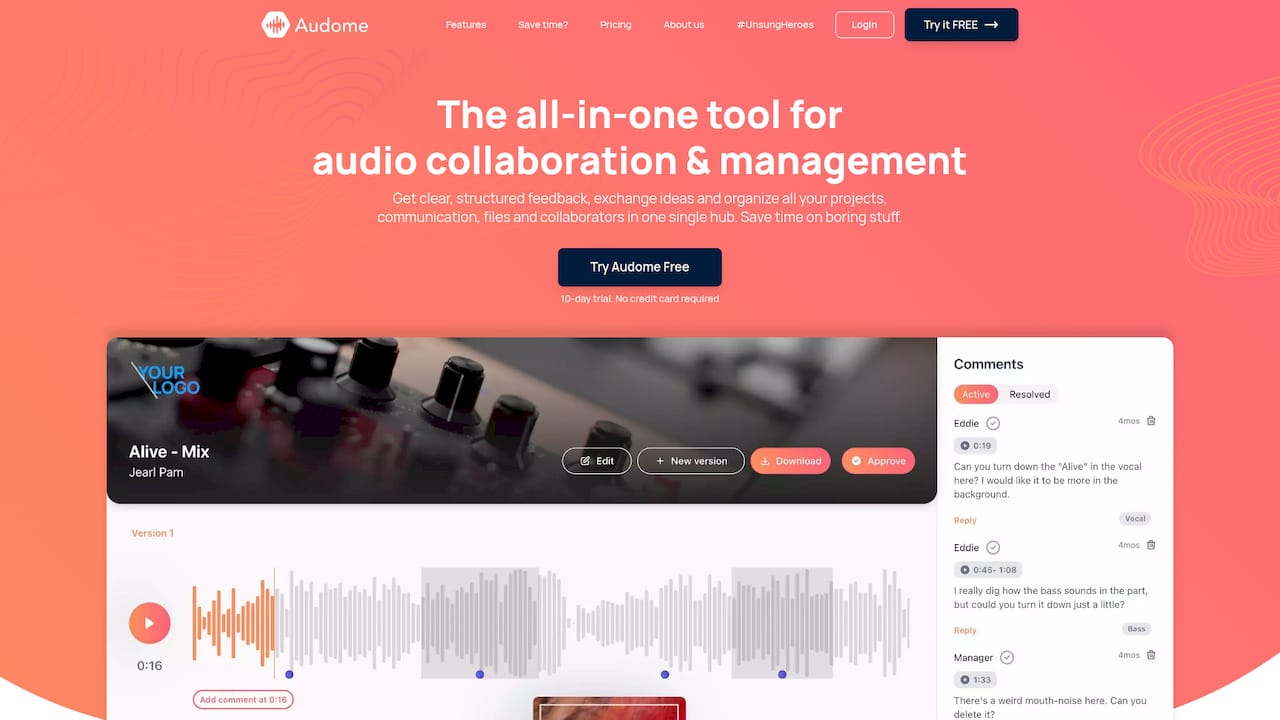
Audome maps directly to every policy in this guide. Project portals keep files organized and access-controlled. Timestamped waveform feedback replaces scattered DMs and email threads. Automated revision limits enforce your policy without a single awkward message. Stripe-powered payment gates lock final downloads until the invoice is cleared. Clients don’t need to create an account, so there’s no friction on their end and no excuses on yours.
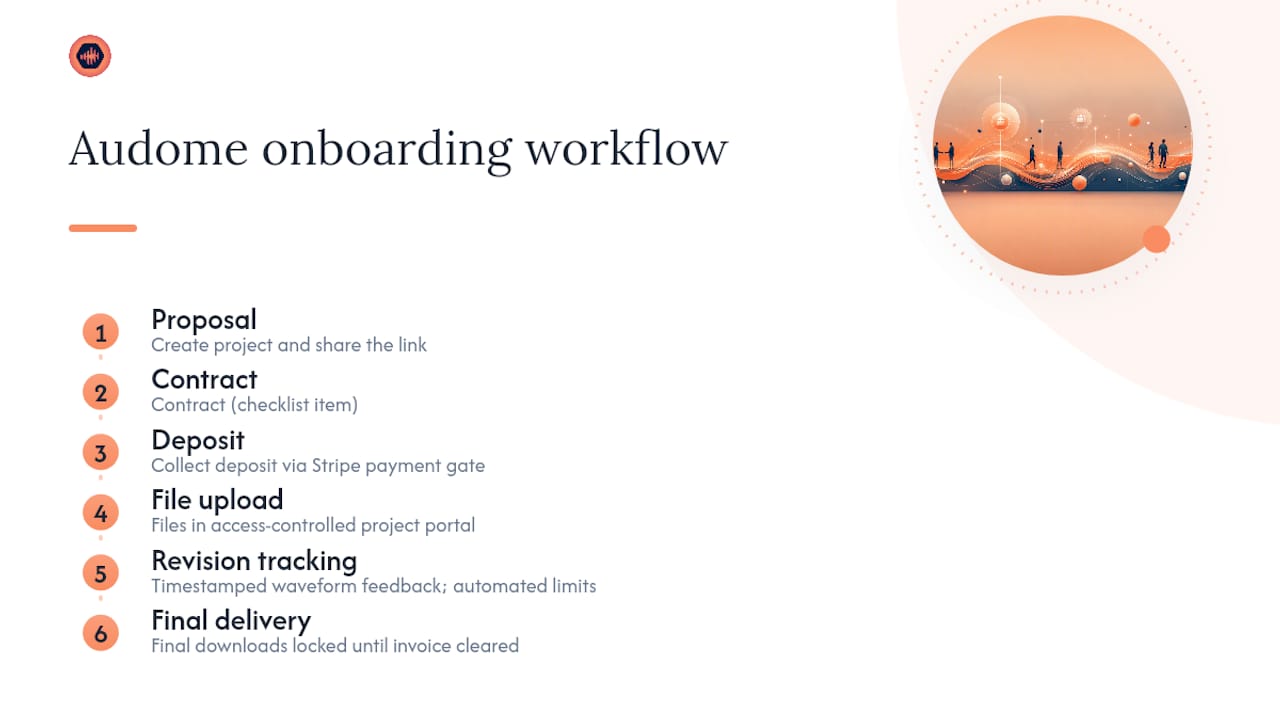
Setup takes minutes. You create a project, set your revision limit, enable the payment gate, and share the link. Your onboarding checklist from this guide maps directly to Audome’s workflow: proposal, contract, deposit, file upload, revision tracking, final delivery. Every step is in one place.
Start your free trial at Audome and run your next project with every boundary in this guide built into the platform from the first upload.
Sources
- Mix Engineer Contract Mistakes That Secretly Cost You Money
- How To Set Client Boundaries Without Losing The Gig | Audio Production: News, Tutorials & Reviews
- Studio Etiquette: Everything Your Engineer Wants You To Know But Is Afraid To Say
FAQ
How do you set boundaries with a client who is also a friend?
Use a written agreement regardless of the relationship — it protects the friendship, not just the business. Keep creative feedback conversations separate from payment conversations, and apply your standard rates consistently.
Is being a mixing engineer hard to sustain as a career?
The craft itself has a steep learning curve, but the bigger challenge is the business side: managing client expectations, protecting your time, and billing properly. Engineers who set clear policies from the start tend to sustain their careers longer than those who rely on goodwill alone.
What is the 1 dB rule in mixing?
The 1 dB rule is a mixing heuristic suggesting that small, incremental gain adjustments (around 1 dB) are more musical and controlled than large moves. It’s a useful technical discipline, but it doesn’t replace a clear revision policy — clients don’t care about your gain staging when they want a different vibe on the chorus.
Are mixing engineers in demand in 2026?
Demand for mixing engineers remains steady, and salary ranges vary widely depending on market, specialization, and business practices. Engineers who run their studios professionally — with contracts, deposits, and defined revision policies — tend to command higher rates and more consistent bookings.
How many revision rounds should a mixing engineer include?
Two rounds is the most common and enforceable standard. Define each round as one consolidated set of notes, and bill additional rounds at your hourly rate before starting them.