
A music supervisor approval is two separate yeses: the creative team likes how the track plays against picture, and every rights holder has agreed in writing to the use. If you mix, master, or deliver audio into that process, your job is to make both yeses easy: the right file, clear metadata, feedback tied to exact moments, and a version history nobody has to argue about. We built Audome for that kind of round, with lossless sharing up to 96kHz/24-bit, time-stamped comments on the waveform, and automatic version tracking in one place.
TL;DR
- A supervisor oversees the music for a project, but creative approval usually sits with the director, producer, or brand, and legal approval sits with the rights holders.
- A playlist, a quote, and a clearance are three different things. Nothing is approved until a written license exists.
- Send supervisors a clean package: a quick-listen preview, a 24-bit WAV, stems on request, and rights details in the metadata.
- Keep every approval round on one timeline: time-stamped notes, numbered versions, and a locked final file.
- Audome handles the file side of that routine: lossless uploads, waveform comments, version tracking, and branded no-login client portals.
Table of Contents
- What a music supervisor actually approves
- Creative approval is not clearance
- Who has the final say
- What to send a supervisor
- Running an approval round, step by step
- After approval: delivery and paperwork
- Audome for approval rounds
- Our view
- FAQ
- Sources
What a music supervisor actually approves
The Guild of Music Supervisors describes the supervisor as the professional who oversees music for film, television, advertising, games, and other visual media, working with the creative team to set the musical vision, tone, and style. Their responsibilities include securing music talent, liaising with labels and legal teams, advising on music budgets, and managing sync and master use clearances, credits, and cue sheets on schedule.
ASMAC adds that the supervisor selects and licenses pre-existing music, negotiates the licenses with labels and publishers, and coordinates between the creative team and the rights side.
For you as an engineer or producer, that means a supervisor can be three different counterparts depending on the day: a creative collaborator reacting to your mix, a gatekeeper asking whether a stem or alternate version exists, and an administrator who needs exact versions for cue sheets and delivery. Knowing which hat they are wearing tells you what to send.
Song choice itself is a team effort. In Vice’s 2022 interviews, supervisors describe showrunners, writers, and directors choosing music and even writing it into scripts, with some scenes relying entirely on the supervisor. One of them put the whole job as everything music-related, from creative to clearance.

Creative approval is not clearance
This is where most delays start. A scene can play beautifully with a track and still be unusable.
In the U.S., using an existing song in an audiovisual work takes two licenses: a synchronization license for the composition and a master use license for the recording. The U.S. Copyright Office’s Musicians Copyright Guide explains both are voluntary, with no compulsory license available. That means each rights holder can say no.

A Georgia law review article by John P. Strohm notes that producers must negotiate with rights holders directly and separately, typically seeking worldwide, perpetual grants covering all media. The same article describes a festival license, where term and territory are limited to what a festival run needs, so a small-budget film does not pay for perpetual rights up front.
Practically, Sunset Music points out that a song with five writers and a major label behind the recording needs agreement from every one of them, and a single refusal means the scene needs a new track within a day or two. Wrapbook’s guide says the same thing in plain terms: approval from all listed parties is required, and one no kills the use.
What does this mean for your files? Expect that a track you delivered and everyone loved can be swapped. When that happens, Berklee Online lists the usual routes: a soundalike rerecording, a live-band rerecording, an equally popular replacement, a new licensable song, or cutting the scene. Several of those land on an engineer’s desk as a fast mix or a revised cut, so a clean record of what was approved and when is worth having.
Who has the final say
There are really four layers of approval:
- The supervisor shortlists and tests options against the edit.
- The creative decision-maker, usually the director, producer, or brand, approves the choice.
- The rights holders approve the use, the fee, and the terms.
- The producer or an authorized company representative signs the license and locks the track.
That Pitch’s guide describes this same sequence: options sourced and tested, creative approval from the director, producer, or brand, clearance confirming the track can be licensed on time and on budget, then the license signed and the track locked.
The supervisor is not automatically the rights owner. Open Music Business notes that final authority comes from the rights owners or their authorized representatives and the written terms, and that a creatively approved track that is not fully cleared is not ready for release. An entertainment-law guide goes further: most productions should reserve final approval of fees, rights grants, and executed licenses to the producer or an authorized representative.
For you, the lesson is simple. When a supervisor says “approved,” ask yourself which layer said it. A verbal thumbs-up on a mix is a creative note. Treat the file as final only when the person with authority has signed off on that specific version.
What to send a supervisor
If you are delivering music, stems, or alternates to a supervisor, the package matters as much as the mix. Guidance from sync-focused sources is consistent on the basics:
- A preview and a master. UniteSync recommends a 192 to 320 kbps preview MP3, a preferred 44.1 kHz/24-bit WAV, a 30-second TV edit, an instrumental, and optional stems sent on request or by download link.
- Embedded metadata. SyncPlacement’s 2026 guide lists title, artist, ISRC, BPM, and key, plus every writer with split percentage, PRO affiliation, IPI number, the publisher, and an explicit one-stop note where it applies.
- Rights information up front. Supe Troop’s submission guidelines ask for composer names, ownership splits, the clearing company with percentage controlled, and licensing contact details in the comments field.
- A tidy file structure. The same guidelines favor a single labeled folder rather than loose attachments, and send only MP3s unless the supervisor asks for uncompressed WAV or AIFF.
- Brief-ready language. Lyric Assistant’s walkthrough says a typical brief names the project type, scene timing, mood, tempo, references, rights requested, budget band, and deliverable format such as a 24-bit 44.1 kHz WAV with stems.
Two habits save the most time. First, name files so a stranger can tell version and content at a glance. Second, never pitch or deliver something whose status you cannot explain: if a sample, an interpolation, or an uninformed co-writer is in the mix, say so before the supervisor finds out.
Supervisors also move quickly. Clearly Music reports that a single song can involve five, ten, or more entities, multiplied across 30 to 50 songs in a film. A package that answers questions before they are asked keeps your file out of the pile of things someone has to chase.
Running an approval round, step by step
Here is the routine for the part you control: getting your audio reviewed and approved. At each step, we note where it usually breaks and what Audome does about it.
1. Share the right file, not a lookalike
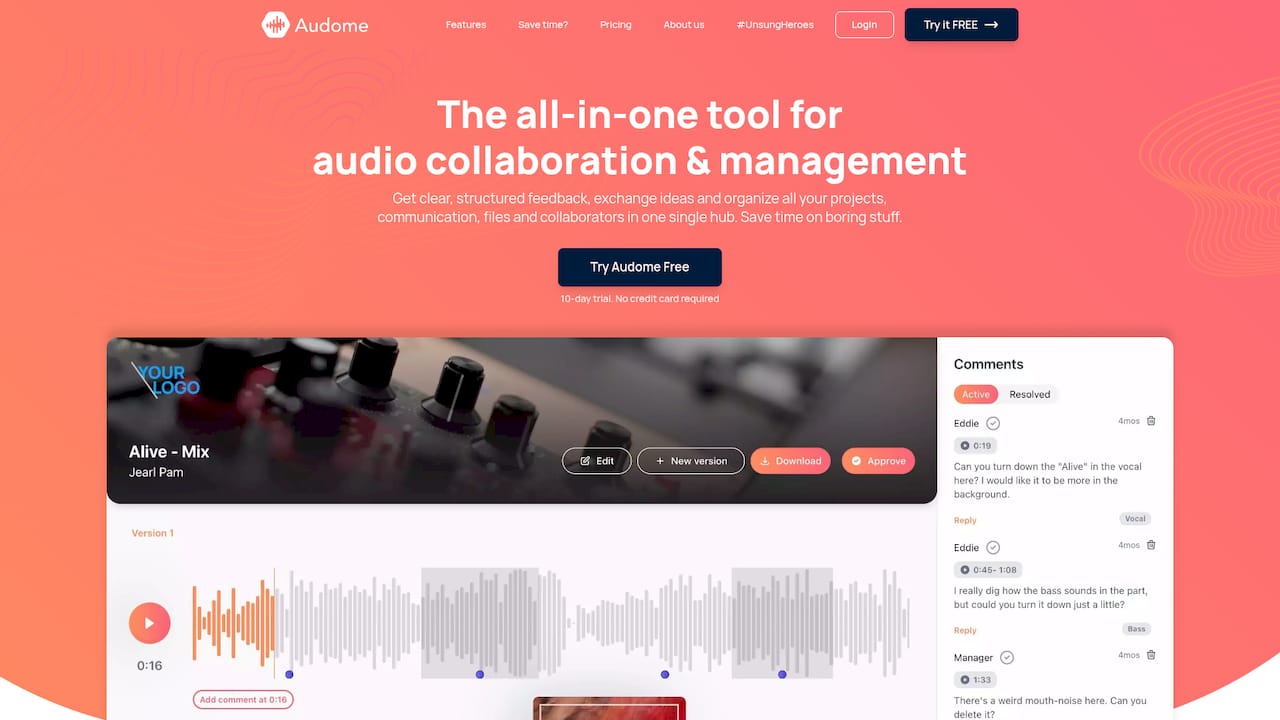
Supervisors and editors audition against picture, so they hear what you send, not what you meant. If the file is compressed or the wrong revision, notes will be about artifacts instead of the mix. Audome shares audio losslessly, up to 96kHz/24-bit, with unlimited uploads, so the version your client hears is the one you exported.
2. Give feedback a place to live
Email threads with “around the second chorus” notes are where approvals stall. Ask reviewers to comment at the exact moment they mean. In Audome, collaborators leave time-stamped comments on the waveform, so a note about a vocal ride at one minute twelve points at one minute twelve. Clients do not need an account to do it, which removes the first excuse for a late reply.
3. Keep versions numbered and traceable
When a supervisor says “go back to the earlier one,” you need to know which one. Audome tracks versions automatically, so every revision sits in the same project in order. That is the record you want when someone asks later what was approved.
4. Set the number of rounds before you start
Unlimited rounds without agreement drain a project. Audome supports revision limits and billing for paid revisions, with Stripe-based payment integration, so extra rounds are a stated part of the deal rather than an awkward conversation. For a closer look at the process, see our mix approval process guide.
5. Check before you ask for sign-off
Send for approval only what you would stand behind. Our checklists for mixes and for mastering cover what to verify before the client commits. If you are working on a self-review of the mix itself, a mix notes template helps you capture how each choice serves the scene or character you are supporting.
6. Lock the final and control the download
Once approval is given, the approved version should be the one that leaves your hands. Audome offers download controls and password-protected, branded client portals, and you can read how studios lock final files until payment in our studio approval process and approval before download guides.
After approval: delivery and paperwork
Approval does not end the work. The entertainment-law guide recommends deliverables that include a current music log, rights-holder contacts, signed licenses, payment status, restrictions, and a final report matching the locked picture. It also recommends a defined response time, since late approvals can make a clearance deadline impossible.
Rights owners may also attach conditions. Open Music Business says they can have requirements about the scene, brand context, edits, lyrics, or association with a message, and that approvals should be written and should state whether they cover a specific cut or the final delivered version. The splitsheetstudio pitch-package guide makes a related point: edit access does not by itself authorize every adaptation, so know who may approve lyric changes, cutdowns, or alternate versions.
That is why a closing summary of what was delivered, in which version, under which terms, belongs in your workflow. Our project recap summary post shows a copy-ready format, and the file retention policy guide covers what happens to files after the job ends.
Audome for approval rounds
If your work passes through supervisors, editors, and producers, Audome keeps the file side in one hub: unlimited lossless uploads, waveform comments, automatic version tracking, branded client portals, and revision billing. Studio is $12.50 per month or $150 per year. Pro is $48 per month or $576 per year. The subscription follows a free trial. See the plans on the Audome pricing page or start from audome.com.
Our view
We see approvals as a record problem more than a taste problem. Taste is the supervisor’s and the director’s call. What an audio professional controls is whether everyone is listening to the same file, whether every note is attached to a moment, and whether anyone can later see which version got the yes.
That is why Audome puts lossless audio, time-stamped comments, and automatic version tracking in one place. Clients can review without logging in, you can brand the portal so it looks like your studio, and revision limits with paid revisions keep the scope honest.
A music supervisor’s world runs on written approvals and clear authority. A workflow that mirrors that, with one source of truth for every version, makes you the easiest person on the project to work with.
Kreg
FAQ
Who approves music in a film or TV show?
The supervisor selects and tests options, but creative approval usually comes from the director, producer, or brand. The rights holders then approve the license, and the producer or an authorized representative signs it. Treat a track as approved only when all of those pieces are in place.
What is the difference between a sync license and a master use license?
A sync license covers the underlying composition and comes from the publisher. A master use license covers the specific recording and comes from the label or owner. The U.S. Copyright Office’s guide says both are voluntary, so each must be negotiated.
What files should I send a music supervisor?
Send a quick-listen MP3 preview, a 24-bit WAV of the full mix, an instrumental, and stems if requested. Include metadata with writer splits, PRO details, and a licensing contact. Share via a single download link instead of email attachments.
Can a supervisor sign off on a mix and a license at the same time?
Not automatically. Open Music Business notes that a supervisor does not automatically have authority to grant licenses, and that final authority comes from the rights owners and the written terms. A creative yes on your mix is separate from legal clearance of the music in it.
How do I keep approval rounds from dragging on?
Agree on the number of rounds first, collect notes at exact timestamps, and number every version. With Audome, revision limits and time-stamped comments are built into the project, so each round has a clear start and finish.
Sources
- What Is a Music Supervisor, Guild of Music Supervisors
- What We Do: Understanding Music Production Roles, ASMAC
- How Do Songs Get Picked for TV?, Vice
- Musicians Copyright Guide, U.S. Copyright Office
- Clearing the Way: Acquiring Rights and Approvals for Music, Georgia Law Review
- How Music Supervision Really Works, Sunset Music
- How to Get Music Rights for Film, Wrapbook
- Music Supervision: What Does a Music Supervisor Do?, Berklee Online
- What Music Supervisors Do in Sync Licensing, That Pitch
- Sync Licensing Deep Dive, Open Music Business
- Music Supervisor Agreements: Film Clearance Guide
- How to Get a Sync License, UniteSync
- How to Make Your Music Sync-Ready, SyncPlacement
- Music Submission Guidelines, Supe Troop
- Sync Licensing: From Metadata to Briefs, Lyric Assistant
- What A Music Supervisor Actually Does, Clearly Music
- Music Supervisor Pitch Package for Sync Submissions
- Mix Notes Template: Session Notes and a Self-Review Checklist