
Adopt a clear studio file retention policy that defines retention windows, who pays for long-term storage or retrieval, and exactly which file formats you archive. A workable default keeps working session files for a few months, delivered masters for up to a couple of years, and offers long-term archival storage as a paid add-on with retrieval fees after that window. Clients remain responsible for their own long-term backups. Tools like Audome can automate delivery, versioning, and paid retrievals so the policy enforces itself.
TL;DR:
- Keep working sessions for a few months and delivered masters for up to a couple of years; charge separately for longer storage and retrieval.
- Tie retention deadlines to final approval, full payment, or a stated acceptance window, so client silence after the deadline closes long running approval disputes.
- Archive continuous, flattened Broadcast Wave files at their original sample rate and bit depth, with a manifest, checksums, and two secondary backups.
- Use a flat fee for routine retrievals, but bill hourly when staff must reconstruct mixes from stems or reprocess them with updated plugins.
Table of Contents
- Studio file retention policy template: fields, triggers, and suggested durations
- Technical archive practices: formats, packaging, fixity, and migration
- Contract and billing rules that prevent becoming an unpaid archive
- Operational workflow and SOP checklist for closing projects and archives
- Treating storage as a managed, billable studio service
- Mapping the policy to Audome: automate versioning, pay-for-retrieval, and secure delivery
- FAQ
- Sources
Studio file retention policy template: fields, triggers, and suggested durations
A usable policy needs defined scope before it needs numbers. Spell out exactly what counts as a project file so nobody argues later about what you were obligated to keep.
- Session files and project sessions: DAW project files, routing, automation, and plugin states.
- Stems and multitracks: individual track exports, usually flattened and dated.
- Mixes and masters: pre-master mixes, final masters, and any alternate versions (radio edit, instrumental, clean version).
- Presets and plugin chains: custom chains or patches tied to a specific project sound.
- Project documentation: client notes, revision logs, and sign-off records.
Once scope is set, attach durations that you can actually sustain on your storage budget. These are starting points to customize, not fixed industry rules:
- Working files: retained a few months after final delivery, then purged unless the client has paid for extended storage.
- Delivered masters: retained up to a couple of years in your primary archive, since clients most often request these again.
- Long-term archive: available indefinitely as a paid tier, moved to lower-cost storage such as object storage or LTO tape.
- Unpaid or abandoned projects: retained a short grace period after an unpaid invoice before deletion.
The retention clock needs a clear trigger, not a vague “after the project ends.” Tie it to final sign-off, full payment, or a defined acceptance window where client silence counts as consent after a set number of business days. That last mechanism matters most: without it, a client who never formally approves a mix can claim you owe them files years later. Our guide on enforcing archive policy through contract terms walks through language that makes silence-as-consent stick.
Access and versioning rules round out the template. Decide how many prior versions a client can retrieve for free, whether retrieval requires a written request, and how quickly you commit to fulfilling it. Most studios set a standard flat fee for routine retrieval within the archive window, and reserve hourly billing for anything that requires reconstruction, such as re-rendering a mix from stems because the original session is gone or the plugin versions have changed.

Technical archive practices: formats, packaging, fixity, and migration
A retention policy is only as good as the files it protects. Technical housekeeping determines whether a 2-year-old archive actually opens when someone needs it.
Start with format. The AES delivery recommendations call for flattening tracks to Broadcast Wave format at their original sample rate and bit depth, and for delivering masters alongside two secondary backups. Flattening removes dependency on specific plugin versions that may not exist in five years.
- Export stems and mixes as continuous, flattened Broadcast Wave files rather than relying on DAW session recall.
- Embed BEXT metadata (project name, date, engineer) directly in the file header.
- Keep an external manifest with PREMIS-style fields covering plugin lists, signal chain notes, and session logs.
- Bundle the full deliverable using ZIP or BagIt packaging, which the FADGI Project IRENE guidance recommends for preserving filenames and provenance during later ingestion.
- Generate checksums for every file in the package so you can verify fixity later without reopening the audio itself.
Storage tier strategy follows the same two-speed pattern most archives use: a fast, accessible tier for files still inside their retention window, and a managed long-term tier, whether that is cloud object storage or LTO tape, for anything moved into paid archival status. The IASA preservation guidelines recommend planning migration cycles before the media or format risks obsolescence rather than waiting for a failure.
Verification is the step most studios skip. Sound Directions documentation recommends scheduled fixity checks after initial archiving and again at each migration point, confirming the stored checksum still matches the file on disk.
Pro Tip: Store your plugin list and signal chain notes as a separate text file inside the archive bundle, not just embedded in the session, so a future engineer can reconstruct the mix even without the original plugins.
For deeper export mechanics, our exporting audio deliverables guide covers client-facing checklist items worth pairing with this archive process.
Contract and billing rules that prevent becoming an unpaid archive
Technical practice protects the files. Contract language protects your business from storing them for free forever.
- Retention and backup responsibility clause: state plainly that long-term backups are the client’s responsibility, and that your studio’s retention window is a courtesy with a defined end date.
- Acceptance window: define a number of business days after delivery during which silence counts as acceptance, closing the door on open-ended revision claims.
- Payment before download: require full payment before final, unlocked files release, and reserve a possessory lien on masters until the invoice clears.
- Revision allowances: specify a fixed number of included revisions per project, then bill automatically for anything beyond that cap.
- Retrieval fee structure: set a flat fee for standard retrieval inside the archive window, and switch to hourly billing when retrieval requires reconstructing a mix from stems or reprocessing with updated plugins.
Lock final files the moment payment clears so there is no ambiguity about which version is the paid, approved master. Our breakdown of locking final files until payment covers the mechanics of pairing that lock with your invoicing system.
Pro Tip: Log every download and retrieval request with a timestamp and the requester’s identity. That log becomes your evidence if a client later disputes whether they received final files or already paid for a retrieval.
Recordkeeping closes the loop. A dated log of downloads, retrieval requests, and payment confirmations gives you a defensible record if a client claims they never got their files, or disputes a retrieval charge months later.
Operational workflow and SOP checklist for closing projects and archives
Policy only works when someone owns each step. Assign an archive owner responsible for final packaging, a backup operator who runs scheduled transfers, a client liaison who handles retrieval requests, and a verification lead who runs periodic fixity checks.
- Close project SOP: flatten and export final files, apply consistent naming, generate the manifest and checksums, bundle the package, upload to the archive tier, and tag metadata before marking the project closed.
- Retrieval SOP: validate the request against the contract and payment status, confirm the applicable fee, deliver the files, and log the completion.
- Periodic operations: run fixity checks on a fixed schedule, review storage capacity quarterly, and plan media migration before any format or hardware approaches end of life.
Our backup strategy guide outlines a practical working copy plus two archive copies structure that fits neatly into this SOP.
Treating storage as a managed, billable studio service
Most studios lose money on storage because they treat it as a favor instead of a service. A written retention policy, backed by paid retrieval tiers, protects cashflow, cuts down on disputes over “where’s my project from two years ago,” and keeps your best work preserved at usable quality instead of buried on a dead drive. Automation tools that enforce acceptance windows and paywalled retrievals remove the awkward conversation entirely.
— Kreg
Mapping the policy to Audome: automate versioning, pay-for-retrieval, and secure delivery
We built Audome around exactly this kind of policy enforcement, so you spend less time chasing storage decisions and more time mixing.
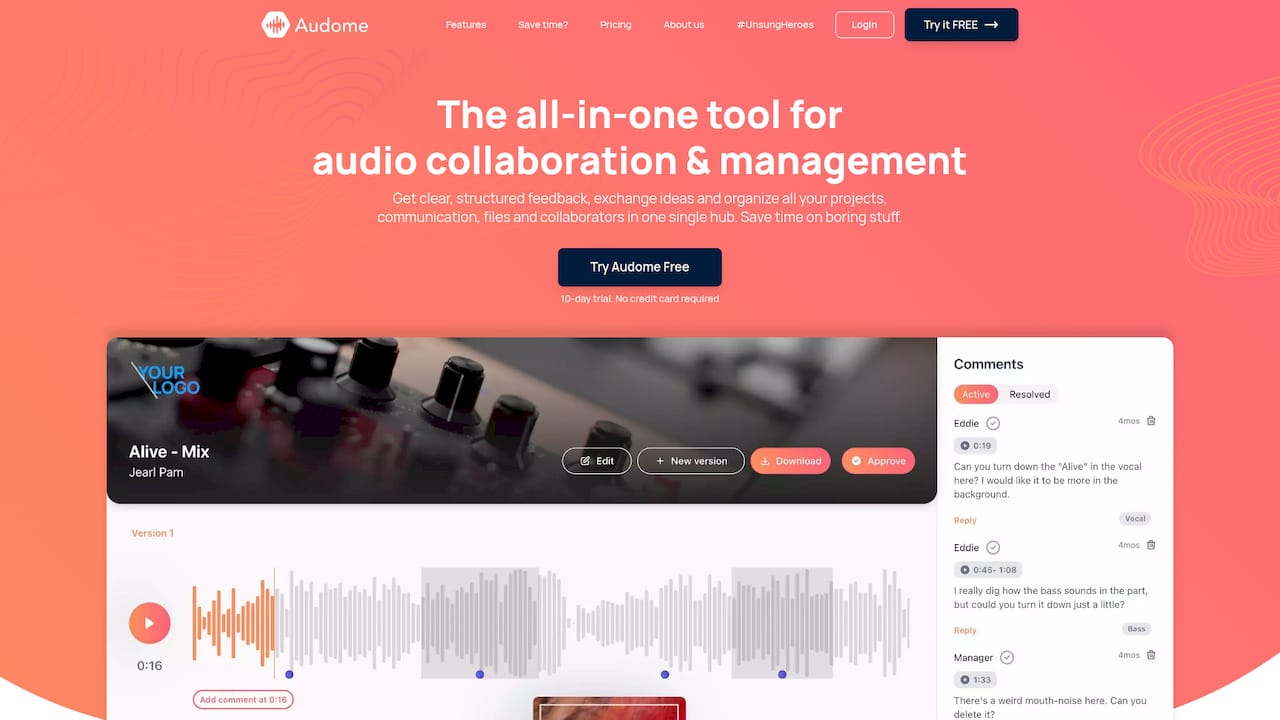
- Version history tracks every revision automatically, so you never lose track of which file is the approved master.
- Download controls and paywalls hold final files until payment clears, enforcing your possessory lien without an awkward email.
- Private client portals give clients a professional space to review and request retrievals without needing their own account.
- Revision limits with automatic billing turn your contract’s revision cap into a system setting instead of a manual invoice.
Set your revision limit, turn on the acceptance window, and enable the paywall for anything requested after your retention window closes. Check Audome pricing to find the plan that fits your studio’s volume.
FAQ
How long should a studio keep client session files?
Working session files are commonly retained a few months after final delivery, with delivered masters held longer, often up to a couple of years in an active archive. Beyond that window, many studios move files to a paid long-term archive tier rather than deleting them outright.
Who pays for long-term storage of audio projects?
The client’s own long-term backup is their responsibility, while the studio’s internal retention window is typically offered as a courtesy for a defined period. Many studios charge a retrieval fee or an ongoing archive fee once a project moves past that free window.
What file format is best for long-term audio archiving?
Flattened, continuous Broadcast Wave files at the original sample rate and bit depth are the recommended format, since the AES delivery recommendations favor this format for both short- and long-term reuse. Bundling the files with a manifest and checksums, as described in FADGI’s packaging guidance, keeps the archive verifiable.
Can a studio charge for retrieving old project files?
Yes, charging a retrieval fee for archived materials is a standard practice that covers storage and labor costs. Studios commonly use a flat fee for routine retrieval and switch to hourly billing when the request requires reconstructing a mix from stems.
What happens if a client never approves a final mix?
A contract clause defining an acceptance window, where silence after a set number of business days counts as approval, prevents a project from staying open indefinitely. Pairing that clause with a locked, paid-for final file keeps disputes from reopening months or years later.
Sources
- AES Recommendation for Delivery of Recorded Music Projects (Delivery Recommendations)
- FADGI White Paper: Defining IRENE System Products for Long Term Retention
- Guidelines on the Production and Preservation of Digital Audio Objects (IASA)
- Sound Directions: Recommended technical practices for digital audio preservation