
Yes, in most cases you can tell whether a client downloaded a shared audio file, though proving a specific person opened it is sometimes harder than proving the file moved. The strongest evidence is an asset-level audit entry with a timestamp, an authenticated recipient token, and payment-gated delivery that ties the event to a paid order. Setting up gated delivery with exportable logs turns a guess into a record you can actually defend.
TL;DR:
- A useful audit record links an asset ID, timestamp, recipient identifier, format, and invoice or order ID; ZIP requests may create several entries.
- Authenticated accounts improve attribution, while anonymous links may show a null user and limited IP data; logs cannot prove who opened or retained a file.
- Gate final delivery behind payment or approval, add a recipient specific token, and export the log with the invoice before closing the project.
- Per recipient tokens and forensic watermarks can connect leaked files to a delivery more strongly than timestamps, which stop tracking once files leave the platform.
Table of Contents
- What download telemetry actually records
- How confident can you really be in a download record?
- Building a delivery workflow that produces reliable evidence
- What to look for in a platform that tracks downloads well
- How Audome handles download tracking for audio deliverables
- Why a clear download workflow saves time and dispute risk
- Get download evidence you can actually rely on
- FAQ
- Sources
What download telemetry actually records
A download log is only useful if you know what each field means. A typical event includes the asset ID, the event type (download request), a timestamp, a requester identifier (a user ID or a null value for anonymous access), the requester’s IP address and user agent, and the specific format requested.
Most delivery systems hand out short-lived presigned URLs rather than permanent links. The Slipstream Developer Platform documents this pattern directly: a presigned URL expires quickly, and when a client requests multiple formats or stems at once, the system can trigger an async ZIP build that returns a pending status before the final download completes. That matters because a single click from the client can generate several log entries before the actual file transfer happens.
The other distinction worth knowing is authenticated versus anonymous access:
- An authenticated download ties the event to a known account or login.
- An anonymous share-link download often logs a null user field with only partial IP data.
- A payment-gated download adds an order or invoice ID to the event, which strengthens the record considerably.
An exportable, filterable audit log that records downloads by asset, user, timestamp, and action is the baseline for reliable delivery evidence, according to digital asset management product documentation. Without that baseline, you are working from assumptions instead of records.
How confident can you really be in a download record?
A download log tells you an event happened. It does not always tell you who triggered it or whether the recipient actually kept the file. Attribution gets fuzzy with anonymous share links, shared credentials, VPNs or proxies that mask the real IP, and copies cached locally on a client’s device before the official download ever fires.
Some signals raise your confidence well above a bare timestamp:
- An authenticated user ID tied to a real account on your platform.
- A payment-gated download that only unlocks after an invoice is settled.
- A per-recipient token embedded in the share link itself.
- A forensic watermark that survives into the delivered file.
Telemetry documentation for asset tracking recommends labeling uncertain events explicitly, for example flagging an anonymous download with a null user field rather than treating it as proof of a specific person’s action. That habit protects you in disputes: you can say “the file was downloaded from this link at this time” without overstating that you know exactly who was at the keyboard.
Pro Tip: When a client disputes receiving a file, quote the log language exactly as it reads, including any “anonymous” or “null user” flags, instead of translating it into a claim of certainty you can’t back up.
Building a delivery workflow that produces reliable evidence
Reliable download evidence rarely happens by accident. It comes from a workflow built around a few deliberate steps.
- Prepare the delivery with a descriptive asset ID and version metadata so the log entry is unambiguous later.
- Choose an access mode: authenticated login for repeat clients, or a time-limited share link with an embedded token for one-off recipients.
- Gate the final download behind payment confirmation or explicit approval so the event itself proves the transaction was complete.
- Record and export the audit log tied to that delivery before you close the project out.
A few operational habits make this easier to sustain. Name assets consistently across versions so a log entry reads clearly months later. Attach the invoice or order ID to every delivery event, not just the payment record. Set a retention policy so logs don’t disappear before a dispute window closes, and automate CSV exports so billing and dispute records don’t depend on someone remembering to pull a report.
There is a real trade-off between client friction and evidentiary strength. Forcing every client through a full account login raises confidence but adds friction for a one-time project. The middle ground is a no-login share link that still carries a per-recipient token, so the client clicks through without creating an account while you retain a traceable identifier in the log. Our guide on sharing audio files with music clients walks through how to balance that friction against the client experience you want to offer.

What to look for in a platform that tracks downloads well
If you’re evaluating your current delivery setup or questioning a vendor, a few features separate a system that gives you real evidence from one that gives you a vague activity feed.
- Asset-level, exportable audit logs you can filter by user, asset, date range, and event type.
- Short-lived presigned URLs, with clear handling of async ZIP flows so a multi-format request doesn’t look like multiple separate downloads.
- Per-recipient tokens and optional forensic watermarking for cases where leak attribution matters.
- Role-based access control and per-collection permissions, paired with an admin dashboard that paginates logs instead of dumping a wall of unreadable entries.
Open-source asset management projects like AssetHub document exactly this combination: per-recipient tokens embedded in downloads, admin verification pages, and paginated audit logs with filters built in. Forensic watermarking and per-recipient tokens offer stronger leak attribution than a timestamp alone, because they survive after the file leaves your system, which a plain log entry cannot do. When you need to allow no-login access for convenience, logging the token and link creation time lets you trace an anonymous event back to the specific link you issued, even without a login.
How Audome handles download tracking for audio deliverables
We built Audome around the idea that a download record should be part of the delivery process, not an afterthought bolted on later. Every project supports high-resolution uploads, version history so you can see mix revisions, and download controls that keep final files locked until you say otherwise.
A typical delivery looks like this: you upload the final mix, attach the invoice or mark the project paid, the client’s final download unlocks through integrated payment processing, and you export the audit log with the asset, timestamp, and recipient token attached to that transaction. Clients never need to create an account to receive files, which keeps their side frictionless while you keep a defensible record on yours.
- High-resolution uploads with organized version history per project.
- Payment-gated final downloads through integrated payment processing.
- No-login client delivery with per-recipient access.
- Exportable logs tied to each delivery for billing and dispute records.
Pro Tip: Export your delivery log the same day you unlock a final download. It takes a minute and saves you from digging through old projects later.
Why a clear download workflow saves time and dispute risk
A common dispute in this business is a client insisting they never received a file, usually right before a payment or revision deadline. The times I’ve seen it resolved fastest, the studio had a single export showing the asset ID, the timestamp, and the payment confirmation side by side. No argument needed, just a record.
My practical suggestion is to keep one CSV export per delivered invoice, filed with your accounting records rather than buried in a project folder. It costs almost nothing to maintain and it is the first thing you’ll want when a disagreement comes up months later.
— Kreg
Get download evidence you can actually rely on
Everything covered here, exportable audit logs, payment-gated downloads, per-delivery version history, and delivery without forcing clients to log in, is built into Audome by default rather than stitched together from separate tools. You upload, you gate the final file behind payment, and you export the record when you need it.
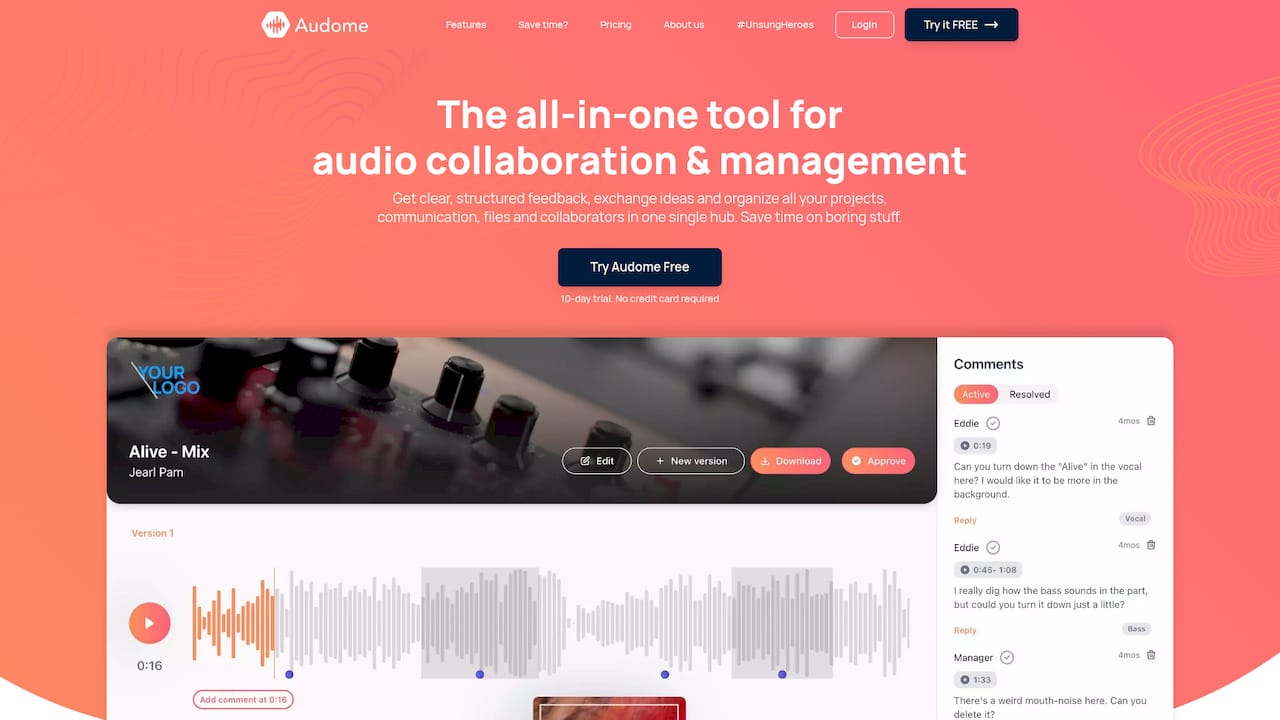
If you’re tired of guessing whether a client actually grabbed the final mix, see how a Studio or Pro plan fits your delivery process, or visit Audome to see the full platform in action.
FAQ
Can I prove a client downloaded my file if they deny it?
An audit log with an asset ID, timestamp, and payment-gated event gives you strong evidence that the download occurred. It won’t prove the client personally opened the file afterward, so pair the log with clear communication rather than treating it as absolute proof.
What’s the difference between authenticated and anonymous downloads in a log?
An authenticated download ties the event to a known account, while an anonymous share-link download often shows a null user field with limited IP data, according to telemetry documentation. Authenticated events give you a clearer attribution trail for disputes.
Why does my log show multiple download events for one file?
If a client requests multiple formats or stems at once, the system can return a pending status before building a ZIP file, which shows up as more than one event in the log, as described in developer documentation. This is normal and doesn’t mean the client downloaded the file multiple times.
How do I stop clients from downloading files before they pay?
Gate the final download behind payment confirmation so the file stays locked until the invoice is settled. On Audome, this works through integrated Stripe Connect, which unlocks the final download only once payment clears.
What should I do before sharing trackouts or stems with a client?
Before sharing stems, confirm the files are labeled consistently and organized by version, which also makes any resulting download log easier to read later. A trackout preparation checklist can help you standardize this step before delivery.
Sources
- Slipstream Developer Platform — download API
- Artifact Keeper telemetry documentation
- AssetHub — forensic watermarking and audit features (GitHub)
- ReelStorage activity-log documentation (via product listing)