
A download limit policy should state three things plainly: how many times a client can download a file for free, how long the link stays active, and when payment or sign-off unlocks the final master. The fastest move you can make today is gating final downloads behind payment or explicit acceptance, then wrapping every delivery link in an expiring, password-protected URL with per-file permissions.
TL;DR:
- Limiting download attempts to three over 14 days and tying final master access to payment prevents unpaid re-deliveries and enhances version control.
- Using expiring, password-protected links with per-file permissions ensures security, traceability, and minimizes file circulation beyond intended recipients.
- Clear, consistent policy language across the statements of work, invoices, and delivery emails reduces client confusion and support queries.
- Implementing signed URLs, download logs, and an acceptance confirmation creates a transparent audit trail that enforces limits automatically.
- Adapting proven delivery standards from label practices, like Sony Music Masterworks’ detailed specs, helps streamline policy compliance and professional discipline.
Table of Contents
- Why a download limit policy protects your studio
- Checklist: exact policy elements to include
- How to implement the policy: contracts, delivery emails, and tech setup
- Common challenges with download limits in practice
- Legal and compliance aspects of download limit policies
- Examples of download limit policies from other platforms
- How to communicate download limits effectively to clients
- Methods to monitor and enforce download limits
- Audome perspective: feature mapping and an example delivery flow
- Enforce your policy without the manual follow-up
- Sources
- FAQ
Why a download limit policy protects your studio
Unlimited downloads feel generous, but they cost you in ways that rarely show up until the invoice goes unpaid or a half-finished mix ends up on a client’s playlist. A clear policy turns a vague favor into a professional boundary that clients actually respect.
- Capping free downloads reduces unpaid re-deliveries and discourages clients from treating revisions as a bottomless well.
- Time-limited or single-use links prevent an old file from circulating after a session gets rebooked or scrapped.
- Version control gets easier when there’s no ambiguity about which download is the one a client is allowed to keep.
- Labels and distributors already enforce strict intake rules, so a studio that mirrors that discipline avoids delays on its own end.
Sony Music Masterworks, for example, lists detailed audio delivery requirements including verified multitracks, manifest files, and a preference for 24-bit audio at 96 kHz or higher before a master is considered delivered. A studio that adopts similar structure, even informally, is less likely to get bounced back for missing stems or an unlabeled file.
Checklist: exact policy elements to include
A usable policy fits on one page. It names the limit type, states the payment trigger, and spells out the technical specs you require on both ends of the transfer.
- Limit types: choose download-count caps (say, three attempts), time-limited links (a link that expires after 7 to 14 days), single-use links for final masters, or bandwidth and size caps for large sessions.
- Payment gating: define how many free downloads or revisions are included in the project fee and state clearly that final, mastered files unlock only after payment clears or the client confirms acceptance in writing.
- File specs: require 24-bit audio at the sample rate the project was recorded in, matching the preference Sony Music Masterworks states for its own intake process. For any single stereo WAV file that will exceed 4GB, require RF64 instead of standard WAV, and avoid 32-bit float unless the recipient specifically asks for it, since many distributors don’t recommend it and may bill separately to convert it.
- Security and traceability: every delivery link should be signed, password-protected, and scoped to the specific file it serves rather than an entire shared folder. Keep a simple log of who downloaded what and when.
- Delivery hygiene: include a one-page manifest listing file names, versions, and checksums, and require a client click or reply confirming they’ve received and accepted the final files.
Pro Tip: Name your unlock condition in plain words, like “final masters unlock after invoice payment,” instead of leaving it implied. Specific language prevents the back-and-forth that eats an afternoon.
For practical guidance on handling oversized files during transfer, see this guide to sending large audio files without losing quality.
How to implement the policy: contracts, delivery emails, and tech setup
A download limit policy only works if it lives somewhere a client will actually read it, and if your delivery tools can enforce it without you manually checking every download.
- Add the clause to your SOW. A single sentence works: “This project includes up to three download attempts per final file; additional downloads or lost-file retrieval after 30 days may incur a service fee.”
- Repeat the terms on the invoice. Invoices are read more carefully than contracts, so restate the payment trigger: “Final masters are released upon payment in full.”
- Send a short delivery email. Tell the client what format they’re getting, how long the link stays live, and what happens if they need the file again later.
- Brief new clients before work starts. A two-line onboarding note covering download limits and payment terms prevents surprise when the paywall appears.
- Configure your delivery tool. Set expiring signed URLs, password protection on the project page, and per-file download permissions so a client can’t forward a link to someone outside the project.
- Require acceptance before final release. A simple click-to-confirm or reply-to-accept step creates a paper trail and triggers the final unlock.
- Set archival rules. Decide how long finished masters stay available for free re-download, commonly 30 to 90 days, and what you’ll charge to pull an older project out of archive.
Pro Tip: Build the acceptance step into the same message that releases the file. A client who has to take one small action to get their masters is far less likely to dispute the delivery later.
Common challenges with download limits in practice
The biggest friction point isn’t the limit itself, it’s communication. Clients who don’t know a cap exists feel blindsided when a link expires mid-project, and that frustration often lands on your support inbox instead of in the contract they signed.
Expiring links create a second problem: timing. A client traveling or juggling a release schedule may try to download a file after the window closes, and if your policy doesn’t say how to request an extension, you’ll field that request ad hoc every time. Build a stated grace period or re-issue fee into the policy so the answer is already written down.
Bandwidth caps can also backfire on collaborative projects where multiple band members or label contacts need the same file. A count-based limit meant for one client can get used up by three people sharing a single link. Scoping each download to a named recipient, rather than a shared URL, avoids that entirely.

Finally, strict limits without an easy appeals path read as punitive rather than professional. A short line like “need another copy? Reply here” keeps the policy from feeling like a wall.
Legal and compliance aspects of download limit policies
A download limit policy touches two separate legal questions: who owns the file, and what you’re allowed to do with the client’s data while delivering it.
Ownership and licensing terms should already exist in your service agreement, separate from the download policy itself. The download limit is a delivery mechanism, not a copyright transfer. Spell out in your contract when ownership or license rights pass to the client (on final payment is standard), and keep the download gate aligned with that moment so you’re never in the position of legally owing a file you haven’t yet released.
Data protection matters too, even at small scale. If your delivery platform logs email addresses, IP data, or download timestamps to enforce limits, that’s personal data under most privacy frameworks, and you should only collect what you need to run the policy. Password-protecting project pages and scoping links to a single client also reduces the chance of a data exposure, since fewer parties ever touch the file.
None of this requires a law degree. It requires a contract that states ownership clearly and a delivery tool that doesn’t collect more than it needs to.
Examples of download limit policies from other platforms
Download gating isn’t unique to audio studios. Software vendors, stock media libraries, and streaming services all use some version of the same mechanics, and looking at how they do it clarifies what’s worth borrowing.
Subscription software platforms commonly cap the number of device activations or re-downloads per license, forcing a support conversation once a user exceeds it rather than letting it happen silently. Stock media and sample libraries often use single-use or time-limited download links tied to a purchase, expiring after a set window to prevent resale of the same link. Streaming services rely on per-account access controls instead of download counts, since their model is access, not delivery.
For studios, the closest real-world precedent is label delivery itself. Sony Music Masterworks requires verified multitracks, manifests, and specific file formats before a master is accepted as delivered, which is effectively a download and acceptance policy running in the other direction, from studio to label. Mirroring that same discipline toward your own clients, specs, manifest, and a clear acceptance step, applies a proven structure to a relationship most studios currently leave informal.
How to communicate download limits effectively to clients
The policy fails if the first time a client hears about it is when a link expires. Communicate it early, repeat it at delivery, and keep the language short enough that no one has to ask what it means.
State the limit in plain numbers rather than vague terms: “three download attempts” or “link active for 14 days” reads clearly, while “limited access” invites questions. Put the same wording in three places: the SOW, the invoice, and the delivery email, so there’s no version where the client missed it. When the policy includes a payment gate, name the trigger directly, “final masters release upon payment,” rather than letting the client guess why a download button isn’t working.
A short FAQ line in your delivery email, covering what happens if the link expires or the client needs an extra copy later, heads off the single most common support question before it’s asked. Clients respond better to a policy framed as protecting their files than one framed as restricting their access, so lead with the “why” (version control, security) rather than the “no.”
Methods to monitor and enforce download limits
A policy without enforcement is a suggestion. Enforcement starts with visibility: you need to know who downloaded what, when, and how many times, without manually checking a shared drive.
Signed URLs with built-in expiration dates handle time limits automatically, no file gets served once the clock runs out. Per-file permissions, rather than folder-level sharing, let you enforce count limits on individual masters instead of an entire project. Password protection on project pages adds a layer that prevents a forwarded link from working for someone outside the agreement. Download logs or receipts, even a simple timestamped record, give you something concrete to point to if a client disputes how many times they accessed a file. Payment gating is the strongest enforcement mechanism available, since it ties the download action itself to a cleared invoice rather than relying on a client’s good faith.

Audome perspective: feature mapping and an example delivery flow
Most of this policy maps directly onto features a studio-focused platform should already have, rather than requiring a patchwork of separate tools.
- Revision limits cap free downloads and automatically charge for extras instead of leaving it to an honor system.
- Stripe Connect payment unlocks tie final master downloads to a cleared invoice, so the file doesn’t release until payment does.
- Signed, password-protected project pages handle the expiring-link and access-control pieces without a separate file-sharing tool.
- Per-file download permissions keep count limits scoped to individual masters rather than an entire shared folder.
- Timestamped feedback on the waveform replaces scattered notes in email or Discord, so version history and client comments live in one place.
A workable flow looks like this: a client gets three download attempts over 14 days on a working mix, with a manifest listing file names and versions included in the delivery. The final master stays locked behind a Stripe-based paywall until payment clears and the client confirms acceptance, at which point the signed download link activates. The result is faster payment, a cleaner version history, and far less time spent re-explaining what’s already been delivered.
Enforce your policy without the manual follow-up
Writing the policy is the easy part. Enforcing it by hand, tracking who downloaded what, chasing payment before sending a final file, re-sending expired links, is the part that eats studio hours. Audome builds the enforcement into the delivery itself.
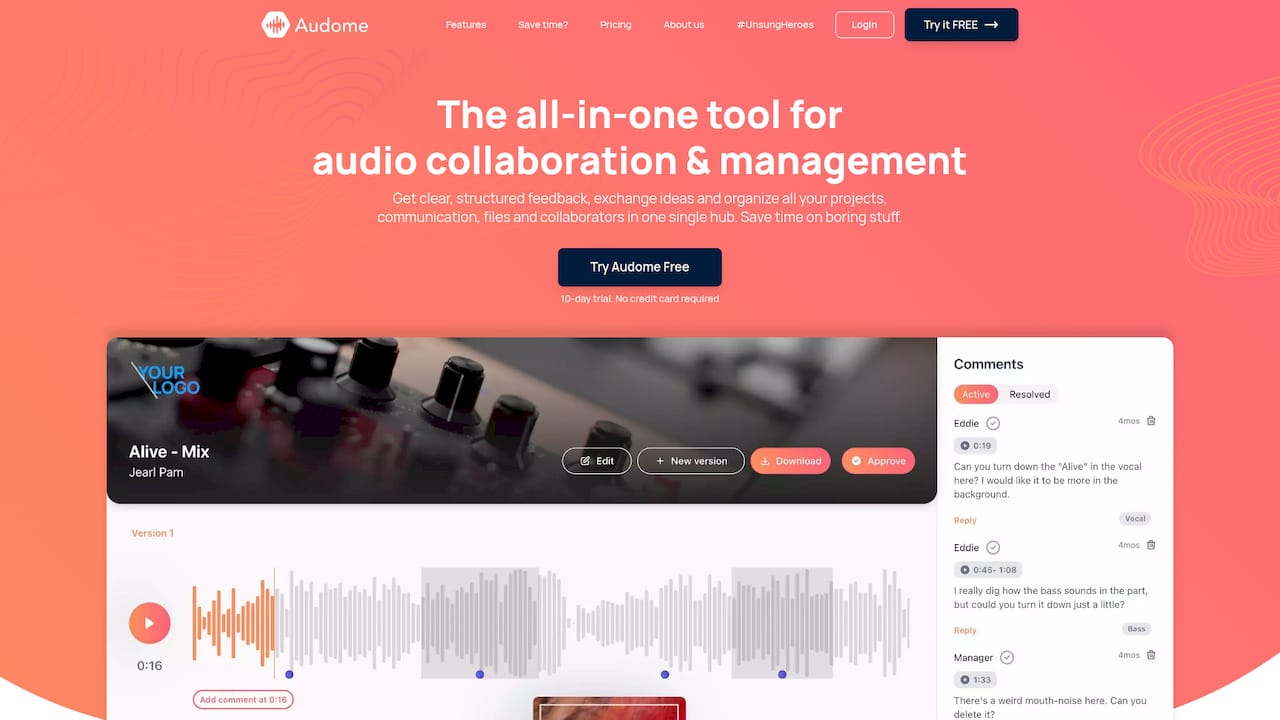
- Set revision limits so extra rounds get billed automatically instead of absorbed into your time.
- Lock final masters behind Stripe Connect payment unlocks, so the download simply doesn’t activate until the invoice clears.
- Deliver through password-protected, per-file-permission project pages that work without asking clients to create an account.
The platform offers plans suitable for studios running this kind of policy day to day. Check Audome’s pricing page to see which plan fits your workflow, or visit the Audome product page for a full feature rundown before you sign up.
Sources
Sony Music Masterworks publishes its own audio delivery requirements and submission guidelines covering file formats and size limits. For file-size workarounds on oversized transfers, see this practical guide to transcription file-size limits. Audome also covers bit depth decisions for delivery and broader file-sharing practices for audio pros.
FAQ
How many free downloads should I include in a policy?
There’s no universal number, but three download attempts per final file over a 14-day window is a common, workable starting point for studios. Adjust based on your typical revision volume and how often clients request re-sends.
What file format should I require for final delivery?
Most distributors and labels prefer 24-bit WAV files at the project’s original sample rate, with RF64 required for any stereo WAV over 4GB. Avoid 32-bit float unless specifically requested, since many recipients don’t accept it without conversion.
What happens if a client disputes a download count?
A download log or timestamped receipt tied to signed, per-file links gives you a clear record to resolve the dispute without relying on memory. This is why pairing count limits with traceable delivery links matters more than the limit itself.
Can I charge extra for downloads after the limit is reached?
Yes, and stating that fee upfront in the SOW or invoice avoids an awkward conversation later. A simple line like “additional download requests after 30 days may incur a retrieval fee” is enough to set the expectation.
Does a download limit policy affect who owns the file?
No, ownership and licensing terms belong in your service agreement, separate from the download mechanism. The download limit controls delivery access, while the contract determines when rights or ownership actually transfer to the client.
— Kreg