
A file request portal gives clients one link to upload project stems, references, or revision notes instead of scattered email attachments and drive folders. If you work with audio, the right move is a portal built specifically for high-resolution files, timestamped feedback, and payment gating rather than a generic file-sharing tool. We built Audome around exactly that workflow.
TL;DR:
- Require support for files up to 96kHz/24-bit, unlimited storage, waveform comments, resumable transfers, and per file permissions before choosing a portal.
- Use resumable uploads for large WAV or BWF files, and have the server issue scoped upload sessions rather than expose API credentials in a browser.
- Set accepted formats, sample rate, bit depth, and included revision rounds before building a reusable project template, then test uploads, feedback, payment, and downloads.
- Protect each project with a password, verify file headers rather than extensions, and define retention periods while keeping backups and an audit trail.
Table of Contents
- Why audio professionals need a dedicated file request portal
- Key features an audio-focused file request portal must have
- Technical upload methods and reliability best practices
- Studio setup checklist: deploy a file request portal in an afternoon
- Security, file integrity, and retention best practices for studios
- What changes for a studio after switching to an audio-first portal
- How Audome delivers this workflow
- FAQ
- Sources
Why audio professionals need a dedicated file request portal
Generic file-sharing tools were not built for audio production, and the gaps show up fast. Feedback arrives as texts, Discord messages, and email replies with no timestamp, so you end up re-listening to a full mix to guess what “the chorus part” means. Metadata gets stripped, file names get mangled, and credits attached to a session can disappear in a messy download chain.
Revision cycles compound the problem. Without a system that tracks and limits revisions, clients request changes indefinitely, and a project that should close in two rounds drags into eight.
A portal built around your workflow fixes this at the source:
- Centralizes every file and comment in one place tied to the project, not a scattered folder.
- Enforces revision limits so extra rounds get flagged and billed instead of absorbed for free.
- Gives clients one branded, simple upload link instead of asking them to learn your file structure.
Pro Tip: Set your revision policy before the first file ever gets uploaded. Clients respect a limit stated upfront far more than one introduced mid-project.
Key features an audio-focused file request portal must have
Not every file-sharing tool qualifies as a true file request portal for audio work. Before you commit to one, confirm it covers the specifics that matter for sound, not just documents or images.
- High-resolution support and unlimited uploads: the portal needs to handle files up to 96kHz/24-bit without compressing or rejecting them, and without a storage cap that forces you to delete old projects.
- Timestamped feedback on waveforms: clients should be able to click a point on the waveform and leave a note there, so “fix the vocal at 1:42” replaces vague written descriptions.
- Resumable uploads and client-side upload keys: large WAV or BWF files need a protocol that survives a dropped connection instead of restarting from zero.
- Payment gating and per-file access controls: final masters should stay locked until payment clears, with download permissions set per file rather than per project.
- No-login upload flow and branded portals: clients upload through a password-protected page carrying your studio’s name, with zero account creation required on their end.
A portal missing any one of these pushes you back toward the same patchwork of tools you were trying to escape. The combination matters more than any single feature: high-resolution support without timestamped feedback still leaves you guessing at vague notes, and payment gating without reliable uploads just moves the failure point earlier in the process.
Technical upload methods and reliability best practices
Upload reliability is where most file-sharing tools quietly fail audio professionals, because a dropped connection on a 2GB stereo master means starting over from zero. Two integration patterns show up across professional upload systems, and understanding them helps you evaluate any portal you’re considering.
- Create the upload session server-side first. Upload integration docs describe a model where the server issues a short-lived upload session, then the client creates a per-file track and uploads bytes to a scoped URL rather than exposing full API credentials in the browser.
- Use resumable protocols for large files. Resumable TUS uploads let a client pick up an interrupted transfer where it left off instead of restarting, which matters far more for a 24-bit multitrack session than for a small MP3.
- Check readiness with webhooks, not constant polling. Once a file uploads, processing and transcoding take time; webhooks notify your system when a file is ready, while polling wastes requests and can hit rate limits on larger batches.
- Validate the file header before accepting it. Content-type checks that inspect the actual file header, not just the extension, catch corrupted or mislabeled files before they ever reach storage.
A resumable upload session can recover from a dropped connection mid-transfer, which matters most for the large, uncompressed files that define professional audio delivery, according to OpenAudio Protocol’s documentation.
Studio setup checklist: deploy a file request portal in an afternoon
You don’t need a multi-day rollout to get a working portal in front of clients. Follow these steps in order and you can go live the same day.
- Write down your file specs and revision policy first. Decide the accepted formats, sample rate and bit depth, and exactly how many revision rounds are included before touching any settings.
- Build one reusable project template. Set up a password-protected client page once, including your branding, and duplicate it for every new project instead of starting from scratch.
- Turn on payment gating. Connect your Stripe account and test that final files stay locked until payment clears, confirming the require-payment-before-download flow actually blocks access.
- Run a full dry run with a test client. Upload a sample file, leave a timestamped comment, trigger the payment gate, and download the result end to end before sending the link to a real client.
- Finalize and save your template. Once the dry run works cleanly, lock in the template so every future project starts from a tested setup.
Pro Tip: Keep your first template simple. Add custom branding and advanced permissions after the core upload-feedback-payment loop is proven to work.
Security, file integrity, and retention best practices for studios
Protecting client files protects your revenue and your reputation, and a few practical habits cover most of the risk.
- Password-protect every project page so only the intended client can view or upload to it, and set per-file download permissions for collaborators who should see some files but not final masters.
- Verify content type on upload, not just file extension, to reject corrupted or mislabeled files before they enter your archive.
- Set a clear retention policy stating how long files stay accessible after delivery and whether a paid retrieval option applies once that window closes.
- Keep backups and an audit trail of uploads, comments, and downloads, so ownership and credit questions have a clear record months or years later.
None of this requires custom engineering on your end. Choosing a centralized feedback system that already bakes in passworded pages and retention policies removes the need to assemble these protections from separate tools.
What changes for a studio after switching to an audio-first portal
The clearest shift is in how fast feedback turns into finished work. Instead of parsing a text that says “change the bridge,” a client marks the exact second on the waveform, and that one change removes most of the guesswork from a revision round.

Revision limits also change client behavior. When a client sees “2 rounds included” stated plainly on the project page, feedback tends to arrive more decisive and consolidated, rather than trickling in over a week of small requests.
The time saved shows up in fewer back-and-forth messages and fewer re-exports for files that were never the actual problem.
— Kreg
How Audome delivers this workflow
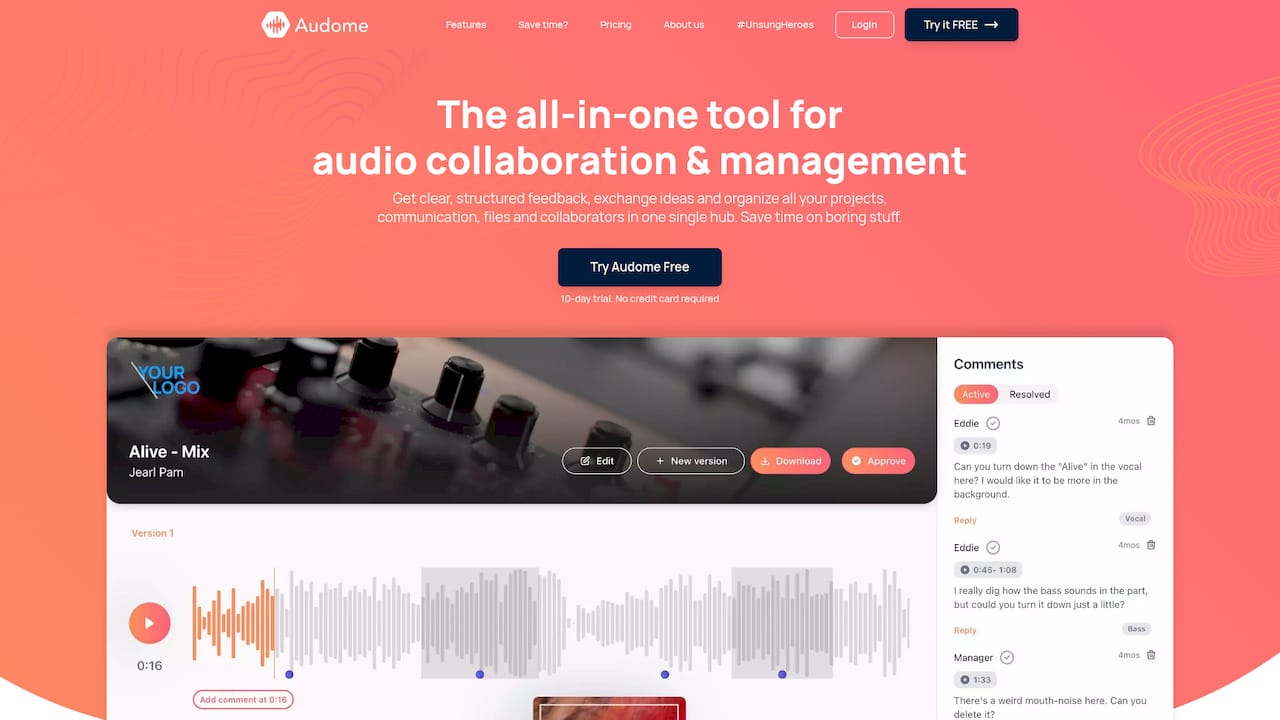
Everything in the checklist above maps directly to what we built. The platform supports unlimited high-resolution uploads, timestamped feedback directly on the waveform, and version tracking that keeps every revision organized under one project. Clients upload through a password-protected, branded portal with no account required on their end, and payment integration lets you lock final downloads until payment clears.
If you’re ready to stop chasing files across email and Drive, view our pricing plans or explore the full platform overview to see how a project template comes together.
FAQ
What is a file request portal for audio professionals?
A file request portal is a dedicated online space where clients upload project files, stems, or references directly to your studio instead of using email or generic cloud storage. The better versions support high-resolution audio, timestamped feedback, and payment gating built specifically for production workflows.
How do resumable uploads help with large audio files?
Resumable upload protocols let a client’s browser pick up an interrupted transfer where it stopped rather than restarting from zero, which matters for large WAV or BWF files on unstable connections. TUS-based resumable uploads are one documented approach used for this purpose.
Can I require payment before a client downloads final files?
Yes, a portal with integrated payment gating can lock final downloads until payment clears, which protects your revenue on completed work. Audome uses Stripe Connect to enable this require-payment-before-download flow directly inside each project.
Do clients need to create an account to upload files?
No, a well-designed portal lets clients upload through a secure, password-protected link without creating an account or logging in. This removes friction for clients who just want to drop off files and get back to their day.
How do I prevent corrupted or mislabeled file uploads?
Validating the actual file header rather than just trusting the file extension catches corrupted or disguised files before they reach storage. This kind of content-type verification is a standard security practice for any upload system handling client files.