
Your studio’s service agreement only works in review if you pair objective SLA metrics with stakeholder feedback, then route that feedback through a simple matrix with two owners: one for fast recovery, one for systemic change. ITIL and the experience level agreement (XLA) concept both support this pairing. A platform like Audome puts timestamped comments and versions in one place so feedback can be organized.
TL;DR:
- Track first response time, resolution time, lane attainment, and breach rate alongside client satisfaction after delivery, interview themes, and revision rounds to expose service gaps.
- Set illustrative response targets by priority lane, name owners for acknowledgment, triage, investigation, and escalation, and define working hours plus exact clock pause rules.
- Have the engineer resolve individual issues daily or weekly, then let the agreement owner review recurring themes monthly or quarterly and change the process.
- Send a brief survey after each delivery, a relationship survey quarterly, and use interviews for context; close items only after client confirmation and linked evidence.
Table of Contents
- Your checklist for a feedback-driven SLA review
- Recommended feedback SLA matrix: lanes, targets, and outputs
- Which metrics should you track to see real stakeholder experience?
- How the inner loop and outer loop split the work
- How do you ask stakeholders for feedback that leads to action?
- How do you turn feedback into decisions and close the loop?
- Why this approach works for studios and small teams
- How we help you run feedback-driven SLA reviews
- FAQ
- Sources
Your checklist for a feedback-driven SLA review
Start with a short list you can complete quickly. Each step gets a named owner, because feedback without an owner is just noise.
- Decide what to measure. Pick a small set of items that mix operational data (response and resolution times) with experience data (satisfaction scores, interview themes).
- Publish a routing matrix. Name who acknowledges, who triages, who owns the investigation, and when it escalates.
- Set starting targets and clock rules. Define working hours and exactly when each SLA clock starts and stops.
- Pick channels and templates. Use one short survey after a delivery and one broader survey each quarter.
- Set the cadence. Triage daily or weekly for urgent items, then review trends monthly or quarterly.
The ITIL 4 Service Level Management guide backs this structure: it calls for service tracking, reporting, and a regular review rhythm, with subjective feedback complementing the numbers. Our home studio client feedback workflow has templates you can adapt.
Pro Tip: Write the clock rules on one page and attach it to the agreement, so nobody argues later about when “waiting on the client” paused the timer.
Recommended feedback SLA matrix: lanes, targets, and outputs

A matrix turns vague promises into commitments. The Voc describes four lanes (Critical, High, Standard, Monitor) with rules for acknowledgment, triage, ownership, and required outputs. The targets below are illustrative starting points for a studio, not market benchmarks. Tune them to your team’s size.
Stop-the-clock rules matter as much as the targets. Per Serval’s SLA documentation, a good policy states what is measured, when the clock starts, and what stops it. Pause only for defined reasons, such as waiting on a client’s answer. LiveAgent’s guide adds a warning: a technically on-target SLA can still produce a poor customer experience.
A technically on-target SLA can still leave the customer unhappy, which is why LiveAgent recommends judging SLA performance from the customer’s perspective.
Which metrics should you track to see real stakeholder experience?
Operational data (O-data) tells you how fast you work. Experience data (X-data) tells you how it felt. You need both.
Good O-data for a studio includes:
- Time to first response on a feedback item
- Time to resolution
- SLA attainment per lane
- Breach rate
Good X-data includes:
- Short surveys sent right after a delivery
- A periodic sentiment survey across clients
- Themes coded from interviews
- Experience indicators, such as how many revision rounds a project needed
The risk of tracking only O-data is the “watermelon” dashboard: green outside, red inside. HDI’s piece on XLAs explains that transactional SLA data measures internal efficiency rather than service value, so interviews and sentiment surveys are needed to understand the stakeholder’s journey and avoid green reports alongside dissatisfied clients. The same article notes that comparing the two data types reveals gaps that should inform SLA adjustments.
Green dashboards can hide unhappy clients: HDI describes how pairing O-data with X-data exposes the gap between measured performance and lived experience.
A practical starter set: first-response time, resolution time, SLA attainment, post-delivery satisfaction, and revision rounds per project. Tie each to a decision. If revision rounds climb, you tighten the brief. If satisfaction drops while attainment stays green, you revisit the targets themselves.
How the inner loop and outer loop split the work
The VOC.AI playbook separates ticket-level recovery from strategic review, which keeps urgent fixes from crowding out lasting improvements and prevents burnout. Here is how we apply it to a studio.
- Inner loop: contain and recover. One owner takes the item, contains the problem (resend the correct file, fix the flagged section), and confirms with the client. Review it daily or weekly.
- Outer loop: find the pattern. Once a month or quarter, look at tagged items together. If the same note shows up across clients, such as unclear mix references, change the process or the agreement itself.
- Route with evidence. Every item links to the exact timestamped comment, file version, and the decision made. Our guide to centralizing client feedback shows how to do this quickly.
- Assign owners by loop. The engineer usually owns the inner loop. The person responsible for the service agreement owns the outer loop and any SLA change.
Feedback loops are not unique to audio. The principle of closing the cycle between input and outcome is covered in this overview of feedback loops, and the same discipline applies here.
Pro Tip: Cap the inner loop at one edit pass per comment batch. Our guide to resolving client comments in one pass shows how it cuts endless revision cycles.
How do you ask stakeholders for feedback that leads to action?
Match the method to the question. Use a transactional survey right after a delivery, a periodic survey for the broader relationship, and interviews when you need the story behind a score.
Handing someone a file and asking “thoughts?” produces vague answers. Practitioner guidance on critiquing advises giving reviewers specific evaluation criteria and asking for examples, and gathering input from both creators and users to expose gaps in understanding. Try prompts like these:
- “When did this problem happen? Point to the moment in the track.”
- “What did you expect instead, and what would you accept?”
- “Did we respond fast enough for your deadline? If not, what was at stake?”
- “What one change would improve working with us next time?”
- “Was anything unclear about how many revisions were included?”
Code open-text answers the same day: assign a theme, a sentiment (positive, neutral, negative), and a link to the project evidence. A simple cadence works for small teams: one short survey per delivery, one broader survey each quarter, and client interviews periodically. Aim to hear from most active clients each cycle, and treat silence from a client as a signal to call them.
How do you turn feedback into decisions and close the loop?
Reports only matter if they change something. Keep the weekly scorecard small and the monthly review decision-focused.
Weekly scorecard items:
- Count of feedback items by stage (new, triaged, owned, resolved)
- SLA attainment per lane
- Overdue items and who holds them
- Conversion between stages, to spot where items stall
Monthly or quarterly deliverables should list improvement initiatives, each with one responsible owner and a due date. Capture these traceability fields on every item: evidence link, owner, decision, and timestamps for acknowledgment, triage, and closure.
An item is closed when the client confirms the fix, the evidence is linked, and any lesson is recorded. If the same root cause shows up repeatedly, update the SLA document and note the revision date. Our mix approval checklist maps neatly onto the “required output” column of the matrix.
Why this approach works for studios and small teams
Our view: small teams fail at feedback not from lack of effort but from lack of structure. Once comments live in one place with timestamps, versions, and an owner, the arguments about “what was said” mostly disappear, and revisions get shorter. Studio habits like timestamped notes and version control already fit this model. Treat the matrix as a draft: shrink the lanes if you are a team of two, add them if you run a facility. The goal is a review you can actually run every month.
— Kreg
How we help you run feedback-driven SLA reviews
We built Audome so studios can run this process without stitching together email, chat, and file-sharing links. Here is how our features map to the process above:
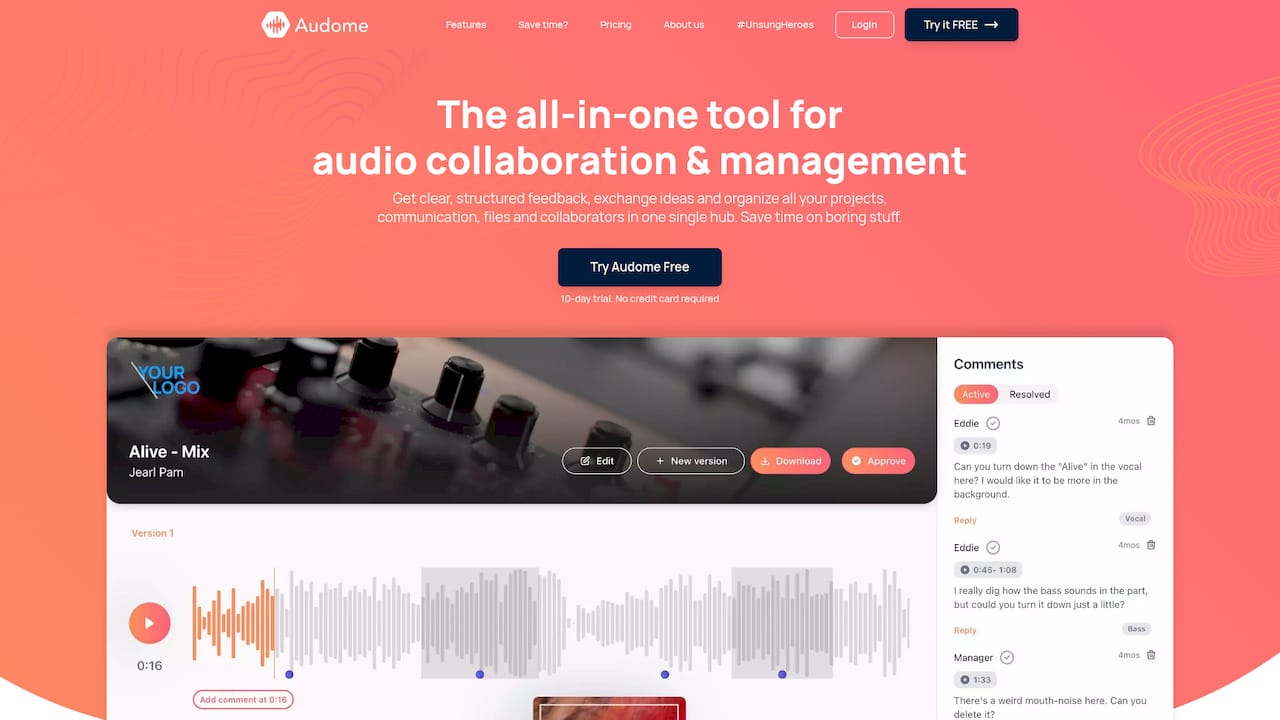
- Timestamped feedback on the waveform: every comment is tied to an exact moment, which gives you the evidence link for each feedback item.
- Version history: each item connects to the file version it concerns, keeping the inner loop short.
- Revision limits and paid extra revisions: these set clear client expectations about turnaround and scope.
- Payment-before-download workflows: final files stay locked until payment is made. See our studio approval process for details.
Clients can collaborate without creating an account. To see which plan fits your studio, check our pricing page: Studio is $12.5 per month or $150 per year, and Pro is $48 per month or $576 per year.
FAQ
What is SLA in ticketing systems?
SLA stands for service level agreement. In a ticketing system, it sets time targets such as first response and resolution, and the clock follows defined start and stop rules. Frappe Helpdesk’s documentation shows how these targets work with working hours and pause states.
What is an SLA review?
An SLA review is a scheduled check of how a service performed against its agreement. Good reviews combine measured results with stakeholder feedback, as ITIL’s service level management guidance recommends. The outcome should be decisions, not just a report.
What does SLA compliance mean?
SLA compliance means meeting the targets written in the agreement within the agreed clock rules. It is worth measuring, but it does not prove clients are satisfied. Pair it with experience data to see the full picture.
How often should you run SLA feedback reviews?
Run inner-loop triage daily or weekly and an outer-loop review monthly or quarterly. Small studios can start with a weekly check and a quarterly trend review. Adjust once you see how much feedback you actually receive.
Sources
- XLAs – An Actionable Approach to Drive Stakeholder Value
- Voc
- Service Level Management ITIL®4 Practice Guide
- How to Critique and Strengthen