
A correct alternate mix delivery includes the full stereo master WAV, every agreed alternate (instrumental, TV mix, a cappella, or cutdowns), and stems if they were contracted. The one rule that decides whether the whole package works: every exported file starts at the same zero-point and runs full length, so stems and alternates sum back to the master instead of drifting out of sync. Bake this into your export chain and deliver interleaved WAV or AIFF at session sample rate and bit depth, with headroom intact.
TL;DR:
- Ensuring all exported files start at the same zero-point and run full length guarantees that stems and alternates sum correctly back to the master without phase issues.
- Stems are processed stereo groups with baked-in effects, allowing limited rebalancing, while multitracks are individual dry tracks that enable full remixing.
- Final files should be exported as interleaved WAV or AIFF at session sample rate with headroom of 3 to 6 dB, with consistent naming and detailed metadata.
- Delivering files via a dedicated platform with version history, timestamped feedback, and secure portals streamlines revisions and reduces file confusion.
- Most projects only require the master WAV and MP3, with stems, cutdowns, and extras scoped as paid add-ons to avoid scope creep and hidden costs.
Table of Contents
- What Counts as Alternate Mix Delivery in Music Production?
- Stems vs. Multitracks vs. Printed Alternates: What’s the Difference?
- What File Format and Export Settings Should You Use?
- How Should You Organize File Names and Folders?
- What Should You Include in a Default Delivery Bundle?
- How Should You Transfer and Host Final Files?
- Pre-Delivery Quality Control: What to Check Before You Send
- How One Collaboration Platform Handles Alternate Mix Delivery
- A Working Mixer’s Delivery Habits
- Try Audome for Your Next Alternate Mix Delivery
- Sources
- FAQ
What Counts as Alternate Mix Delivery in Music Production?
Alternate mix delivery covers the set of extra versions built alongside a final mix so a client can use the song in more than one context. Which alternates you build depends entirely on who’s asking and what they’re doing with the track.
- Instrumental: full mix minus lead vocal, requested constantly for sync licensing and karaoke use.
- TV mix: vocal pulled down but not fully removed, common for broadcast promos.
- A cappella: vocal-only stem, used for remixes and mashups.
- Clean/radio edit: profanity or content edited for broadcast standards.
- Cutdowns: 60, 30, or 15 second versions for ads and trailers.
- Stings: 5 to 10 second musical tags for show openers or bumpers.
Sync and licensing work tends to demand instrumentals and clean edits by default. TV and radio placements usually want the TV mix and a cutdown. Trailer houses want stems plus a “no drums” version. When you quote a project, fold the common small alternates (instrumental, TV mix, a cappella) into the base package price, and treat stems, custom cutdowns, or extra stings as billable add-ons. That distinction alone saves most disputes before they start.
Stems vs. Multitracks vs. Printed Alternates: What’s the Difference?
Stems are processed, grouped stereo files, drums, bass, vocals, and music printed as their own two-track mixes, with group processing baked in. Multitracks, sometimes called track outs, are the dry, individual tracks with no bus processing at all. Confusing the two is the single most common source of scope creep, since clients often assume “stems” means they can rebuild the mix from scratch, when in fact stems only allow limited rebalancing, according to iZotope’s stems and multitracks breakdown.
- Stems: fast to deliver, allow volume and EQ tweaks between groups, not a full remix.
- Multitracks: slower to export and larger in file size, but they let a mixer rebuild the song from the ground up.
- Printed alternates (instrumental, a cappella): finished, standalone mixes, not meant for further manipulation.
Include your bus compression, EQ, and reverb sends on stems. Leave off any master-bus limiter unless the client specifically asked for a limited stem set, otherwise a mastering engineer downstream will fight double-processing.
Pro Tip: Write your stem/multitrack decision into the delivery email itself. A one-line note like “these are processed stems, not dry multitracks” prevents a confused follow-up message three weeks later.

What File Format and Export Settings Should You Use?
Getting the technical spec right the first time is what separates a clean handoff from a week of resend requests. Follow this sequence for every alternate mix delivery:
- Export as interleaved WAV or AIFF at the same sample rate and bit depth as your session, typically 24-bit, plus a 320kbps MP3 as a quick reference file.
- Start every file at the identical zero-point, either session start or bar 1, and export the full duration, including any leading or trailing silence, so stems and alternates line up automatically in any DAW. This is the export rule Sound On Sound’s stem creation guide and the Avid Pro Tools user guide both build their workflows around.
- Leave 3 to 6 dB of headroom on the master print. Do not run a loudness maximizer or limiter on any file unless the client contracted a “print hot” master.
- Dither only when reducing bit depth, for example printing a 16-bit consumer copy from a 24-bit session.
The math behind zero-point alignment: if your vocal stem starts even one sample later than your drum stem, phase relationships shift and the mix no longer sums correctly when a recipient drops the files into an empty session. Full-length, same-start exports are what guarantee that math checks out every time. Our guide to exporting audio deliverables walks through the settings screen by screen if you want a DAW-specific reference.
How Should You Organize File Names and Folders?
A recipient who has to guess which file is the real master is a recipient who emails you back. Build a folder structure that reads clearly without any context: a root folder per song, subfolders for Masters, Stems, and Alternates, and a README or manifest at the top level listing every file, its format, sample rate, and any special notes.
- Filename template:
SongTitle_Variation_vX_24bit-48k.wav, soMidnight Drive_Instrumental_v2_24bit-48k.wavsorts and searches cleanly. - Use consistent numeric prefixes (01_Master, 02_Instrumental, 03_Stems) so folders sort in delivery order rather than alphabetically.
- Tag BWAV metadata fields with the version and variation name where your DAW supports it, so the info survives even if a file gets renamed later.
- Include a manifest CSV listing filename, format, sample rate, bit depth, and notes. Violet Recording’s delivery guide treats this manifest habit as one of the highest-leverage things a studio can build once and reuse forever.
What Should You Include in a Default Delivery Bundle?
Most projects don’t need the kitchen sink. A sensible default bundle covers the master WAV and an MP3 reference, with the instrumental or TV mix available on request rather than shipped automatically. Stems become a paid add-on or a deliverable you scope explicitly in the quote, not something bundled in by habit.
- Standard bundle: master WAV + MP3, instrumental/TV mix on request.
- Sync and trailer bundle: master, no-drums version, multiple cutdowns, stings, and full stems, since trailer houses and TV supervisors want role-specific playlists rather than one generic mix.
- Remix bundle: a cappella plus multitracks, priced separately from a standard mix delivery.
Stems cost more time than clients assume, since setting up buses, verifying the sums, running longer export passes, and doing the QA pass all add real hours. Pricing that reality into your rate card, rather than absorbing it as a courtesy, keeps alternate mix delivery profitable instead of a hidden cost center. A documented stem delivery policy makes that conversation with clients much shorter.
How Should You Transfer and Host Final Files?
Where you send files matters almost as much as how you export them. A permanent cloud folder or a dedicated delivery platform beats an ephemeral transfer link, since expired links are still one of the most common reasons a client re-requests a file weeks after a project closes.
- Permanent storage: files stay live indefinitely, no re-sending when a client loses the original email.
- Ephemeral transfer links: fine for quick reference bounces, risky for final deliverables that need to survive months of archive access.
- Password protection and gated downloads: require payment or a signed confirmation before the final WAV unlocks, which protects revenue on top of protecting the files themselves.
Before you consider a delivery finished, ask the recipient for a quick acknowledgement and, ideally, confirm they’ve test-imported the stems into an empty session on their end. That one extra step catches sync problems before they become a client complaint instead of after.
Pre-Delivery Quality Control: What to Check Before You Send
Run this sequence every time, no exceptions, even on rush jobs:
- Import every stem into an empty session and confirm they sum back to the stereo master with no phase cancellation or level mismatch.
- Verify zero-point and length: every file should start at the same timestamp and run the identical duration, per the alignment standard in Pro Tools’ stem creation workflow.
- Listen for clipping and confirm headroom sits in the 3 to 6 dB range on the master print.
- Check filenames, BWAV tags, and manifest accuracy against the actual files in the folder, and confirm any agreed processing, printed reverb, a specific limiter setting, made it into the final export.
Pro Tip: Keep a five-minute QA pass as a non-negotiable last step, even under deadline pressure. Catching a misaligned stem before delivery takes five minutes; catching it after the client has opened the session in front of a director takes a full day of goodwill to repair.
How One Collaboration Platform Handles Alternate Mix Delivery
The workflow above gets easier to enforce when the delivery mechanism itself is built for it. A collaboration platform lets you upload high-resolution files, so masters, stems, and alternates all live in one project instead of scattered across email threads and expiring transfer links.
- Version history tracks every export, so a reprinted stem after a mix revision doesn’t get confused with the outdated one.
- Timestamped waveform feedback turns vague revision notes into precise, point-in-time requests tied to the actual audio.
- Paid revision limits protect your time once a client’s feedback rounds go past what was quoted.
- Password-protected client portals gate the final WAV download until the project is approved, no client account required on their end.
None of that replaces good export habits, but it does remove the file-chasing that eats into billable hours.
A Working Mixer’s Delivery Habits
Most of my export headaches disappeared once I built a template that routes every stem group to its own bus and prints the master, stems, and alternates in a single bounce pass, an approach Sound On Sound has documented for years. I never release a final WAV before invoicing clears, I attach a manifest to every delivery without exception, and I reprint the entire ALT set the moment a master changes, even if it’s just a level tweak. Consistency here beats cleverness every time.
— Kreg
Try Audome for Your Next Alternate Mix Delivery
Audome is the alternative to juggling Dropbox links, email attachments, and text threads for alternate mix delivery: everything from the master WAV to the stem package lives in one project, with version history and timestamped feedback replacing guesswork about which file is current.
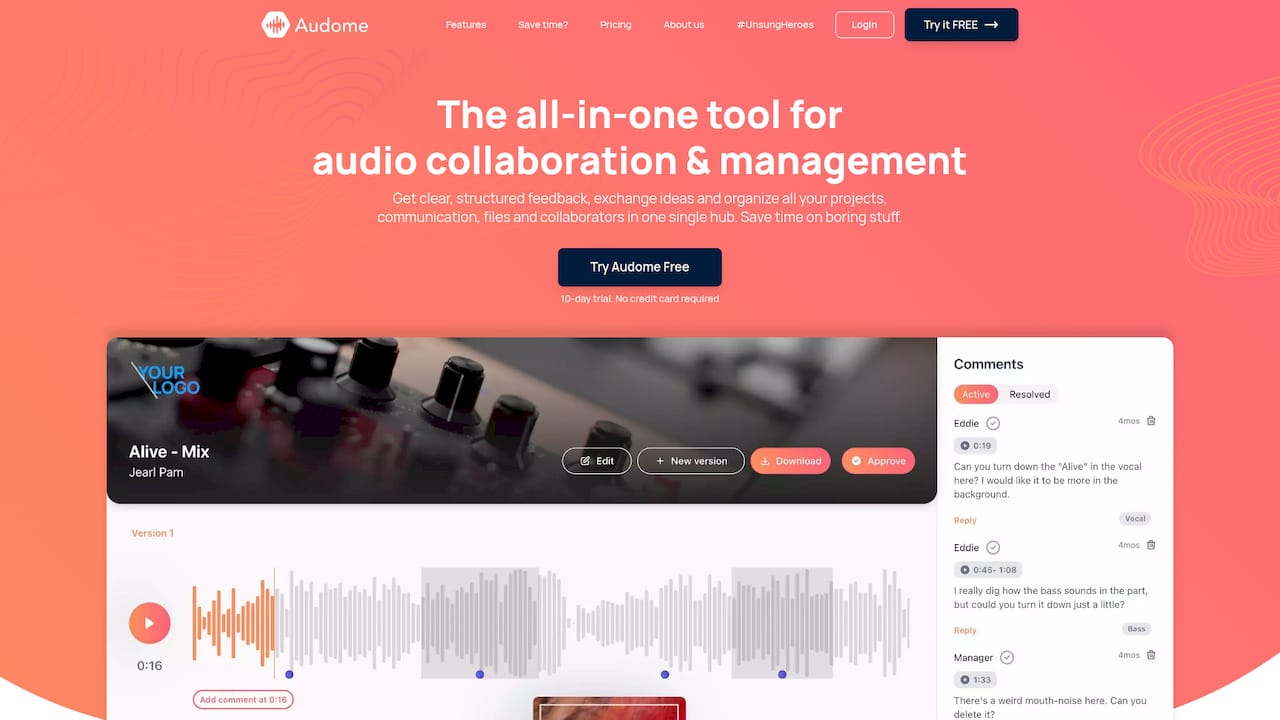
Version tracking solves the “which file is final” problem that kills so many deliveries. Timestamped feedback on the waveform turns a vague “can you fix the chorus” into a precise, actionable note tied to the exact second in the mix. Paid revision limits protect your time once a client’s requests run past what was quoted, and password-protected portals mean the final files only unlock once payment clears, no chasing invoices after the fact. If you’re setting up your own alternate mix delivery workflow, check the Studio and Pro plan details and start a trial to see how it fits your process.
Sources
- Pro Tools: creating stems — Sound On Sound
- Stems and multitracks — iZotope community blog
- How to deliver mixes to clients: files & stems — Violet Recording
- Exporting individual tracks (Track Outs) — Avid Pro Tools user guide
FAQ
What Does “Alternate Version” Mean in Music?
An alternate version is any mix of a song built for a different use case than the main release, an instrumental, TV mix, a cappella, or short cutdown, rather than a different artistic take on the arrangement. In alternate mix delivery, each of these gets exported separately and packaged alongside the master.
Do I Need to Deliver Stems With Every Mix?
No. Most standard deliveries only need the master WAV and an MP3 reference, with stems scoped and priced as a separate deliverable when a client specifically needs them for remixing or sync work, as outlined in iZotope’s stems guide.
Why Do My Stems Not Line Up When Imported?
This almost always traces back to files not starting at the same zero-point or not being exported at full length, which breaks the sum back to the master, per the export standard in the Avid Pro Tools guide. Re-export every file from the same start marker and confirm identical duration across the set.
What File Format Should I Use for Final Delivery?
Interleaved WAV or AIFF at your session’s native sample rate and bit depth, usually 24-bit, is the standard for final and alternate mix delivery, with a compressed MP3 included only as a quick-reference copy. Add dithering only if you’re intentionally reducing bit depth for a separate consumer file.
Can a Platform Like Audome Handle My Delivery Workflow?
Audome supports high-resolution uploads at 24-bit, version history, and timestamped feedback, which covers the file organization and revision tracking pieces of alternate mix delivery. Pricing details for the Studio and Pro plans are available on Audome’s pricing page.