
A QC audio review is a three-stage process that catches technical problems before a client ever hears them: an automated technical scan, a critical listening pass, and a timestamped QC report that travels with the final files. The scan checks format, loudness, and true peak; the listening pass catches sync drift, artifacts, and phase issues a meter alone can miss. Every delivery leaving a studio should include the master, matching stems, and that report.
TL;DR:
- Properly checking stem-sum levels and phase routing prevents common rejection issues caused by mismatched or inverted signals.
- Running loudness and true-peak measurements on the exported delivery file ensures compliance with streaming and broadcast standards.
- Including a timestamped QC report with detailed findings and measurement logs helps streamline revisions and resolve disputes.
- Final listening should verify sync at multiple points and artifact absence, not relying solely on session meters or preliminary checks.
- Using a centralized platform for file management, feedback, and version control reduces errors and speeds up the approval process.
Table of Contents
- What Goes Into a QC Audio Review Checklist
- How Do You Measure Loudness and True Peak Correctly?
- What Are the Most Common QC Audio Failures?
- Building a Timestamped QC Report Template
- Connecting QC to Revision Management and Client Sign-Off
- What an Engineer Checks Last Before Delivery
- A Centralized Workspace for QC and Revision Control
- Sources
- FAQ
What Goes Into a QC Audio Review Checklist
Run the checks in order, from automated to manual, so you catch cheap problems before you spend time listening.
- Check file format and sample rate. Confirm the delivered file matches the spec sheet: sample rate, bit depth, channel layout, and container format.
- Measure loudness and true peak. Pull LKFS/LUFS integrated loudness and true-peak readings before anything else, since these are the most common causes of rejection at delivery.
- Run a stem-sum check. Sum all stems and compare against the final master; a mismatch usually means a routing or phase error.
- Verify M&E stems separately. Confirm music and effects play cleanly without dialogue bleed.
- Spot-check sync at head, mid, and tail. Drift often shows up only after several minutes, so three checkpoints catch what one won’t.
- Confirm file naming, timecode, and embedded BWF metadata. A mislabeled file can delay a delivery as badly as a technical defect.
- Label the version and archive the session. Lock the session file alongside the delivered version so you can trace any later dispute back to its source.
A pre-render checklist like this one catches most problems before a client ever opens the file, and it turns “sounds fine to me” into something you can actually prove.
How Do You Measure Loudness and True Peak Correctly?
LKFS and LUFS measure the same thing, integrated loudness, just under different naming conventions (LKFS is the broadcast term, LUFS is the streaming and production term). Streaming platforms generally target integrated loudness in the range of negative 14 to negative 16 LUFS, while broadcast delivery specs often call for negative 24 LKFS with a tolerance window, depending on the network or region. True peak is a different measurement entirely: it estimates the actual waveform peak between samples, not just the sample values themselves, which matters because inter-sample peaks can clip on playback even when your meter shows headroom.

Pro Tip: Never trust a session-level peak meter for a true-peak reading. Session meters read sample peaks, not the reconstructed waveform, so a track can pass in your DAW and still clip on a consumer decoder.
Tools professionals lean on for this stage generally fall into three categories:
- Integrated loudness meters that log LKFS/LUFS over the full program length, not just a momentary reading.
- Oversampled true-peak meters that reconstruct the waveform between samples to catch clipping a standard meter would miss.
- Phase and correlation visualizers that flag mono-compatibility problems before they reach a client.
DAW session meters are fine for mixing decisions in the moment, but a proper QC pass should run on the actual exported delivery file, since encoding and dither can introduce anomalies a session never shows. That distinction gets even more important with immersive formats: Atmos QC needs a downmix check on top of the loudness and true-peak pass, because panning and dropout errors often only surface after objects fold down to a 7.1.4 or stereo bed.
What Are the Most Common QC Audio Failures?
Four failure types account for most rejected deliverables, and every one of them has a repeatable fix.
- Stem-sum mismatch. Sum the stems, compare against the master, and if levels don’t match within expected noise, check your bus routing and look for a phase-inverted aux feeding the sum incorrectly.
- Sync drift. Spot-check at three or more points; if drift grows over time rather than staying constant, the culprit is usually a sample-rate conversion error, not a simple offset.
- Clicks, pops, and artifacts. Run a spectral view across the full file, not just a listen-through, since brief transients hide easily in a fast playback pass.
- Phase and mono-compatibility issues. Sum to mono and listen for cancellation, then correct with polarity flips or micro-timing adjustment on the offending track.
- True-peak and loudness overages. Apply a true-peak limiter, re-render, and re-measure the exported file rather than trusting the pre-render session reading.
Pro Tip: A stem-sum mismatch is rarely a level problem. It’s almost always a phase or routing problem hiding behind a level problem, so check polarity before you touch a fader.
Building a Timestamped QC Report Template
A usable QC report needs a header, a measurement summary, and a findings table, and it should live inside the same delivery package as the master and stems, not in a separate email thread.
Header fields: project name, client, session date, deliverable version, engineer contact, and reference to the picture lock or EDL if applicable.
Measurement summary example:
| Metric | Target | Measured |
|---|---|---|
| Integrated loudness | -16 LUFS | Negative 14 to negative 16 LUFS |
| True peak | True peak limit | True peak limit |
| Stem-sum check | Match master | Passed |
Timestamped findings table:
| Timecode | Description | Severity | Status | Version |
|---|---|---|---|---|
| A timestamp | Faint click, left channel | Minor | Fixed | v3 |
| A timestamp | Dialogue slightly buried | Moderate | Open | v3 |
Attach measurement logs and, where your delivery spec calls for it, checksums for each file. Place the report in the root of the delivery folder alongside the master and stems, matching the deliverables and QC documentation a distributor or client expects to receive.
Connecting QC to Revision Management and Client Sign-Off
A QC report is only useful if the feedback that follows it stays attached to the version it describes. Timestamped notes pinned to an exact waveform position remove the ambiguity of a note that says “the drop feels off” with nothing pointing to where. Comments pinned to seconds, not vague descriptions, keep revision rounds honest about what was actually requested and when it got addressed.
A few habits make this repeatable:
- Centralize files and feedback in one workspace instead of splitting them across email, texts, and file-transfer links.
- Require one consolidated feedback round per version rather than accepting notes as they trickle in.
- Keep v1 comments attached to v1 permanently, even after v2 ships, for auditability if a dispute comes up later.
- Lock final downloads until outstanding revisions or payment are settled, and document how many free revisions a project includes.
Pro Tip: Store the QC report inside the same version folder as the mix it describes. If your workspace supports version-locked feedback, tie the report directly to that version so nobody accidentally reviews an old mix against a new report.
What an Engineer Checks Last Before Delivery
Before any file leaves the building, do one more quick-listen pass: sync at three points, dialogue clarity on small speakers, and a fast artifact sweep on headphones. Accept a minor creative compromise if the deadline demands it. Never accept a technical failure. The single habit that prevents most rejected deliverables is running QC on the exported file, not the session.
— Kreg
A Centralized Workspace for QC and Revision Control
Every checklist in this guide points to the same underlying problem: feedback, versions, and final files scattered across email, texts, and file-transfer links create the exact confusion that gets deliverables rejected. Audome is built around this workflow directly, timestamped waveform comments stay locked to the version they describe, version history is automatic, and final downloads can require payment before they unlock, so revision limits actually mean something.
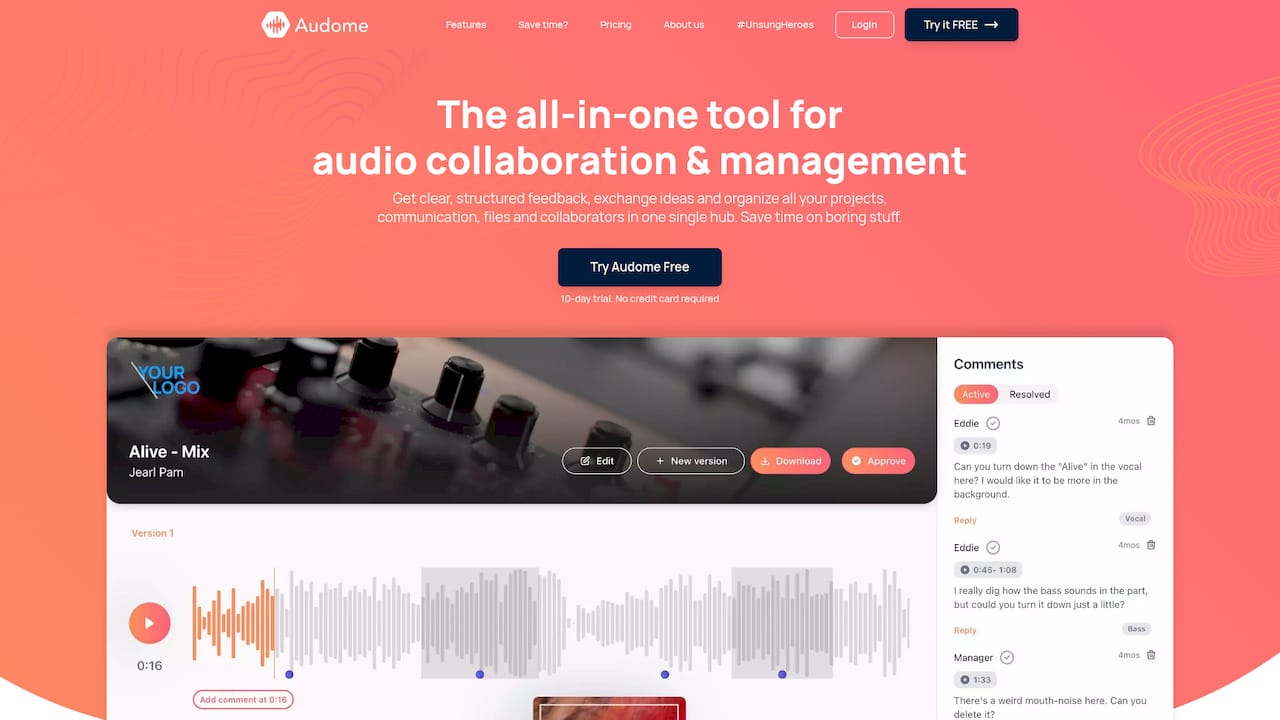
The platform supports unlimited high-resolution audio uploads and a review process that does not require clients to create an account, streamlining QC report approval. If you’re tired of chasing feedback across five different apps, check the Audome pricing plans, Studio starts at $12.50 per month billed annually, and see whether a centralized workspace fits the way your studio already delivers work.
Sources
- Post-Production Audio Deliverables Checklist | Forte
- Timestamped Music Feedback for Composers & Supervisors
FAQ
What Is the Difference Between LKFS and LUFS?
LKFS and LUFS measure the same integrated loudness value; LKFS is the term used in broadcast specifications, while LUFS is the term used in music and streaming delivery. Streaming platforms commonly target integrated loudness around negative 14 to negative 16 LUFS, though exact targets vary by platform.
Why Does a Stem-Sum Check Matter?
A stem-sum check confirms that all delivered stems add up numerically to match the final master, and a mismatch usually points to a routing or phase error that would otherwise cause a distributor to reject the delivery. Running this check before sending files out catches an error that a casual listen almost never reveals.
What Should a QC Report Include?
A QC report needs project and version header fields, a loudness and true-peak measurement summary, a stem-sum result, and a timestamped findings table listing each issue by timecode, severity, and status. It should ship inside the delivery package alongside the master and stems, not as a separate document.
How Does Timestamped Feedback Speed Up Revisions?
Timestamped feedback pins a comment to an exact second in the waveform instead of a vague description, which removes the guesswork of figuring out what a client actually meant. Platforms like Audome keep those comments attached to the version they reference, so nothing gets reviewed against the wrong mix.
How Much Does Audome Cost for a Studio?
Audome’s Studio plan is $12.50 per month or $150 per year, and the Pro plan is $48 per month or $576 per year, all listed on the Audome pricing page. Both plans include unlimited high-resolution uploads and no-login client reviews.