
A studio payment policy is a short written document that tells clients what they owe, when they owe it, how they can pay, and what happens if they don’t. For a recording, mixing, mastering or post-production studio, a good one covers seven things: the fee, a deposit, the due dates, accepted payment methods, late and failed payments, cancellations and refunds, and when final files are released. Put it in front of the client before any work starts, and get a yes in writing.
This guide walks through each part with sample wording, real examples from published studio agreements, and the mistakes that cost studios money.
TL;DR
- Collect a deposit at booking (50% is common) and make the balance due at or before the session or before final delivery.
- Spell out late fees, cancellation windows, and rescheduling rules in numbers, not in adjectives like “reasonable.”
- Cap free revisions and price extra rounds, so “one more tweak” stops being free labor.
- Hold final files until the balance is paid, and say so in the policy before the client books.
- Have the client accept the policy electronically before work begins, and keep that record.
Table of Contents
- Why a payment policy matters more in audio than in most trades
- What a studio payment policy should cover
- Set your fees in a way that fits the payment terms
- Deposits: how much and when
- Due dates and accepted payment methods
- Late payments, late fees and failed payments
- Cancellations, rescheduling and no-shows
- Revisions: the hidden payment issue
- Delivery: release final files after payment
- A complete studio payment policy template
- Our perspective: make the policy part of the workflow
- Enforcing your policy inside Audome
- Common mistakes to avoid
- FAQ
- Sources
Why a payment policy matters more in audio than in most trades
Audio work has an awkward feature: the product is a file. Once a client has the final WAV, you have no leverage left. A mix engineer who sends a finished master before the invoice is paid is relying on goodwill, and goodwill is a poor collection strategy.
The second problem is scope. Sessions get rebooked, mixes get “one last” revision, and a project can sit untouched for months. Without written rules, every one of those moments becomes a negotiation, and the negotiation happens when you are least able to win it, with the client already unhappy or already gone.
A policy fixes both by moving the conversation to the start, when everyone is friendly. Clients rarely object to terms they read before paying. They object to terms that appear after.
What a studio payment policy should cover
The people searching this term are often music teachers, since many top results are piano-lesson policies. The same skeleton works for any service business, but a recording or post-production studio needs a few extra sections. Here is the full list.
| Section | What it answers | Typical form |
|---|---|---|
| Fees | What does the work cost? | Hourly, per-song, per-episode, per-project, or day rate |
| Deposit | How is the booking secured? | Percentage of total, paid at booking |
| Due dates | When is the balance owed? | At or before session, or before final delivery |
| Payment methods | How can the client pay? | Card, ACH, bank transfer, invoice |
| Late payment | What if the money is late? | Interest or flat fee, pause on work |
| Cancellations | What if the client cancels or no-shows? | Tiered windows, credit or forfeit |
| Revisions | How many changes are included? | A fixed number, then paid rounds |
| Delivery | When do files go out? | After payment in full |
One published example is the session agreement from M3 Studios, a Texas studio. It sets the session fee, a booking deposit, the balance due at or before the session, late-payment interest, cancellation terms and delivery conditions, and the client accepts it electronically at booking. That is a good model for the order of topics: money first, then the exceptions.
Set your fees in a way that fits the payment terms
Your payment terms depend on how you price. Hourly rates suit tracking sessions, where time is the cost. Per-song or per-project rates suit mixing and mastering, where the deliverable is the cost. Podcast producers often charge per episode or by monthly retainer.

For context on the tracking side, one 2026 rate guide says most professional studios charge between $75 and $400 per hour, with half-day and full-day bookings usually cheaper per hour. Rates vary a lot by city and room, so use that as a sanity check and not as your price list.
Whatever you charge, put the number and what it includes on the same page as the payment terms. A quote that says “$400 per song” and a policy that is silent on revisions invites a fight about what $400 bought.
Deposits: how much and when
A deposit does two jobs. It reserves the date, and it filters out clients who aren’t serious. The question is how much.
Published studio terms show two different approaches:
- Flat percentage. M3 Studios collects a 50% deposit at booking to reserve the date and time, with the remaining 50% due at or before the session.
- Sliding scale. A UK studio, Sound & Script Studio, uses a sliding scale: 100% up to £100, 50% for £101 to £500, 30% for £501 to £1,000, and 25% above £1,000. The idea is that small jobs are paid in full while large jobs need a smaller share up front.
For a US studio, a flat 50% is the easiest to explain and the easiest to enforce. A sliding scale makes sense if you take both small jobs (a single vocal edit) and large ones (a full album mix). Large projects can also use written milestones, for example a third at booking, a third at first mix delivery, and a third before final files.
Sample deposit wording
A non-refundable booking deposit of 50% of the quoted project fee is due when you accept this agreement. The deposit reserves your session or start date. The remaining balance is due before final files are released.
If your deposit is partly refundable, say exactly which part and when. Our guide to studio deposit policy and refund windows goes deeper on how to set those windows.
Due dates and accepted payment methods
Pick one due date rule and apply it everywhere. The three that work in audio:
- Before the session. Best for tracking, rehearsal and rental time.
- Before final delivery. Best for mixing, mastering, editing and post work, where the client hears previews first.
- Milestone-based. Best for long projects like albums, audiobooks and scored media.
The music-teacher policies that rank for this keyword show how much detail clients accept. One lists the exact payment methods it takes and the ones it doesn’t. Another bills monthly in advance and is paid on the first. A third requires autopay and states that monthly payments are a payment plan, not a month-to-month arrangement. Studios can borrow that clarity: name the methods you accept and the ones you don’t.
For methods, a studio might accept card payments through a secure online system, ACH or bank transfer, and invoice. Sound & Script Studio lists bank transfer, Stripe, PayPal or direct invoice as its options. Whichever you choose, decide who covers fees. A short line such as “returned payments and any bank fees are the client’s responsibility” saves arguments later.
Card and online payments also give you something cash and check do not: a timestamped record that the client paid, which matters if there is ever a dispute.
Late payments, late fees and failed payments
A late fee clause only works if you apply it, and it only holds up if it is reasonable and legal where you operate.
M3 Studios’ agreement says an unpaid balance may accrue interest at the lower of 1.5% per month or the maximum rate Texas law permits. It also makes the artist responsible for reasonable collection costs, including attorneys’ fees, as the law allows, and lets the studio pause or end a session for nonpayment.
The phrase “the lower of” matters. Late-fee and interest limits differ by state, so you cannot copy another studio’s percentage and assume it is enforceable in yours. Before you publish a rate, check your state’s rules or ask a local attorney. That one hour of legal review is cheap compared with a clause a court refuses to enforce.
A workable late-payment section has four parts:
- The grace period, if any (for example, seven days).
- The penalty: a flat fee or monthly interest, capped by the law that applies to you.
- What you will do: pause work, hold files, or end the project.
- What happens on a failed card payment: the client has a set number of days to fix it before the same consequences apply.
Sample late-payment wording
Invoices are due on the date shown. Balances unpaid after seven days may accrue a late fee of up to the maximum permitted by [your state] law. We may pause work and withhold deliverables until the balance is paid in full.
Cancellations, rescheduling and no-shows
Cancellation terms protect the one thing a studio can’t resell: an empty room or a blocked calendar. Tiered windows work best because they reward early notice instead of simply punishing late notice.
M3 Studios is a clear example. Cancel 48 or more hours before a session and the deposit converts to studio credit. Cancel 24 to 48 hours before and half becomes credit while half is forfeited. Cancel under 24 hours, or no-show, and the deposit is forfeited. Rescheduling up to twice with at least 12 hours’ notice is free.
The same agreement says that once work has started, all sales are final, except as expressly stated or for rights that cannot be waived under applicable law. That last clause is important. You can write a strict policy, but you cannot contract away consumer rights that the law gives clients.
For remote work like mixing and mastering, “cancellation” looks different. There is no room booked, so the real question is what happens if the client walks away mid-project. Set a rule such as: the deposit covers work started, the balance is due for any mix already delivered, and a project with no client response for 60 days is considered closed. You can then charge a fee to reopen it. If you keep old sessions around, a file retention policy with retrieval fees makes that clean.

Revisions: the hidden payment issue
Most payment disputes in mixing and mastering are really revision disputes. The client paid for a mix, then asked for twelve rounds of notes. Your policy should say how many revisions are included, what counts as a revision, and what extra rounds cost.
A simple structure:
- Two or three revision rounds included in the project fee.
- A round means one consolidated set of notes, not a stream of texts.
- Extra rounds are billed at a flat price or an hourly rate.
- Changes to the arrangement or a new reference track count as new work.
The “one consolidated set of notes” rule is what changes behavior. Clients who know a round is limited tend to collect their thoughts, listen properly, and send decisive feedback. Our guide to client onboarding for audio studios shows how to introduce the revision limit during intake so it never feels like a surprise.
Delivery: release final files after payment
This is the clause that protects you most. M3 Studios’ terms say session files are delivered within three business days after payment in full, and the studio may withhold deliverables for any unpaid balance.
That structure works because clients can still hear and approve the work. They just can’t download the final version until the balance is paid. A common pattern is to share low-resolution or watermarked previews for review, then unlock full-resolution masters on payment. Our post on the studio approval process and locking final files until paid explains the step-by-step flow, and the one on how freelance audio engineers deliver files covers formats and handoff.
Write it plainly:
Final files are released after payment in full. Until then, you may stream and comment on previews, but downloads remain locked.
A complete studio payment policy template
Adapt the following to your business. Replace the brackets, check the legal parts against your state’s rules, and have an attorney review it before you publish.
1. Fees. The project fee is [amount], as quoted. It includes [number] revision rounds.
2. Deposit. A [50%] deposit is due at booking and reserves your date. [State whether it is refundable, credit, or forfeited.]
3. Balance. The balance is due [before the session / before final files are released].
4. Payment methods. We accept [card, ACH, bank transfer]. We do not accept [methods]. Returned payments and bank fees are the client’s responsibility.
5. Late payment. Balances unpaid after [7] days may incur a late fee of up to the maximum allowed by [state] law. We may pause work and withhold files until paid.
6. Cancellations. [48+ hours: deposit becomes credit. 24 to 48 hours: half credited. Under 24 hours or no-show: deposit forfeited.]
7. Revisions. [Number] rounds are included. Additional rounds are billed at [rate].
8. Delivery. Final files are released within [3] business days after payment in full.
9. Acceptance. By paying the deposit or clicking accept, you agree to these terms.
Our perspective: make the policy part of the workflow
We built Audome because we kept seeing the same pattern. A studio writes a sensible policy, then runs the project across email, a cloud folder, text messages and a separate invoicing tool. The policy lives in a PDF nobody reopens, and every rule depends on the engineer remembering to enforce it, usually while trying to keep a client happy.
Our view is that a payment policy should be built into the way the project moves, not sitting beside it. If the revision limit is a setting on the project, the engineer doesn’t have to be the bad guy when round four arrives. If final downloads are locked until payment clears, nobody has to send an awkward “just a reminder” message. The client sees the same rules the studio set, at the moment they matter.
The other thing we’ve learned is that boundaries make clients better, not worse. When a revision costs something, feedback gets sharper. When payment gates the final file, invoices stop aging. Most clients are fine with this as long as they were told on day one, which is why the policy comes first.
— Kreg
Enforcing your policy inside Audome
A policy only protects you if it is applied the same way every time. Audome lets you limit the number of free revisions on a project, charge automatically for extra ones, and require payment before final downloads unlock, using Stripe Connect. Clients review and comment on a waveform with timestamped notes without creating an account, so the process stays simple for them while the rules stay firm for you.
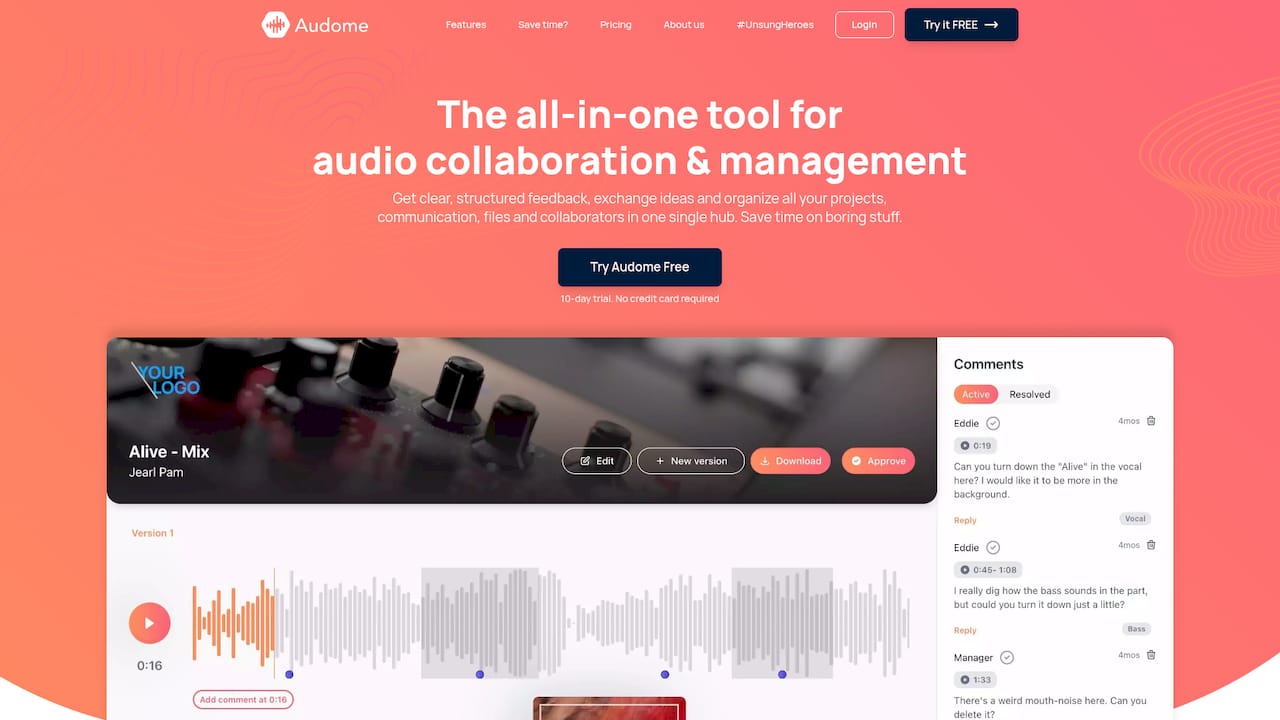
The Studio plan is $12.50 per month or $150 per year, and the Pro plan is $48 per month or $576 per year. You can compare them on the Audome pricing page, or see how the full platform fits a studio workflow.
Common mistakes to avoid
- Vague language. “Reasonable notice” means different things to you and your client. Use hours and percentages.
- Copying another studio’s legal terms. Interest caps and fee rules vary by state. Another studio’s clause may not be valid where you work.
- Sharing the policy after the deposit. Terms should be accepted before or at payment, not after.
- Releasing files early to keep a client happy. It feels friendly, and it is the most common way studios end up chasing invoices.
- Not applying the policy. A rule you waive every time is not a rule. If you make an exception, make it a visible, deliberate favor.
- Leaving revisions unlimited. Unlimited rounds turn a fixed fee into an hourly rate that gets worse the longer the project runs.
FAQ
How much do studios usually charge?
It depends on the type of work and the city. One 2026 guide puts most professional recording studios between $75 and $400 per hour. Mixing, mastering and podcast editing are often priced per song or per episode instead. Your payment policy applies the same way whatever the pricing model.
How much deposit should a studio require?
Fifty percent at booking is the simplest and most common structure in the published agreements we reviewed. Some studios use a sliding scale, taking the full amount on small jobs and a smaller share on large ones. Choose a rule you can explain in one sentence and apply it to every client.
Should a studio payment policy include late fees?
Yes, if you are willing to enforce them. State the grace period, the fee or interest rate, and the action you will take, such as pausing work. Check your state’s limits on late fees and interest first, because the maximum allowed differs by state.
When should clients get their final files?
After payment in full. Let clients stream and comment on previews while the balance is outstanding, then unlock downloads once it clears. Put this in the policy before the client pays the deposit so nobody is surprised.
Do I need a lawyer to write a studio payment policy?
You can draft the structure yourself using the template above. A local attorney should review the late-fee, collection-cost and refund clauses, since those depend on state law and can be unenforceable if written wrong.
Sources
- Session Agreement, M3 Studios
- Terms and Conditions, Sound & Script Studio
- Recording Studio Rates: Complete 2026 Cost Guide