
TL;DR:
- Flexible paywall models significantly increase paying users by offering options like pay-per-article, day passes, and week passes. Clear communication and FTC compliance are essential to successfully manage subscription updates and maintain audience trust. Treating paywalls as ongoing products with continual optimization and proper technical practices ensures reliable revenue growth.
Paywall revisions are defined as deliberate updates to content access restrictions and subscription models to increase paying users and stabilize revenue. For content creators and media producers, getting these changes right separates a profitable operation from one that bleeds audience goodwill. The right revision strategy accounts for the willingness-to-pay gap between readers who want your content and those ready to commit to a recurring subscription. Flexible access models, transparent pricing language, and FTC-compliant disclosures are the three pillars every revision plan needs.
What are the best paywall revision strategies for content creators?
The most effective paywall revisions introduce flexible, transactional entry points alongside traditional subscriptions. Not every reader is ready to commit to a monthly or annual plan. Transactional models like pay-per-article serve high-intent but short-term users who would otherwise bounce without paying anything.
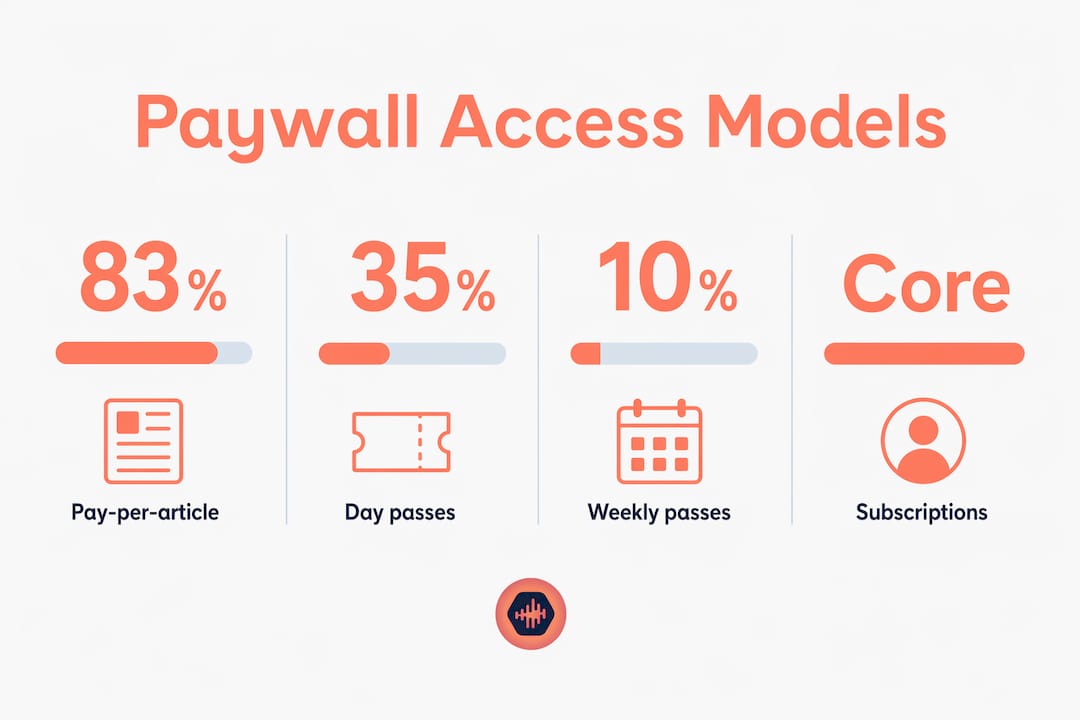
The volume lift data on flexible access models is striking. Pay-per-article models increase paying user volume by 83%, while day passes yield a 35% increase and week passes produce a 19% increase. Those numbers show that lower-commitment options convert a meaningfully larger share of your audience into paying customers.
| Access model | Volume lift | Best for |
|---|---|---|
| Pay-per-article | 83% | High-intent, low-commitment readers |
| Day pass | 35% | Occasional visitors and event-driven traffic |
| Week pass | 19% | Trial users evaluating long-term subscriptions |
| Monthly subscription | Baseline | Core recurring audience |
Diversified revenue tiers that combine off-platform partnerships, flexible access, and core subscriptions produce the strongest monetization results. The Salt Lake Tribune tested this logic at scale, shifting from a traditional paywall to a membership model backed by a $2.6 million fundraising runway, with digital advertising representing 9.6% of 2025 revenue. That move shows how subscription model updates can be paired with advertising diversification to reduce dependence on any single revenue stream.
Pro Tip: Before launching a paywall revision, map your audience into three segments: committed subscribers, occasional visitors, and one-time readers. Build a separate access model for each group rather than forcing all three into the same subscription funnel.
For audio producers and podcasters managing client revision workflows, the same logic applies. Offering tiered access to deliverables, with free previews and paid final downloads, mirrors the flexible paywall model that news publishers have proven works.
How do you manage subscription model updates without losing users?
Subscription pricing revisions carry real risk. Change too much without explaining why, and users cancel. Plex demonstrated this tension directly in 2026, raising its lifetime pass to $750 while introducing a $250 five-year subscription to replace permanent lifetime access. The goal was to stabilize recurring revenue. The challenge was communicating a significant value proposition shift to an existing user base.
Clear communication is the deciding factor in whether a pricing revision succeeds or triggers backlash. Successful subscription revisions depend on transparent value propositions and honest framing of what users gain and lose. Burying the change in a terms-of-service update is the fastest way to erode trust.
A practical communication checklist for any subscription model update:
- Send direct notification to existing subscribers before the change goes live, not after.
- State the new price, the old price, and the effective date in plain language.
- Explain what the pricing change funds, whether that is new features, infrastructure, or content investment.
- Offer a grace period or grandfathered rate for long-term subscribers where financially viable.
- Update all pricing pages, checkout flows, and confirmation emails simultaneously to avoid contradictory messaging.
Pro Tip: Audit every customer-facing touchpoint, including confirmation emails, receipts, and account dashboards, before a pricing revision goes live. Inconsistent pricing language across those surfaces is the most common source of user complaints and chargebacks.
The media incentives shaping editorial decisions also shape how audiences perceive pricing changes. Readers who trust your editorial independence are more likely to accept a price increase framed as supporting that independence.
What legal requirements apply to paywall revisions?
The FTC is the primary regulatory body content creators and media producers must satisfy when revising subscription terms. The FTC actively targets subscription businesses using dark patterns that obscure auto-renewal terms, requiring clear and conspicuous pricing disclosures and straightforward cancellation processes. This enforcement applies to any business collecting recurring payments online, including independent media producers and audio studios.
The specific language used in checkout flows matters enormously. Framing like “Total due today” without a clear recurring billing statement is exactly the kind of phrasing the FTC scrutinizes for deception. The standard requires that users understand they are entering a recurring charge before they complete payment, not after.
Compliance best practices for paywall revisions include:
- Display the full recurring charge amount, billing frequency, and next renewal date on the checkout page before the user clicks “Subscribe.”
- Include a one-click or clearly labeled cancellation path accessible from the account dashboard at all times.
- Obtain affirmative consent, such as a checked box, for auto-renewal terms rather than pre-checking the box by default.
- Retain records of consent for each subscriber in case of a dispute or regulatory inquiry.
- Review cancellation flows after every paywall revision to confirm no new friction has been introduced inadvertently.
The Digital Millennium Copyright Act adds a separate layer of protection. The DMCA restricts circumvention of technological access controls, meaning your paywall itself has legal standing as a protected access mechanism. Documenting your paywall architecture supports any enforcement action against unauthorized access. Pairing that with editorial standards around transparent disclosure builds both legal and audience trust simultaneously.
What technical practices make paywall revision management reliable?
Paywall editing errors are expensive. Publishing a broken or misconfigured paywall can expose paid content to free users, lock paying subscribers out, or display incorrect pricing. Technical workflow discipline prevents all three.

The most reliable paywall editing systems include version history that shows who edited each version, plus the ability to discard unsaved drafts before they go live. Version history creates accountability in multi-author teams and makes rollback straightforward when an error reaches production.
A structured workflow for paywall revision management:
- Draft in a staging environment. Never edit a live paywall directly. Staging environments let you test pricing display, access logic, and checkout flows without affecting paying users.
- Assign a single approver for each revision. Multi-author workflows without a designated approver produce conflicting versions. One person signs off before any change publishes.
- Use centralized branding assets. Paywall pages that pull from a shared asset library stay visually consistent across revisions. Fragmented assets create mismatched designs that undermine credibility.
- Test every user path after each revision. Run through the full purchase flow as a new user, an existing subscriber, and a lapsed subscriber to catch access logic errors before they affect real customers.
- Log every revision with a timestamp and author note. A simple change log, even a shared document, gives your team a reference point when diagnosing issues weeks after a revision goes live.
Placing power-user features behind a paid tier is a proven way to manage infrastructure costs while targeting users who genuinely value premium functionality. Features like advanced metadata, transactional emails, and third-party integrations justify a paid plan because they serve users with high engagement and high willingness to pay. For audio producers, the equivalent is locking final high-resolution downloads or unlimited revision rounds behind a paid project tier. Audome builds this logic directly into its platform, letting studios set revision limits and require payment before final files are released.
Pro Tip: Schedule paywall revisions during low-traffic windows, typically early weekday mornings, and notify your team in advance. Revisions pushed during peak traffic amplify the impact of any error.
Knowing when to charge for revisions is as important as knowing how to configure the paywall that enforces those charges. The technical setup only works when the pricing logic behind it is sound.
Key Takeaways
Paywall revisions succeed when flexible access models, transparent pricing communication, and FTC-compliant disclosures work together to convert more users without sacrificing trust.
| Point | Details |
|---|---|
| Flexible models convert more users | Pay-per-article access lifts paying user volume by 83% compared to subscription-only paywalls. |
| Pricing changes need clear communication | Notify subscribers before changes go live and explain what the new pricing funds. |
| FTC compliance is non-negotiable | Auto-renewal terms must be clear and conspicuous at checkout, with a simple cancellation path. |
| Version control prevents costly errors | Use staging environments and version history to catch paywall errors before they reach live users. |
| Power-user gating controls costs | Placing advanced features behind paid tiers targets high-value users and manages infrastructure spend. |
The part of paywall strategy most creators get wrong
Most content creators treat a paywall revision as a one-time fix rather than an ongoing practice. They launch a new pricing structure, watch the numbers for a week, and move on. That approach misses the point entirely.
The creators I see building durable revenue treat paywall optimization as iterative. They test one variable at a time, whether that is price point, access duration, or cancellation flow, and measure the effect before changing anything else. That discipline is rare, and it is exactly what separates studios and publishers that grow from those that plateau.
The other mistake I see constantly is conflating “flexible access” with “discounting.” A day pass is not a discount. It is a different product for a different buyer. When creators frame transactional options as cheaper versions of their subscription, they train their audience to wait for the deal rather than commit. Price your flexible options as standalone products with their own value, not as consolation prizes for people who won’t subscribe.
Compliance is the third area where creators consistently underinvest. The FTC’s enforcement posture on dark patterns is not theoretical. The language in your checkout flow, the placement of your auto-renewal disclosure, and the friction in your cancellation process are all audit targets. Building compliant flows from the start costs far less than retrofitting them after a complaint.
The creators who get this right share one trait: they treat their paywall as a product, not a gate. They design it, test it, and revise it with the same care they give their content. That mindset shift is worth more than any single tactic in this article.
— Kreg
How Audome helps audio producers manage revisions and payments
Managing client revisions and content access restrictions gets complicated fast when feedback arrives across email, text, and file-sharing platforms simultaneously.

Audome is an all-in-one audio collaboration platform built for music producers, mix engineers, mastering engineers, podcasters, and post-production professionals. It centralizes every stage of client collaboration, from file delivery to revision tracking to final payment, in one secure workspace. Studios can set revision limits, automatically charge clients for additional rounds, and require payment before final high-resolution files are released, all through integrated Stripe Connect payments. If you want a platform that enforces your revision policy without awkward conversations, explore Audome and see how it fits your workflow.
FAQ
What are paywall revisions?
Paywall revisions are updates to content access restrictions, pricing structures, or subscription terms designed to increase paying users and stabilize revenue. They include changes to pricing tiers, access models, and cancellation flows.
How much can flexible paywall models increase paying users?
Pay-per-article models increase paying user volume by 83%, while day passes and week passes yield increases of 35% and 19% respectively, based on flexible access model testing.
What FTC rules apply to subscription paywall changes?
The FTC requires clear and conspicuous disclosure of auto-renewal terms, recurring charge amounts, and cancellation processes at the point of purchase. Using language like “Total due today” without a recurring billing statement can trigger enforcement action.
How do you prevent errors when editing a paywall?
Use a staging environment for all edits, assign a single approver for each revision, and rely on version history to track who changed what. Discarding unsaved drafts before publishing prevents accidental live updates.
When should content creators charge for additional revisions?
Content creators should charge for revisions beyond a defined free limit, set at the start of a project, to protect their time and encourage decisive client feedback. Platforms like Audome automate this by enforcing revision caps and requiring payment before releasing final files.