
Yes, require payment before download by confirming payment server-side rather than trusting the browser. Check the Checkout Session’s payment status or PaymentIntent status through a webhook, then unlock files only after that confirmation lands. Pair the technical gate with a contract clause that spells out revision limits and payment terms, so the policy holds up even if a client disputes it later.
TL;DR:
- Using server-side webhook verification ensures files are unlocked only after confirmed payment, preventing premature client-side releases.
- Implementing signed URLs or private portals protects delivery until payment status is validated via webhook events like checkout.session.completed or payment_intent.succeeded.
- Setting clear contract clauses on payment and revision limits aligns legal agreements with technical controls, reducing disputes over file access.
- Testing webhook handling with simulated events and delayed payment methods mitigates the risk of unlocking files for unpaid clients.
- Automating payment verification and download locking streamlines workflows, especially when integrating Stripe Connect, reducing manual follow-up.
Table of Contents
- What to prepare before you build a pay to download files flow
- Technical implementation: webhook-first sequence to unlock deliverables reliably
- Delivery controls: signed URLs, locked pages, and review proofs
- Contracts and pricing: sample clauses and automating paid revisions
- Testing and QA: verifying webhooks and catching delayed payments
- How Audome handles payment-gated delivery for studios
- Kreg’s perspective: why gating downloads protects more than revenue
- Audome: build this workflow without writing a webhook
- FAQ
- Sources
What to prepare before you build a pay to download files flow
Before writing any code, gather the pieces that make a payment-gated delivery system actually work. Skipping one of these is the most common reason studios end up shipping files before they get paid.
- A Stripe account with webhook access enabled and either Checkout Sessions or PaymentIntents configured for your pricing.
- A server endpoint that can receive and verify webhook events, running in both staging and production.
- File storage that supports signed or expiring URLs, or a client portal that hides download links until the project status changes to paid.
- Contract language that states deliverables unlock only after payment clears, plus a defined number of included revisions.
- A testing setup, including the Stripe CLI, so you can simulate payment events before a real client ever sees the flow.
Most of this is one-time setup. Once the webhook endpoint and storage rules exist, every new project reuses the same pattern.
Technical implementation: webhook-first sequence to unlock deliverables reliably
The core idea behind requiring payment before download is simple: never let the browser decide when a file unlocks. The success page a client sees after checkout is a convenience, not proof of payment, because a customer can close the tab, lose connection, or use a payment method that settles days later. Stripe’s fulfillment guidance is direct about this: webhooks, not client redirects, should drive order fulfillment.
A reliable sequence looks like this:
- Create the Checkout Session or PaymentIntent on your server, attaching metadata such as project ID and order ID so you can match the event back to the right deliverable.
- Listen for
checkout.session.completedandpayment_intent.succeededwebhook events rather than waiting for the client to land on a success page. - Verify the webhook signature, then fetch the session or PaymentIntent and check its
payment_statusorstatusfield before marking anything as paid. Stripe’s PaymentIntent documentation recommends inspecting this status directly rather than assuming success from the redirect alone. - Handle asynchronous events like
checkout.session.async_payment_succeededfor payment methods that settle later, and treatpayment_failedevents as a signal to keep files locked. - Persist the fulfillment state in your own database and make the webhook handler idempotent, so a retried or duplicate event never unlocks a project twice.
Pro Tip: Store the Checkout Session ID once you process it, and have your webhook handler check for that ID before doing anything else. That single check prevents almost every double-unlock bug.
This pattern holds regardless of whether you’re building it from scratch or configuring a platform that already handles the webhook plumbing for you.
Delivery controls: signed URLs, locked pages, and review proofs
Confirming payment is half the job. The other half is making sure the files themselves stay inaccessible until that confirmation arrives. A few approaches work well together rather than as substitutes for each other.
- Signed, time-limited URLs generated by your object storage give you fast, scalable access control, and you can revoke them instantly by rotating the signing key or deleting the underlying file.
- Password-protected project pages or private client portals can check your server’s payment state and only render a download link once that state reads “paid.”
- Low-resolution or watermarked proofs let clients review mixes and masters without ever touching the final, unlocked file, which matters most for mastering engineers sending reference copies.
- A redirect that shows the client an immediate “payment received” message is fine for user experience, as long as the actual file access still waits on the webhook rather than the redirect itself.
None of these require exotic infrastructure. A signed URL with a short expiration window, served from a page that checks payment status before rendering it, covers the vast majority of studio use cases.
Contracts and pricing: sample clauses and automating paid revisions
Technical gating works best when the contract says the same thing the system enforces. A simple clause covers most situations: “Final masters are unlocked for client download after payment clears. Included revisions: two; additional revisions billed at $75 per revision.”
- Write the payment-before-download terms directly into your project agreement, so there’s no ambiguity if a client asks why files aren’t available yet.
- Attach a revision counter to your Checkout Session metadata, then require a paid-revision purchase before unlocking any version beyond the included count.
- Send an automated receipt that includes the Checkout Session ID and project ID, giving the client a clear, checkable record of what they paid for and when.
- Decide upfront whether you’ll hold deliverables until payment clears or deliver first and invoice after. Holding back protects cashflow, but only works smoothly when the client knew that term before starting the project.
This kind of automation removes the need to personally chase anyone for a late invoice.
Testing and QA: verifying webhooks and catching delayed payments
A payment-gated workflow that hasn’t been tested against failure cases is a workflow that will eventually unlock a file for free. Before pointing this at real clients, run it through a few deliberate scenarios.
- Use the Stripe CLI or local webhook forwarding to simulate
checkout.session.completed, asynchronous payment success, andpayment_failedevents in staging. - Verify webhook signatures on every incoming event and log the raw payloads so you can trace exactly what happened if a client disputes an unlock.
- Send the same event twice on purpose and confirm your handler doesn’t unlock the project a second time, which tests the idempotency logic before a real duplicate event does it for you.
- Set up alerting for failed fulfillments and test what happens on a refund or chargeback, since access should be revoked when a payment reverses, not left open indefinitely.
Pro Tip: Run a full test cycle with a delayed payment method like a bank debit before launch. These methods can take days to settle, and that delay is exactly when an untested flow unlocks files too early.
How Audome handles payment-gated delivery for studios
Stripe Connect can be integrated into project workflows to enable webhook-driven unlocking without custom backend code. Here’s how we put the patterns above into practice for studios and engineers:
- Payment status can be checked through Stripe before any download link becomes active, closing the gap that client-side success pages leave open.
- Password-protected project pages, download controls, and signed or expiring links can be used so finished masters stay hidden until payment clears.
- Included revision limits can be set and payment can be required automatically for any revisions beyond those limits, tying billing to the same project record as the deliverable.
- A typical setup involves creating the project, setting included revisions, connecting a Stripe account, and switching download controls to locked until paid.
Studios looking for more detail on specific pieces of this can read our posts on restricting file downloads with signed URLs and setting a clear download limit policy.
Kreg’s perspective: why gating downloads protects more than revenue
Requiring payment before download is a cashflow decision disguised as a technical one. Every unlocked file sent before payment clears is a bet that the client will pay anyway, and most studios have at least one story where that bet didn’t pay off. A locked delivery page paired with a plain-language contract clause removes the awkward follow-up message entirely: the system says no until the payment says yes. That’s a better position for the relationship, not just the invoice.
— Kreg
Audome: build this workflow without writing a webhook
We set up Stripe Connect, download controls, and paid revision limits as part of the same project workspace, so you get the payment-before-download pattern this guide describes without maintaining webhook code yourself. 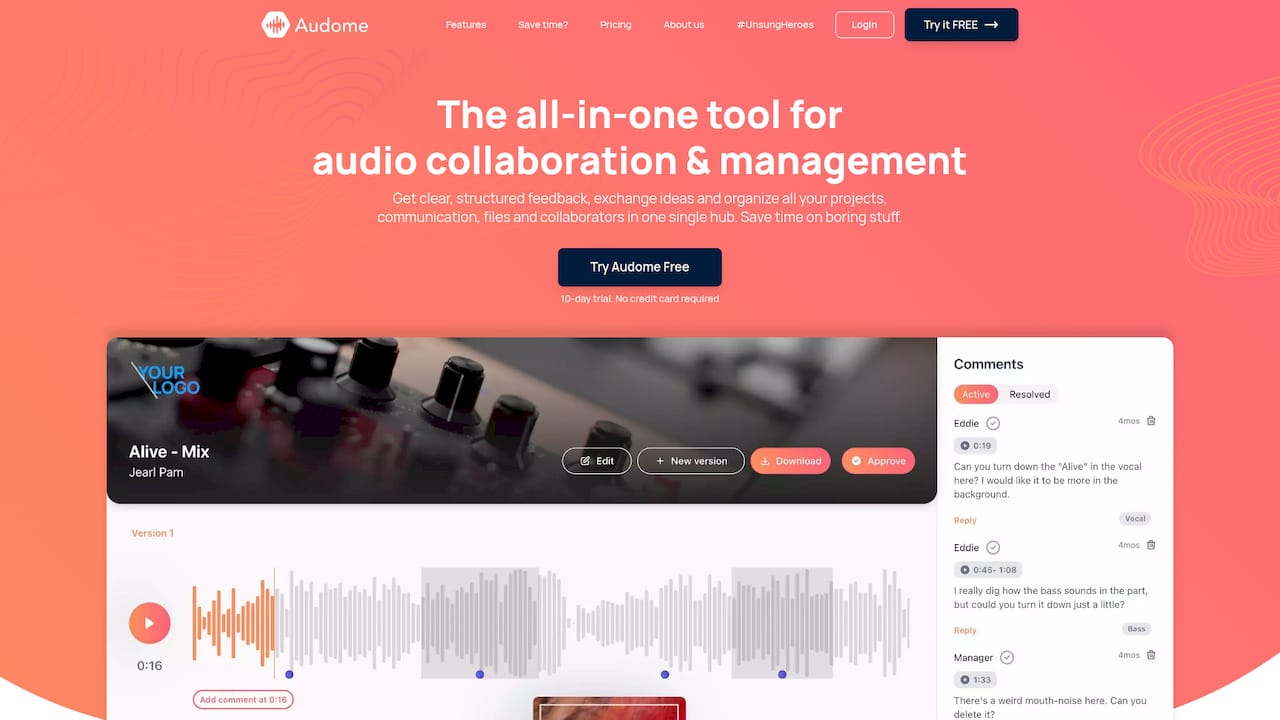
If you send mixes, masters, or final audio to clients and want delivery locked until payment clears, see current Audome plans and pricing and set up your first project today.

FAQ
Why require payment before download instead of invoicing after delivery?
Requiring payment first protects your cashflow because once a client has the final files, there’s little incentive left to pay quickly. Gating the download until payment clears, as described in Stripe’s fulfillment guidance, removes that risk entirely.
How do payment gated downloads actually get enforced technically?
Enforcement happens on your server, not in the browser: a webhook confirms the Checkout Session’s payment status before your system generates or reveals a download link. The client-facing success page is just a message, never the trigger for unlocking files.
What happens if a client pays with a bank debit that settles days later?
Delayed payment methods fire an asynchronous success event rather than an immediate one, so your webhook handler needs to wait for that event before unlocking anything. Stripe’s documentation covers handling these async events alongside standard card payments.
Do I need a written contract clause if I already gate downloads technically?
A contract clause still matters, since it sets client expectations before the project starts and gives you something to point to if a payment is disputed. Pairing a clear clause with approval-before-download enforcement covers both the legal and technical sides of the policy.
Can I require payment before download for revisions as well as final files?
Yes, many studios attach a revision counter to the Checkout Session metadata and require a paid-revision purchase before unlocking any version past the included count. Our guide on download limit policy covers how to structure that language clearly.