
Centralized client communication means routing every client message, whether email, text, or file comment, into one shared system where ownership, history, and status are visible to the whole team instead of buried in someone’s personal inbox. The payoff is straightforward: faster response times, no lost context when someone’s out sick, and a clear record of who owns what. This guide walks through the setup, the daily workflow, and the mistakes that sink most attempts.
TL;DR:
- Centralized client communication reduces the risk of missed messages by ensuring every request has a clear owner and visible status.
- Using a shared inbox or triage system with defined ownership rules and channel roles improves response times and SLA adherence.
- Proper setup, including automation, contact mapping, and SLA definition, prevents operational pitfalls and ensures ongoing workflow efficiency.
- Sending messages through automated routing and assigning ownership immediately minimizes duplicate replies and confusion.
- Limiting notifications to SLA breaches and conducting a two-week trial helps optimize automation and solidify operational discipline.
Table of Contents
- Key Takeaways: Who Benefits from Centralized Client Communication
- What Centralized Client Communication Actually Means
- Why Centralizing Client Communication Actually Pays Off
- Step-by-Step Setup Checklist to Centralize Client Communication
- How Does the Daily Triage Workflow Actually Work?
- Common Pitfalls in Centralized Client Communication (and Fixes)
- How Do You Choose a Communication Platform?
- Studio-Focused Implementation: Applying This to Audio Workflows
- Where Automation Helps, and Where It Gets in the Way
- Bring Your Studio’s Client Communication Into One Place
- Sources
- FAQ
Key Takeaways: Who Benefits from Centralized Client Communication
Teams that pull client messages into one system see fewer dropped requests and faster handoffs almost immediately. Account managers, project managers, and studio owners tend to feel the difference first, since they’re the ones currently piecing together context from five different apps.
Expect these results within the first few weeks:
- Less time spent switching between email, texts, and chat apps to find one message
- Clearer service-level adherence because requests aren’t hiding in someone’s personal inbox
- Fewer files or attachments that go missing between platforms
- Faster onboarding for new team members, since history lives in one place instead of in someone’s head
What Centralized Client Communication Actually Means
At its core, centralized client communication is a shared inbox or triage queue where every inbound request lands, gets a visible owner, and moves through stages the whole team can see. It separates internal notes (the back-and-forth your team has while solving something) from the client-facing thread (what the client actually reads).
It typically pulls in email, SMS, WhatsApp, social DMs, and increasingly, comments left directly on shared files or project pages. What it is not: a single app where everyone dumps messages with no ownership rules. Centralization without triage just moves the chaos into a new location. The point isn’t consolidation for its own sake, it’s making sure every request has one accountable owner and a visible status.

Why Centralizing Client Communication Actually Pays Off
The biggest cost of scattered communication isn’t the occasional missed message, it’s the constant context switching. A producer checking four apps before replying to one client note loses more than time; they lose the thread of what they were doing before the interruption.
Field research on teams that layered AI-assisted collaboration into their workflows found something worth noting: message volume went up 63%, but the increase was almost entirely task-oriented coordination messages, not noise, while professionals shifted 20 to 23% of their effort away from repetitive editing work. Centralizing communication produces a similar shift when it’s done right: more structured coordination, less manual chasing.
Teams that centralize typically see:
- Faster first-response times because requests aren’t sitting in an unmonitored inbox.
- Better SLA adherence, since breaches become visible instead of invisible
- Cleaner handoffs between team members covering for each other
- Fewer files lost in the gap between “someone sent it” and “someone found it”
Pro Tip: Track your median first-response time for two weeks before you centralize anything. It’s the single easiest number to prove the change worked.
Step-by-Step Setup Checklist to Centralize Client Communication
Building this system in the wrong order is the most common reason teams abandon it after a month. Work through these steps roughly in sequence:
- Stand up the shared inbox or triage queue first. Decide what counts as “in scope” (client requests, revision notes, billing questions) before you connect a single channel.
- Set ownership rules. Assign a primary owner per client or project, a named backup, and, for larger teams, group requests into pods so no one person becomes a bottleneck.
- Turn on internal collaboration features. Private comments, draft replies, and internal notes need to exist separately from what the client sees, or your team will start negotiating in front of the client by accident.
- Map every channel you actually use. Email, SMS, WhatsApp, social DMs, and client portal comments all need a defined role, not just a connection.
- Build contact and project cards. Capture the metadata that matters: client tier, project type, prior revision count, and preferred channel.
- Define SLAs by client tier. A 4-business-hour standard response window works for most clients; VIP tiers often warrant something closer to 30 to 60 minutes.
- Build a canned-response library with version control. Templates save time, but only if outdated versions get retired instead of quietly living forever.
- Set handoff rules for when a message becomes a task. Decide exactly what triggers a ticket, and make sure it syncs automatically with whatever project management tool your team already uses.
Skipping step two is the fastest way to end up with a beautifully organized inbox that nobody actually owns.
How Does the Daily Triage Workflow Actually Work?
A message comes in. What happens next determines whether your team looks organized or scrambled.
- Auto-route the message based on channel, client tier, or keyword to the right queue.
- Assign an owner immediately, even if that owner is a placeholder until someone claims it.
- Coordinate internally using private notes or draft replies, never the client-facing thread, before anything gets sent.
- Reply directly or convert to a task if the request needs work beyond a quick answer, syncing it to your project tool with owner, priority, due date, status, and a link back to the original thread.
Two habits prevent the most common failure points. First, one person “claims” a thread before replying, so two teammates don’t send conflicting answers to the same client. Second, escalations need actual metadata attached, not just a panicked ping, so whoever picks it up understands client impact and urgency without re-reading the whole thread. Managers should scan a daily digest of open items and SLA status rather than reacting to every notification as it lands.
Common Pitfalls in Centralized Client Communication (and Fixes)
Most teams don’t fail at centralizing communication because the tool was wrong. They fail because they skip the boring operational rules.
- Notification fatigue. Pinging the whole team for every message trains people to ignore notifications entirely. Reserve real-time alerts for SLA breaches, not routine updates, and push everything else into a daily or twice-daily digest.
- Ownership blur. If two people think they own a thread, neither does. Enforce single ownership with a visible backup, not a rotating cast of “whoever’s free.”
- Channel sprawl. Every new channel you add without a defined role becomes another place messages can get lost. Decide what each channel is for before you turn it on.
- Ignoring scaling signals. When response times start slipping as the client roster grows, that’s the cue to add routing automation or appoint a dedicated communications owner, not to just work faster.
Pro Tip: If your team’s Slack or email notifications feel like white noise, that’s not a discipline problem. It’s a sign your alert rules need to be scoped down to SLA breaches only.
How Do You Choose a Communication Platform?
Skip the brand comparisons and evaluate by feature fit instead. The right platform for your team depends on what it needs to do, not which logo is on the login page.
Look for these capabilities:
- A unified inbox that pulls in every channel your clients actually use
- Internal notes or comments separated from client-facing messages
- Version tracking for files and feedback, not just message history
- Routing automation and configurable SLA alerts
- Gated delivery or payment controls, if your business model depends on collecting payment before final files go out
On the integration side, check compatibility with your project management tool, cloud storage, payment processor, and single sign-on setup, along with API or webhook access if you plan to automate handoffs later. Just as important is operational fit: how much friction does a client feel using it? A platform that forces every client to create an account before they can leave feedback adds friction you don’t need.
Studio-Focused Implementation: Applying This to Audio Workflows
Audio studios face a version of this problem that’s uniquely painful: feedback scattered across email threads, text messages, and Discord, with no way to tell which file version a client is even referencing. Timestamped feedback tied directly to a waveform solves the ambiguity that kills most revision cycles, because a comment like “fix the vocal at 1:42” leaves no room for interpretation.

Version history solves the second half of the problem: no more guessing whether the client heard the final mix or an earlier bounce. Studios that cap free revisions and gate final downloads behind payment also report fewer endless revision loops, since clients tend to give more decisive feedback when unlimited free rounds aren’t on the table.
A basic studio onboarding checklist should include:
- Setting the client’s revision limit and payment terms before the first file goes out
- Creating a project card with genre, deadline, and delivery format up front
- Confirming the client understands where to leave feedback (and that it’s not their inbox)
Where Automation Helps, and Where It Gets in the Way
Automation genuinely increases throughput. The field research cited earlier backs that up: task-oriented messaging goes up, manual editing time goes down. But automation optimized purely for speed tends to strip out the social coordination that keeps teams from feeling like they’re managing a queue instead of working with people. The fix isn’t to avoid automation, it’s to scope it tightly: digests instead of pings, SLA-only alerts, and human judgment kept in the loop for anything that isn’t routine.
If you take one step away from this article, make it this: appoint a single person as the communications owner and run a two-week triage experiment with real SLA tracking before you roll out anything permanent. You’ll learn more from two weeks of real data than from any amount of platform shopping.
— Kreg
Bring Your Studio’s Client Communication Into One Place
If scattered feedback across email, text, and Discord threads has ever cost you a deadline, A platform built around exactly that problem offers audio professionals unlimited high-resolution uploads, timestamped feedback directly on the waveform, and automatic version history, so nobody’s guessing which mix is current.
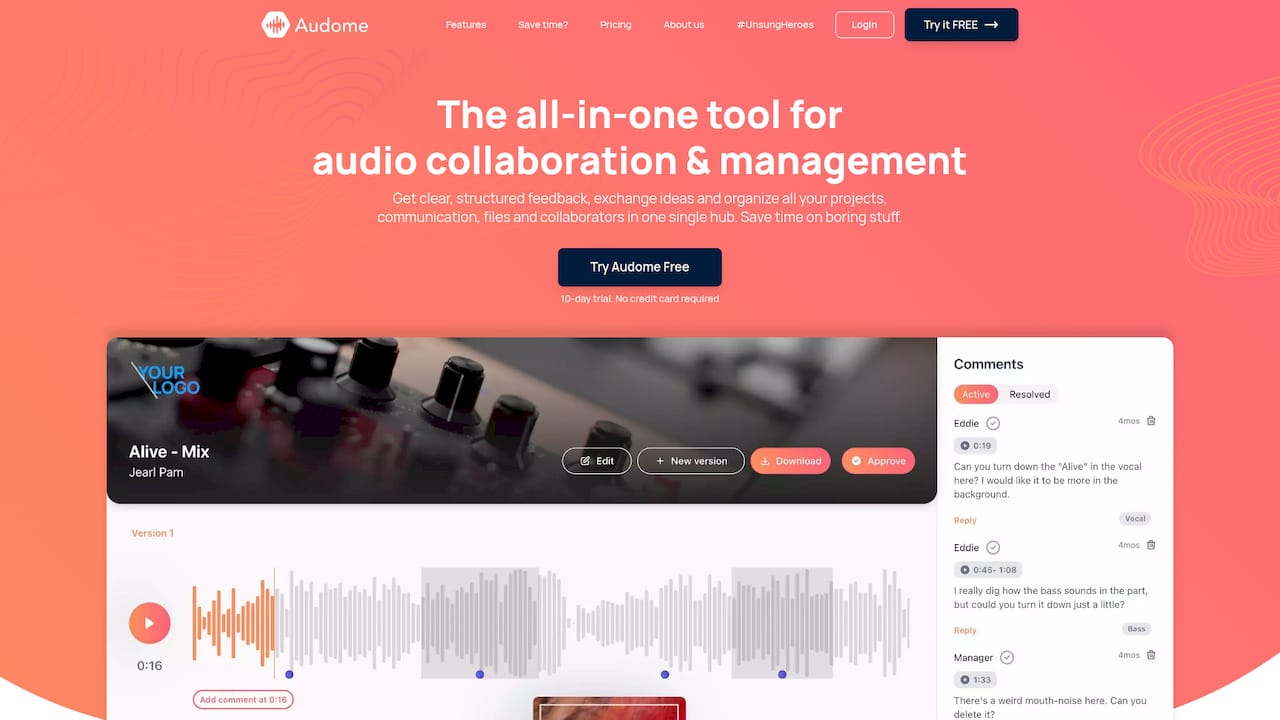
Clients can leave feedback without creating an account, which removes a major source of friction in client-facing tools. Payment integration features allow studios to set revision limits and require payment before final downloads unlock, which tends to produce more decisive feedback and fewer runaway revision cycles. If you’re ready to see how it fits your workflow, check Audome’s pricing starting at $12.50 per month for the Studio plan, or explore the full feature set before you start a trial.
FAQ
What Are Some Examples of Client Communication?
Client communication includes emails, text messages, phone calls, chat app messages, comments left on shared files or project portals, and video call follow-ups. In a centralized system, all of these get routed into one shared inbox or triage queue rather than staying scattered across separate apps.
What Are the 5 C’s of Communication?
Definitions vary slightly by source, but a common version lists clear, concise, concrete, correct, and complete as the core principles of effective communication. Applied to client work, this means every message should state the point plainly, include only relevant detail, and avoid leaving room for misinterpretation.
What Are the Four Types of Organizational Communication?
Organizational communication is typically grouped into four types: downward (manager to team), upward (team to manager), horizontal (peer to peer), and external (organization to client or vendor). Centralized client communication systems primarily manage the external category, though internal notes attached to a client thread often function as horizontal communication.
What Are the Seven Types of Communication?
Common frameworks list verbal, nonverbal, written, visual, listening, formal, and informal communication as the seven main types. Centralized platforms mostly handle written and visual communication (like timestamped comments on a waveform or file), which is why tools like Audome focus on making written and visual feedback as unambiguous as possible.
Does Audome Handle Both Internal Notes and Client-Facing Messages?
Yes. Audome keeps timestamped feedback and version history organized within each project, giving studios a clear, client-facing view while keeping the underlying files and revision history under the studio’s control. Current pricing details are available on Audome’s pricing page.