
Audio watermarking embeds an imperceptible, content-bound identifier directly into an audio signal so studios can prove provenance, trace leaks, and support rights enforcement. The marker travels with the file through every format conversion and platform upload. Primary use cases include:
- Provenance and authorship verification — confirm who created a track and when, using standards like C2PA provenance manifests bound to the file container
- Leak detection and version tracing — unique per-client payloads identify exactly which delivery copy surfaced in the wild
- Short-clip identification for royalty tracking — ISRC-linked identifiers let rights holders match even brief excerpts to the source recording
One operational rule applies across all of these: watermark the final distribution-ready master, not intermediate stems. Embedding earlier risks corruption or removal during subsequent mastering and format conversion.
Table of Contents
- How does audio watermarking actually embed data?
- What trade-offs should you prioritize for studio masters?
- What breaks a watermark before it reaches the listener?
- How do you implement watermarking for 96kHz/24-bit masters?
- How do you test whether your watermark will actually survive?
- Legal and forensic considerations for US studios
- How does watermarking fit into a studio collaboration workflow?
- Key Takeaways
- Why provenance is the real reason studios should care
- Audome keeps your watermarked masters secure after delivery
- Further reading and sources
- FAQ
How does audio watermarking actually embed data?
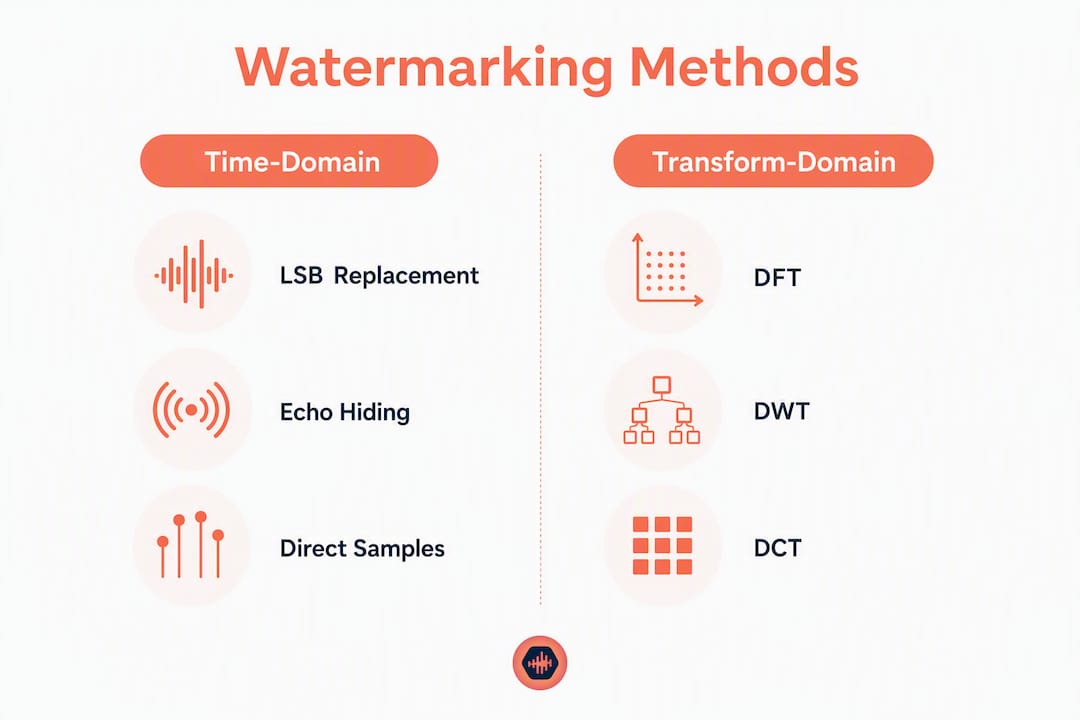
The field divides cleanly into four technical families, each with a different risk profile for professional use.
Time-domain methods (LSB replacement, echo hiding) operate directly on audio samples. LSB replacement swaps the least-significant bits of each sample with payload bits; echo hiding encodes data in subtle echo delays. Both are straightforward to implement but fragile against compression and resampling, which is why they rarely survive a trip through a streaming platform’s transcoder.

Transform-domain methods (DFT, DWT, DCT) embed data in spectral or wavelet coefficients rather than raw samples. Because the watermark energy is distributed across frequency bins, it survives equalization and moderate compression far better. Spread-spectrum techniques extend this further by spreading watermark energy across many frequencies simultaneously, making targeted removal require so much noise that the audio becomes unusable.
Neural and localized methods represent the current state of the art. AudioSeal, Meta’s open-source framework, embeds sample-level localized marks using a learned generator and detects them in a single forward pass, with models tested across multiple sampling rates. Detection in clips as short as one second is now a stated industry target.
Pro Tip: For 96kHz projects, validate the watermark at native resolution on your reference monitoring system before delivery. Artifacts that are inaudible at 44.1kHz can surface in the upper frequency range at 96kHz.
What trade-offs should you prioritize for studio masters?
Every watermarking system balances three competing axes: capacity (how many bits you can embed), robustness (whether the mark survives processing), and imperceptibility (whether listeners can detect it). You cannot maximize all three simultaneously.
For mastering and distribution work, the priority order is clear:
- Imperceptibility first — artifacts on a 96kHz/24-bit master are audible on high-end monitoring. Aggressive embedding can introduce artifacts that critical listening systems will catch.
- Robustness second — the mark must survive lossy encoding, resampling, and platform transcoding to be useful at all.
- Capacity last — you don’t need to embed a full rights database in the audio. A short cryptographic identifier (a short cryptographic identifier pointing to a server-side record) pointing to a server-side record is enough.
For broadcast or short-clip identification where robustness requirements are higher, accept lower capacity or use a multi-layer approach: embed a minimal audio watermark plus a C2PA manifest in the container.
Pro Tip: Embed a cryptographic identifier as the audio payload, then store all rights metadata server-side. The watermark’s job is to point, not to carry.
What breaks a watermark before it reaches the listener?
Understanding the attack surface is what separates a watermark that works from one that only works in your DAW.
Common deliberate and accidental attacks include:
- Lossy compression (MP3/AAC/Ogg at any bitrate)
- Resampling (96kHz → 44.1kHz or 48kHz)
- Bit-depth reduction (24-bit → 16-bit dither)
- Equalization and filtering (shelves, notches, dynamic EQ)
- Loudness normalization (LUFS targeting on streaming platforms)
- Temporal edits: cuts, crossfades, loop extraction
- Remixing, overdubs, and stems recombination
- Additive noise and room ambience
- Pitch shifting and time-stretching
Distribution-chain threats are often overlooked. Platform transcoders strip or rewrite container metadata, preview clipping extracts short segments, and automated audio processing (normalization, noise reduction) runs without notice. Standard ID3 tags and container metadata are routinely removed by these pipelines, which is exactly why sample-level watermarks matter.
The distinction between targeted attacks (deliberate removal by someone who knows a watermark exists) and incidental degradation (transcoding, format conversion) shapes how you test. Most real-world failures are incidental, not adversarial.
Minimum test simulation checklist:
- Re-encode to MP3 at 128, 192, and 320 kbps
- Resample to 44.1kHz and 48kHz
- Apply a typical mastering EQ curve and a brickwall limiter
- Add background noise at a realistic SNR
- Extract a 10-second clip from the middle of the track
How do you implement watermarking for 96kHz/24-bit masters?
Follow this sequence to avoid corrupting the mark or degrading fidelity:
- Finalize the mix and complete all mastering processing.
- Export the final master at target resolution (96kHz/24-bit WAV).
- Sign a C2PA manifest and embed it in the RIFF chunk of the WAV container.
- Embed the audio watermark as the absolute last step before delivery.
- Upload to your secure delivery portal and log the recipient, timestamp, and payload ID.
A few format-specific notes worth keeping:
- RIFF/WAV is the preferred container for masters. It supports RIFF chunk embedding for C2PA manifests and preserves bit depth through the delivery chain.
- Lossless containers (FLAC, AIFF) are acceptable for archival; sign the distribution format after any final transcode.
- Stems: generally avoid watermarking stems. Watermark final deliverables only. Stems get processed further, which increases corruption risk.
- Versioning payload: include a short payload encoding a track ID and release timestamp. Keep a secure server-side mapping of payload to full metadata.
Choosing the right audio file format for each stage of delivery matters as much as the watermarking method itself.
Pro Tip: Keep a private detection key for each release campaign and rotate keys between campaigns. If a leak surfaces, you can run detection against the leaked file and match it to a specific delivery.
How do you test whether your watermark will actually survive?
Testing is where most studios skip steps they later regret. Run this sequence on every new watermarking configuration:
- Start with the original watermarked master (96kHz/24-bit).
- Encode to MP3 at 128, 192, and 320 kbps; run detection after each.
- Resample to 44.1kHz and 48kHz; run detection.
- Apply EQ (high-shelf boost, low-shelf cut) and a brickwall limiter; run detection.
- Add pink noise at 20dB SNR; run detection.
- Extract a 10-second clip; run detection.
- Log all metrics for each attack variant.
Objective and subjective testing should both be captured. Objective metrics catch what measurements miss; subjective listening on multiple monitoring systems catches what measurements miss.
| Attack | Detection rate | Payload error rate | Perceived artifact score (targets vary by implementation) |
|---|---|---|---|
| MP3 @ 128 kbps | Typical high detection rate | Low payload error | Low artifact perceptibility |
| MP3 @ 320 kbps | Typical very high detection rate | Very low payload error | Low artifact perceptibility |
| Resample 44.1kHz | Typical high detection rate | Low payload error | Low artifact perceptibility |
| EQ + limiter | Typical high detection rate | Low payload error | Low artifact perceptibility |
| 10-second clip | Typical good detection rate | Moderate payload error | Acceptable artifact perceptibility |
Pro Tip: Always measure at native 96kHz and at 44.1/48kHz to confirm cross-rate survivability. A watermark that detects cleanly at 96kHz but fails after a consumer-rate resample gives you false confidence.
Legal and forensic considerations for US studios
Watermarking strengthens chain-of-custody but is not standalone legal proof. Combine it with cryptographic manifests and server-side logs to build a defensible evidentiary record.
Practical guidance for US-based studios:
- Signed, timestamped C2PA manifests improve admissibility by binding provenance claims to specific file content at a specific moment.
- Server-side delivery logs (recipient, timestamp, payload ID) corroborate the watermark’s forensic story.
- Metadata alone is not enough. ID3 tags and container metadata are commonly removed by platforms; only sample-level watermarks and cryptographically bound manifests survive reliably.
- Watermarking functions as corroborating technical evidence, not a substitute for registration, contracts, or copyright filings.
Consult qualified legal counsel for evidentiary standards in your specific jurisdiction. Copyright registration with the U.S. Copyright Office remains the foundational step; watermarking supports it.
How does watermarking fit into a studio collaboration workflow?
Integration patterns range from manual to fully automated:
- Finalize the master and complete all processing.
- Run a checksum and sign the C2PA manifest in the container.
- Embed the audio watermark with a unique per-client payload.
- Upload to a secure delivery portal with access controls and download restrictions.
- Log delivery details: recipient name, timestamp, payload ID, file hash.
For studios managing catalogs, batch signing and automated embedding at the release pipeline stage saves significant time. The key is that privacy controls and secure sharing work alongside watermarking, not instead of it.
A few platform-level tips:
- Prefer delivery systems that preserve RIFF/WAV container structures and do not silently strip metadata on upload.
- Use per-client unique payloads so a single leaked file identifies the recipient without exposing other clients.
- Controlled download settings and password-protected portals reduce the surface area for leaks before a watermark even needs to do its job.
Key Takeaways
Audio watermarking works best as provenance infrastructure: embed last, keep payloads small and cryptographically bound, test against real-world attacks, and layer it with signed manifests and secure delivery.
| Point | Details |
|---|---|
| Watermark last | Embed after all mastering processing to prevent corruption during format conversion. |
| Prioritize imperceptibility and robustness | At 96kHz/24-bit, audible artifacts are a real risk; keep payloads small and test on reference monitors. |
| Run a standard test suite | Test against MP3 encoding, resampling to 44.1/48kHz, EQ, limiting, and short-clip extraction. |
| Pair with C2PA manifests | Signed manifests in RIFF chunks survive where editable metadata like ID3 tags does not. |
| Audome for secure delivery | Use Audome’s password-protected portals, download controls, and version tracking alongside watermarking for a complete provenance workflow. |
Why provenance is the real reason studios should care
The conversation around watermarking has shifted. For most of the past decade, studios thought about it primarily as a piracy deterrent. That framing undersells it. The more urgent problem now is provenance: proving that a specific human created a specific piece of audio at a specific time, in an environment where AI-generated content is indistinguishable to the ear.
A watermark paired with a signed C2PA manifest is not just a leak-tracing tool. It is a timestamped claim of authorship that exists at the sample level, independent of whatever platform hosts the file. That matters in disputes, in licensing negotiations, and increasingly in sync licensing workflows where buyers want documented chain-of-custody before they commit.
Studios that treat watermarking as a checkbox miss the operational value. The real payoff is faster dispute resolution: when a client questions which version was delivered, or a track surfaces without credit, the answer is already embedded in the file. That is a different kind of confidence than hoping your email thread is still searchable.
Audome keeps your watermarked masters secure after delivery
Watermarking handles provenance at the signal level. What it cannot do is control who downloads your file, when, or how many times. That is where the delivery layer matters.
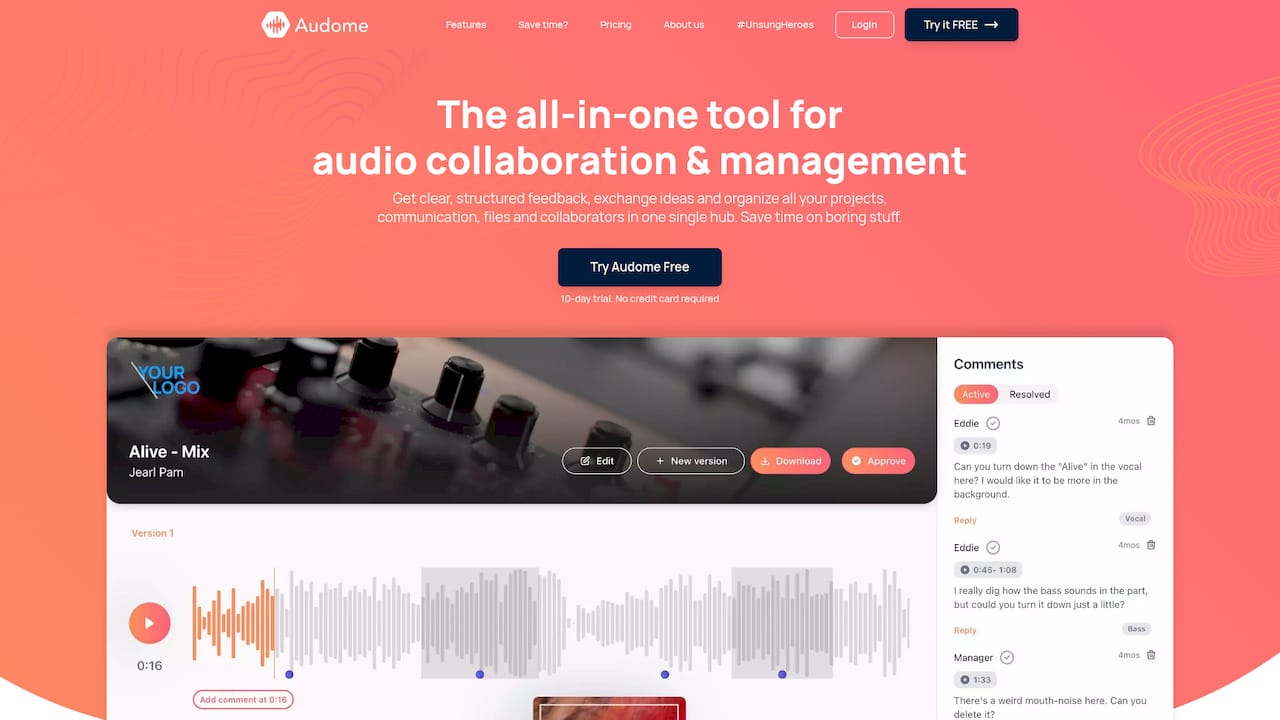
Audome is built for exactly this gap. Upload unlimited high-resolution files up to 96kHz/24-bit, deliver them through password-protected client portals, and lock final downloads behind Stripe-powered payment gates. Version history and timestamped feedback on the waveform give you a complete record of every revision and delivery event, which complements your watermark logs directly. Per-client portals mean each recipient gets their own access point, so a unique watermark payload maps cleanly to a specific delivery. Start a free trial at Audome and add a secure delivery layer to your watermarking workflow today.
Further reading and sources
Choose sources based on your primary goal: provenance verification, forensic tracking, or broadcast robustness. Keep records of all signing events and test results for future audits.
- AudioSeal (facebookresearch) — open-source neural watermarking with localized detection; the practical starting point for studios exploring learned embedding
- Resemble AI — Audio Watermarking Techniques and Applications — accessible overview of technique categories and robustness trade-offs
- Encypher — Content Provenance for Music — C2PA manifest implementation guidance for audio containers
- Applied Sciences (MDPI) — Audio Watermarking Research — peer-reviewed treatment of capacity, imperceptibility, and testing methodology at high resolution
- Digital Watermarking Alliance — Content Protection — industry-level context on watermarking in commercial audio and video distribution
FAQ
What is audio watermarking used for in professional studios?
Audio watermarking embeds an imperceptible identifier into a recording to prove provenance, trace leaked copies, and support royalty tracking. Studios use it alongside C2PA manifests and server-side delivery logs to build a complete chain-of-custody record.
Which watermarking technique is best for high-resolution audio?
Transform-domain methods (DFT, DWT, DCT) and neural approaches like AudioSeal offer the best balance of robustness and imperceptibility for 96kHz/24-bit masters. Time-domain methods like LSB replacement are fragile against compression and resampling.
Can a watermark survive MP3 encoding and platform transcoding?
Spread-spectrum and transform-domain watermarks are designed to survive lossy compression, but survivability depends on the specific method and bitrate. Always test against MP3 at 128–320 kbps and resample to 44.1kHz before treating a watermark as production-ready.
Is audio watermarking legally admissible in the United States?
Watermarking functions as corroborating technical evidence, not standalone legal proof. Pair it with signed C2PA manifests, timestamped server logs, and U.S. Copyright Office registration; consult qualified legal counsel for evidentiary standards in your specific case.
How does Audome complement audio watermarking?
Audome provides the secure delivery layer that watermarking alone cannot: password-protected portals, download controls, version history, and per-client access. Together, they cover both signal-level provenance and delivery-chain security.