
A milestone payments policy is a short written rule that says how much a client pays, when, and for which finished piece of work. For audio, the policy that works ties every payment to something you can point at (an approved mix, a delivered episode, a mastered file), sets a review window, and holds the final payment until the last approval. Below is how to build one, with example splits, wording and the points where policies usually break.
TL;DR
- Tie each payment to a deliverable a third party could verify, such as an approved rough mix or a delivered episode, never to a vague sense of progress.
- A common split for long projects is 30/30/30/10, with the last 10% held until delivery and acceptance, according to AIR’s Guide to Fair Practice. Shorter jobs often use a deposit plus a balance.
- Put review deadlines, included revision rounds and the price of extra rounds in the policy, so late feedback and scope creep have a stated cost.
- Agree it in writing before work starts, and release final files only after the last payment clears.
Table of Contents
- What a milestone payment means in audio work
- Why a policy beats case-by-case haggling
- Example payment splits for audio projects
- Build your policy in six steps
- Late feedback, rejected work and cancellations
- A policy you can adapt
- Our view: the policy only works if it is easy to follow
- Run your milestones from one place
- FAQ
- Sources
What a milestone payment means in audio work
A milestone payment is a set portion of the total fee that becomes due when a defined stage is finished. In a mixing job the stages might be “first mix delivered” and “final mix approved.” In a podcast season they might be “episodes 1 to 4 delivered.”
You will see the term “performance-based payments” in search results. That one comes from US federal procurement: the Federal Acquisition Regulation treats it as contract financing, and the contract must name the event or criterion that counts as successful performance. It is a federal rule with federal conditions, not a rule for private audio contracts. What carries over is the idea: name the event, name the proof.
Your policy is a private agreement between you and your client, so you set the terms. That freedom is the reason to write them down carefully.
Why a policy beats case-by-case haggling
Without a policy, every project starts with the same awkward conversation, and every late payment becomes a personal dispute. With one, the client sees the schedule before signing, and you point to a clause instead of making a judgment call.
AIR recommends that independent audio professionals and clients agree in writing before work starts on rates, rights, payment terms, deliverables, schedules and editorial control. A milestone policy is the payment part of that agreement.
If you want the broader picture of how a proposal and a contract differ, this piece on written agreements for freelancers is a good companion. The policy below slots into the contract half.
Example payment splits for audio projects
There is no single correct split. These real examples from audio professionals show the range:
| Project type | Split | Source |
|---|---|---|
| Multi-month independent audio project | 30% at start, 30% after three months, 30% after six months, 10% on delivery and acceptance | AIR |
| 12-episode solo podcast season, $5,000 | Paid in full, or two $2,500 payments: at project start and after 30 days | One Stone Creative |
| Audiobook production | 40% deposit before production, balance on approval of final audio and before file delivery | CA&C Audio |
| Audiobook production, larger projects | 40% upfront, 30% at midpoint, 30% at delivery; milestone payments offered on projects over $5,000 | CA&C Audio |
The pattern: small jobs use a deposit and a balance, and larger jobs add one or two middle payments. Every one of them holds back a final portion until the client has the finished work and has accepted it.
Should you ask for 50% upfront?
Many audio professionals do. A published example from a contract guide shows a podcast at $1,200 per episode across eight episodes with a 50% deposit of $4,800. Treat that as an illustration of how a deposit is calculated, not a rule.
What matters is what the deposit covers. Say in the policy that it reserves your schedule and covers setup, and that it is not refundable once you have started. Then the first payment has a clear purpose rather than looking like an advance against nothing.
Build your policy in six steps

1. Break the job into deliverables
List exactly what you will and will not provide. For a podcast that might be a trailer, ten episodes and a closer, plus show notes or audiograms if you include them. One production company spells out its 12-episode package as a trailer, 10 full solo episodes and a closer, with production, show notes, graphics and publishing items. For a mix, list the number of tracks or stems, the formats and the sample rate and bit depth of delivery.
The more specific the deliverable, the easier it is to say whether a milestone has been hit. Contract template guidance suggests defining formats, quantities and acceptance criteria up front.
2. Attach each payment to an observable event
A trigger is strongest when someone outside the project could verify it. “First mix uploaded and shared with the client” passes. “Mix about 60% done” does not. Templates for podcast agreements tie payments to a finished episode, a date or delivery of the master for exactly this reason.
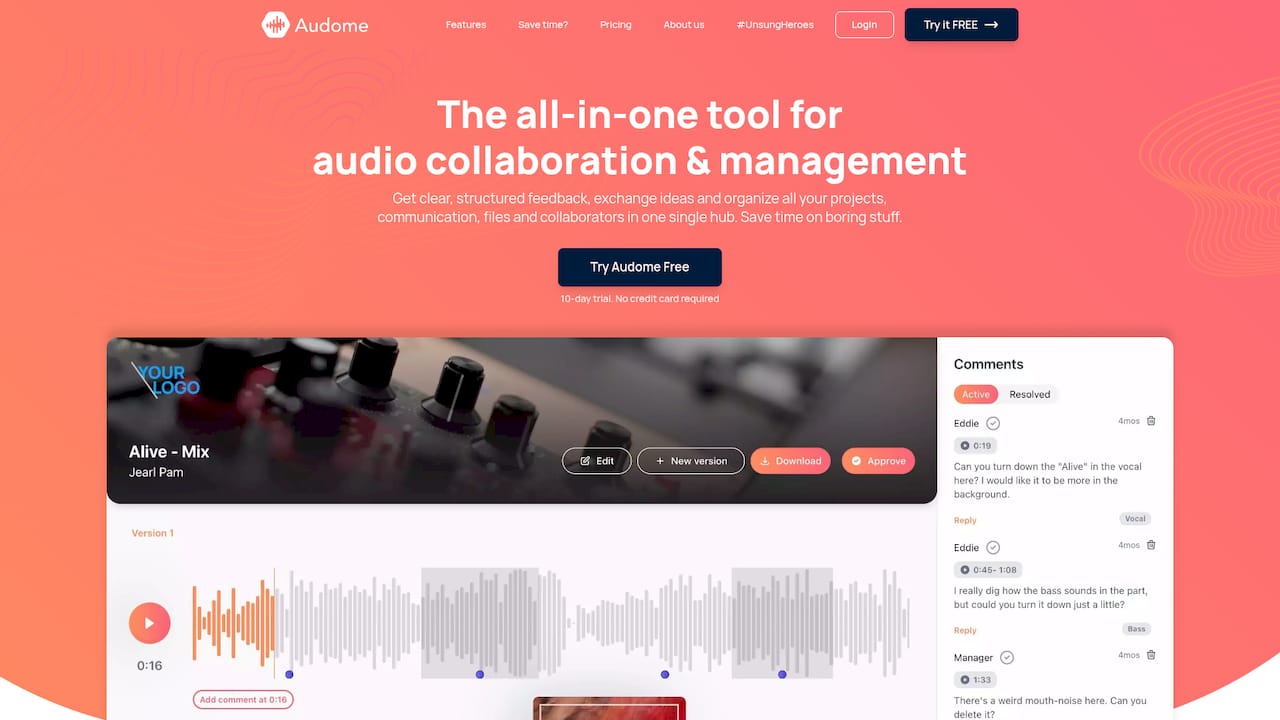
This is also where tools earn their keep. When the client listens and comments on a shared version with a visible timestamp, “delivered” and “approved” stop being matters of memory. On Audome, each version you upload is tracked automatically and clients leave time-stamped comments on the waveform, so the record of what was delivered and what was said sits with the project instead of in an email chain.
3. Name who approves and how fast
A milestone that depends on approval needs two answers: who can approve, and how long they have. Spell out who approves each episode, how long they have to respond and what happens if they miss the deadline.
A workable clause: “Client has five business days from delivery to approve or send consolidated revision notes. If no response is received in that time, the milestone is treated as approved and the next invoice is issued.” Pick the number of days that fits your workload, and keep it the same across clients.
One approver per project saves the most trouble. Mixes held up by four people giving conflicting notes are the usual cause of a stalled final payment.
4. Cap the revisions
Every milestone should say how many rounds of changes it includes and what extra rounds cost. The same contract guidance recommends defining included edit rounds and extra-edit charges. A round means one consolidated set of notes, not a trickle of single comments.
Audome lets you set revision limits and bill for paid revisions through Stripe, so a client who wants a fourth round sees the charge before the work starts. If you are still deciding what to charge, our guide on when to charge for revisions walks through it, and the revision billing post shows how timestamped notes keep rounds countable.
5. Set invoice dates and payment terms
Agree the payment date in writing, invoice promptly once work is delivered, and state the due period. AIR’s guidance is to pay within 15 days unless other terms were agreed in advance. If you prefer longer terms, write them in. Our post on copyable net terms has Net 30 and late-fee wording you can adapt.
In New York, there is a law behind this. A law firm’s summary of the Freelance Isn’t Free Act says a written contract is required for work of $800 or more, and that payment is due within 30 days of completion unless the contract says otherwise. AIR encourages everyone to adopt those standards wherever they work. If you work in another state, or have a dispute over a larger sum, check your own state’s rules and talk to a lawyer licensed there.
6. Control the final files
The last payment only protects you if the client does not already hold the final deliverable. Hand over lower-quality previews or watermarked streams for approval, and release the full-resolution masters when the balance is paid. The CA&C Audio policy above does exactly this: the balance is due on approval of final audio, before file delivery.
In Audome, download controls let you share work for review while keeping final downloads locked. Our posts on approval before download and the studio approval process cover the setup.
Late feedback, rejected work and cancellations
A good policy answers the uncomfortable cases before they happen. Cover these:
- Late feedback. State what happens when the client misses the review window: automatic approval, a rescheduled slot, or a rush fee. Write the consequence into the contract, as contract guidance recommends.
- Disputed work. Say the client must identify what in the deliverable differs from the agreed scope. Notes that reference a timestamp are easier to resolve than “it doesn’t sound right.”
- Scope changes. Anything not on the deliverables list is a new quote. A new episode, a new format or an extra stem set is a change order, not a revision.
- Cancellation. Say which payments are non-refundable and how work done to date is billed. The same guide recommends addressing cancellation fees and late-payment consequences, including when you may pause work.
- Overdue invoices. Set a late fee and state that work pauses until the account is current.
A policy you can adapt
Copy this and change the numbers:
Payment schedule. The project fee is divided into milestones. Milestone 1 (deposit, 40%) is due before work begins and reserves the production schedule. Milestone 2 (30%) is due when the first full mix or first batch of episodes is delivered for review. Milestone 3 (30%) is due on delivery of the approved final files.
Approval. Client has five business days to approve or send one consolidated set of notes. Two revision rounds are included per milestone; additional rounds are billed at the stated rate.
Delivery. Final full-resolution files are released when all invoices are paid. Invoices are due within 15 days.
Cancellation and late payment. Paid milestones are non-refundable. Work pauses on any overdue invoice.
This is a starting draft, not legal advice. If your contracts involve large sums, or clients in other states or countries, have a lawyer review the final wording once, then reuse it.
Our view: the policy only works if it is easy to follow
Most payment disputes we hear about in audio are not about money. They are about proof: which version was delivered, what the client said about it and whether the notes were part of the agreed rounds.
That is why we built Audome around the same structure a good policy has. Versions are tracked automatically, feedback is time-stamped on the waveform, revision limits are set per project, and paid revisions can be billed through Stripe. Clients do not need to log in to review, so the approval step is not delayed by account creation.
When the delivery, the approval and the payment trigger all live in one place, a milestone policy stops being a document you have to defend and becomes the way the project simply runs.
Kreg
Run your milestones from one place
Audome is a collaboration and project management platform for audio professionals. You upload high-resolution audio (up to 96kHz/24-bit), share it through a password-protected, branded client portal, collect time-stamped feedback, track revisions and control downloads until the work is approved.
The Studio plan is $12.50 per month or $150 per year, and the Pro plan is $48 per month or $576 per year. See Audome pricing for what each includes, or start from the Audome homepage. If you are setting up a new client relationship, our guide to client onboarding for audio studios shows where the payment policy fits, and the podcast delivery and revision workflow guide covers episode-by-episode handoffs.
FAQ
What is a good milestone split for a podcast production job?
For a short season, a deposit and a balance works: one published example takes two $2,500 payments on a $5,000 season, at start and after 30 days. For longer work, add middle payments and keep a final portion, such as 10%, until delivery and acceptance, as in AIR’s example schedule.
What is an example of a milestone in audio?
Any finished, checkable stage: an approved rough mix, a delivered batch of edited episodes, a mastered album sequence or the final master file. The test is whether someone other than you could confirm it happened, which is the standard podcast agreement templates recommend.
What is the difference between milestone payments and performance-based payments?
In everyday freelance contracts, a milestone payment is due when a named stage is complete. “Performance-based payments” is a term from federal contracting, where the FAR treats them as contract financing tied to a defined event. For private audio work, use milestone language and define the event yourself.
When should the final payment be due?
On delivery and acceptance of the final work, with files released after payment. Set the invoice due period in the contract; AIR suggests 15 days unless otherwise agreed. If you are in New York, the Freelance Isn’t Free Act sets a 30-day default when the contract is silent.
Sources
- Guide to Fair Practice for Working with Independent Audio Producers (AIR)
- Subpart 32.10 – Performance-Based Payments (Acquisition.gov)
- Podcast Production Contract: Key Clauses To Include (Sprintlaw)
- Free Podcast Production Agreement Template (ContractPDF)
- Business Podcast Sprints (One Stone Creative)
- Audiobook Production & ACX Publishing FAQ (CA&C Audio)
- New York’s Freelance Isn’t Free Act guide (Tsilimparis Law)
- Freelance Proposal vs. Contract: Understanding the Differences