
Clear, written boundaries let producers work less and create more. Boundaries protect your creative time, keep client relationships predictable, and make your income sustainable instead of dependent on how loud a client shouts. If you set nothing else this week, set these:
- Communication hours: post a response window (e.g., 10 AM to 6 PM, replies within one business day).
- Deposits: require 30 to 50% before you touch a session.
- Revision limits: cap free revisions at two or three rounds, then charge for more.
- Booking and cancellation policy: published, dated, and sent before the first session.
- A calendar link: stop negotiating time slots by text.
Each of these is a small policy that removes a recurring argument. That’s the whole point.
Key Takeaways
Written, priced boundaries protect a producer’s creative time, income, and client relationships more reliably than verbal agreements ever do.
| Point | Details |
|---|---|
| Deposits before sessions | Require a deposit upfront; no deposit means no calendar slot. |
| Cap revision rounds | Include two or three rounds free, then charge a flat fee per extra round. |
| Publish response hours | State a business-hours reply window so clients stop expecting instant answers. |
| Document scope in writing | List deliverables, out-of-scope items, and approval steps before booking. |
| Automate enforcement | Audome enforces paid revisions, timestamped feedback, and payment locks automatically. |
Table of Contents
- Why boundaries free your creativity, reputation, and revenue
- Common boundaries producers use (and how to word them)
- Turn the checklist into enforceable policies
- Copy-ready scripts, email subjects, and contract snippets
- Tools and workflows that automate boundary enforcement
- How to handle clients who resist your boundaries
- What changed when I actually enforced my own deposit policy
- Let a platform hold the line for you
- Sources
- FAQ
Why boundaries free your creativity, reputation, and revenue
Boundaries work because they remove decisions you’d otherwise make on the fly, under pressure, mid-session. That’s what Production Like a Boss means when it argues that pre-production checklists and decision limits reduce decision fatigue and speed up actual production. Three benefits show up almost immediately:
- Protected creative time. No boundary, no deep work. A client who can text you at 11 PM will, and you’ll answer, because you never told them not to.
- Fewer surprises for clients. A published revision limit means nobody’s shocked by an invoice for round six.
- Sustainable pricing. Deposits and paid revisions turn scope creep from a hidden cost into a line item.
Soundcheck’s guide to boundaries in the music industry points out that fear of seeming “difficult” is the main thing stopping producers from setting limits in the first place, even though clear limits are what signal that your time has value. Try this line the next time a client pushes: “I want your project to get my full attention, which is why I keep revision rounds capped.”
Common boundaries producers use (and how to word them)
Boundaries aren’t abstract. They’re specific policies you can write down today and repeat word for word to every client.
- Communication hours. State them in your welcome email: “I respond Monday through Friday, 10 AM to 6 PM, within one business day.” Production Expert’s guide to setting client boundaries found that a consistent response window trains clients to respect your schedule without costing you the gig.
- Booking and cancellation rules. Require advance notice to reschedule; charge a fee for no-shows. Say it once, in writing, before the first session lands on the calendar.
- Deposits. A deposit upfront, non-refundable once work begins. This alone filters out clients who were never serious.
- Revision limits and fees. Two or three rounds included, then a flat fee per additional round.
- Turnaround times. State your standard delivery window and your rush fee for anything faster.
- Session structure. Require a one-page brief and reference tracks before booking. This alone kills the “just make it sound good” session.
- Ownership and credits. Put stem ownership, sample clearance, and credit language in writing before you deliver files, not after. This partner resource on what a music production credit actually covers is a useful primer if you’ve never formalized this.
Remote sessions need the same rules, just with a DAW template and shared reference folder standing in for the in-person conversation.
Turn the checklist into enforceable policies
A boundary only works if it’s written down, priced, and backed by a payment step the client has to clear before you start. That’s the entire enforcement model: written terms, deposit before work begins, scheduled windows instead of open-ended availability, and a documented process for anything that falls outside the original scope.
- Send a short SOW before booking. List deliverables, number of revision rounds, what’s explicitly out of scope, and how approvals happen.
- Collect the deposit before the first session. No deposit, no calendar slot. This is non-negotiable.
- Lock scheduling to a calendar tool. Booking links remove the back-and-forth and the “can we do tonight instead?” texts.
- Build a change-control step. Anything outside the SOW gets a quick quote and a yes/no before you touch it, not after.
- Price rush work separately. A same-day turnaround costs more than a five-day one. Say so upfront.
Postplanify’s guide to managing client expectations found that structured onboarding and documented approval workflows cut disputes dramatically, mostly because clients stop assuming “unlimited” was ever on the table. A clear producer client workflow does the same job at the process level.
Pro Tip: Require a one-page brief and at least one reference track before you’ll book a session. It’s the single smallest habit that eliminates the most back-and-forth, because vague requests almost always turn into extra revision rounds later.
Copy-ready scripts, email subjects, and contract snippets
These aren’t drafts. They’re short, tested phrasings you can paste into your next email today.
Email subjects:
- “Booking Confirmed: Session Details + Deposit Link”
- “Revision Round 2: What’s Included and What’s Extra”
- “Quick Reminder: Invoice Due Before Final Files”
Booking confirmation message:
Revision request reply:
Contract clauses worth pasting into your standard agreement: a deposit clause (percentage and non-refundable terms), a revision clause (number of included rounds and per-round fee after), and a cancellation clause (notice period and no-show fee). The scripts and templates built for mixing engineers cover several more variations if you want to adapt the tone for different client types.
Tools and workflows that automate boundary enforcement
The right tool removes the need to negotiate a boundary every single time; it just enforces the rule automatically. Look for a few specific features when you pick a platform:
- Paid revision limits that lock further edits behind a fee instead of relying on you to remember and invoice manually.
- Timestamped feedback on the actual waveform, so notes stop scattering across text threads and Discord.
- Client portals with no login required, so clients get a professional experience without friction.
- Stripe-based payments that hold deposits and unlock final downloads only after payment clears.
Audome bundles these into one workspace, which is exactly the enforcement layer most freelance setups are missing. Pair it with a calendar booking tool and an invoicing app for a complete workflow, and check a remote collaboration setup if your clients aren’t local.
Pro Tip: Automation fails quietly when change requests happen outside the tool, like a client texting “just one more tweak.” Keep every change request inside the project timeline so there’s a record, even for the small ones.
How to handle clients who resist your boundaries
On first pushback, do three things in order: acknowledge the request, restate the boundary plainly, and offer two options with different trade-offs. Don’t apologize for the policy; explain it once and move on.
- Late-night urgent request: “I saw your message. I’m off until 10 AM tomorrow, but I can prioritize this first thing, or you can book a rush slot tonight for an added fee.”
- Free extra revisions: “You’re past the included rounds. I can add round four for $75, or we can lock what we have and revisit later.”
- Faster turnaround, no extra fee: “Standard turnaround is five days. I can do 48 hours for a rush fee, or keep the standard timeline at no extra cost.”
Escalate only when it’s warranted: negotiate on timing, send a change order on scope, and walk away on non-payment or repeated disrespect. Those are the only three outcomes worth tracking.
What changed when I actually enforced my own deposit policy
Requiring a deposit before every session cut my no-shows to almost zero and stopped one recurring headache: chasing final payment after delivery. Revision rounds dropped too, since clients read the terms more carefully once money was already on the table.

Let a platform hold the line for you
Audome removes the guesswork from enforcing the policies above, so you’re not the one re-explaining your revision cap every single project.
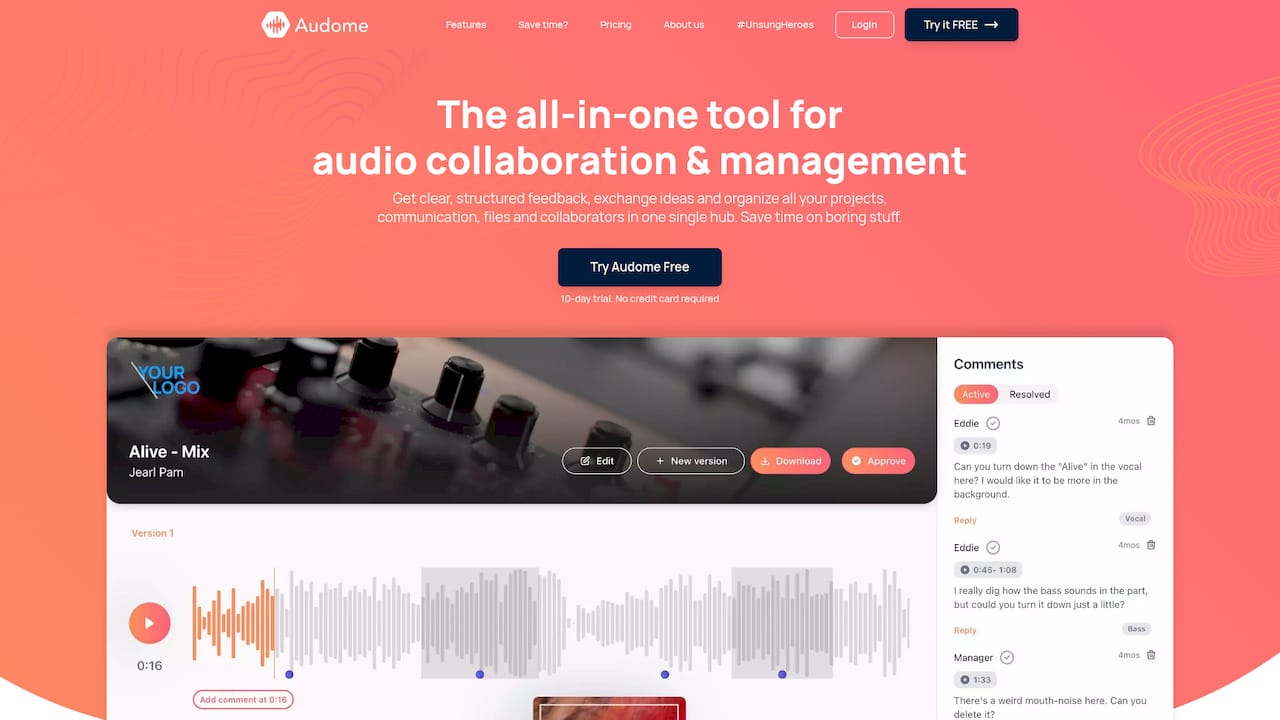
Three features do most of the heavy lifting: paid revision limits that automatically bill beyond your included rounds, timestamped feedback that keeps every note attached to the exact second in the waveform instead of scattered across five apps, and client portals that give clients a clean, professional experience without forcing them to create an account. Stripe Connect handles deposits and locks final downloads until payment clears, so “I’ll pay you later” stops being a thing you have to negotiate. If you’re tired of being the enforcement mechanism for your own contract, try Audome and see how much of this runs itself.
Sources
- How to Set Boundaries and Manage Expectations in the Music Industry
- Using Boundaries To Create Freedom As A Producer
- How to set client boundaries without losing the gig
- How to Manage Client Expectations: Agency Guide (2026)
FAQ
What skills should a music producer have?
Beyond technical mixing and arranging skills, producers need clear written communication, basic contract literacy, and the assertiveness to enforce a scope of work once it’s signed.
Is it hard to make a living as a music producer?
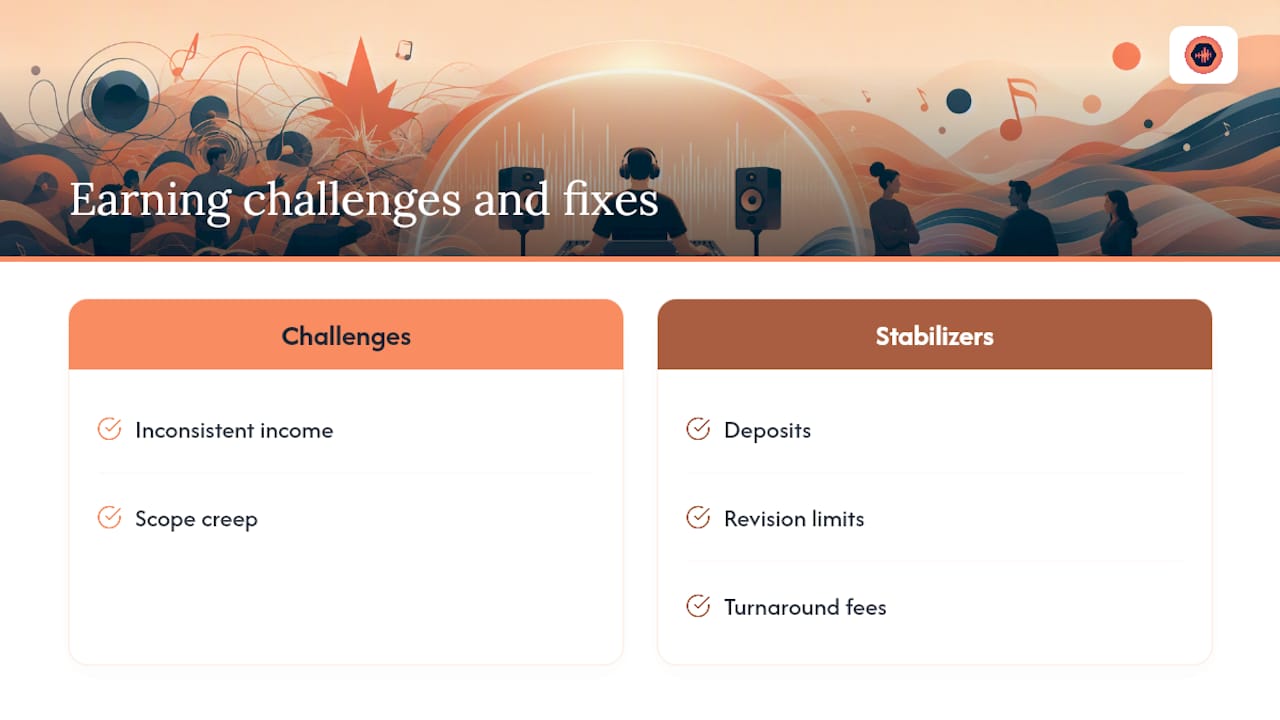
It’s difficult mainly because of inconsistent income and scope creep, not lack of demand; producers who set deposits, revision limits, and turnaround fees tend to stabilize their income faster than those who don’t.
Is 20 too late to start producing?
No. Boundary-setting and business skills matter more for sustainable income than age, and most producers build client management habits over years regardless of when they start.
What are the challenges of being a producer?
The biggest recurring challenges are unclear scope, unpaid revision requests, and always-on availability expectations, all of which written policies and tools like Audome directly address.