
Net terms are the number of days a client has to pay an invoice after a set trigger date, and Net 30 is the default that dominates US business-to-business transactions. For most freelancers and small studios, Net 30 is the right place to start, with shorter terms or an upfront deposit reserved for new or unproven clients. The rest comes down to picking the right variant, writing it clearly, and enforcing it without wrecking the relationship.
TL;DR:
- Offering shorter payment terms like Net 7 or Net 15 may be necessary for small or unproven clients to ensure faster cash flow management.
- Clarifying and explicitly stating the exact trigger event, due date, and late fee policy in contracts reduces payment disputes and enforces enforceability.
- Using milestone billing or requiring deposits can mitigate risks associated with extending longer net periods for high-risk or large accounts.
- Incorporating automated payment links and pre-delivery payment requirements speeds up collection and minimizes late payments.
- Clear, enforceable, written terms that specify due dates and penalties directly influence clients to pay faster and avoid delays.
Table of Contents
- What Do Net Payment Terms Mean, and What Are the Common Variants?
- What Are the Benefits and Risks of Offering Net Terms?
- How Do You Choose Payment Terms for Different Clients?
- How Do You Enforce Net Terms and Handle Late Payments?
- What Should Your Invoice and Contract Wording Actually Say?
- What Are the Alternatives to Standard Net Terms?
- Why Clear, Enforceable Terms Change How Clients Behave
- How Audome Helps You Get Paid on Time, Every Time
- Sources
- FAQ
What Do Net Payment Terms Mean, and What Are the Common Variants?
Net terms tell a client how many days they have to pay after a trigger event, usually the invoice date, but sometimes the date goods or services are received or a milestone is completed. The word “net” just means the full amount is due by that day, with no discount attached unless one is specified. Where that clock starts matters more than most freelancers realize: an invoice dated the day you send it versus the day a client’s finance team logs it can create a week of drift, and a poorly defined trigger is one of the most common causes of payment disputes.
Here’s how the standard variants break down:
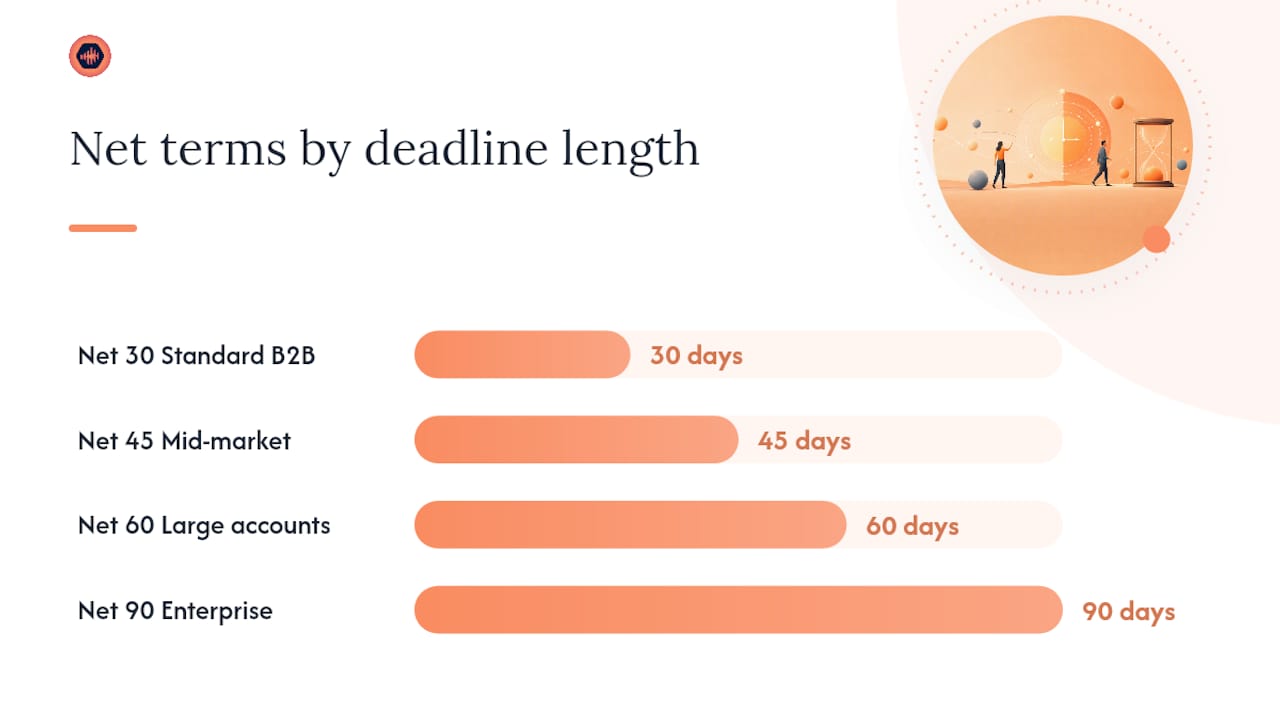
- Net 7 or Net 15: Short terms typical for smaller invoices, new relationships, or freelancers who need faster turnaround on cash.
- Net 30: The default for most B2B invoicing in the United States, covering everything from freelance contracts to agency retainers.
- Net 45: A common middle ground for mid-market clients with slower internal approval processes.
- Net 60 or Net 90: Reserved for larger accounts, enterprise clients, or complex projects with multiple deliverables.
- EOM (End of Month): Payment due at the close of the calendar month, sometimes combined with a net period (e.g., “Net 30 EOM”).
You’ll also see shorthand like 2/10 net 30, which means the client gets a 2% discount if they pay within 10 days, otherwise the full amount is due in 30. That discount sounds small, but skipped, it functions as a high implicit interest rate.
Net 30 remains the de facto standard in US business-to-business transactions, with Net 45 increasingly common as a middle-ground compromise, and Net 60 or Net 90 typically reserved for larger, more complex accounts. This pattern holds across Corpay’s market breakdown and reflects how procurement cycles at bigger companies simply move slower than a freelancer’s invoice cadence.
What Are the Benefits and Risks of Offering Net Terms?
Offering net terms can win you clients you’d otherwise lose to competitors who already extend credit. B2B buyers, especially procurement departments at mid-size and large companies, expect it. Refusing to offer any net terms at all can knock you out of consideration before a conversation even starts.
But net terms come with real costs:
- Slower cash flow: Every day you wait to get paid is a day that money isn’t working for you.
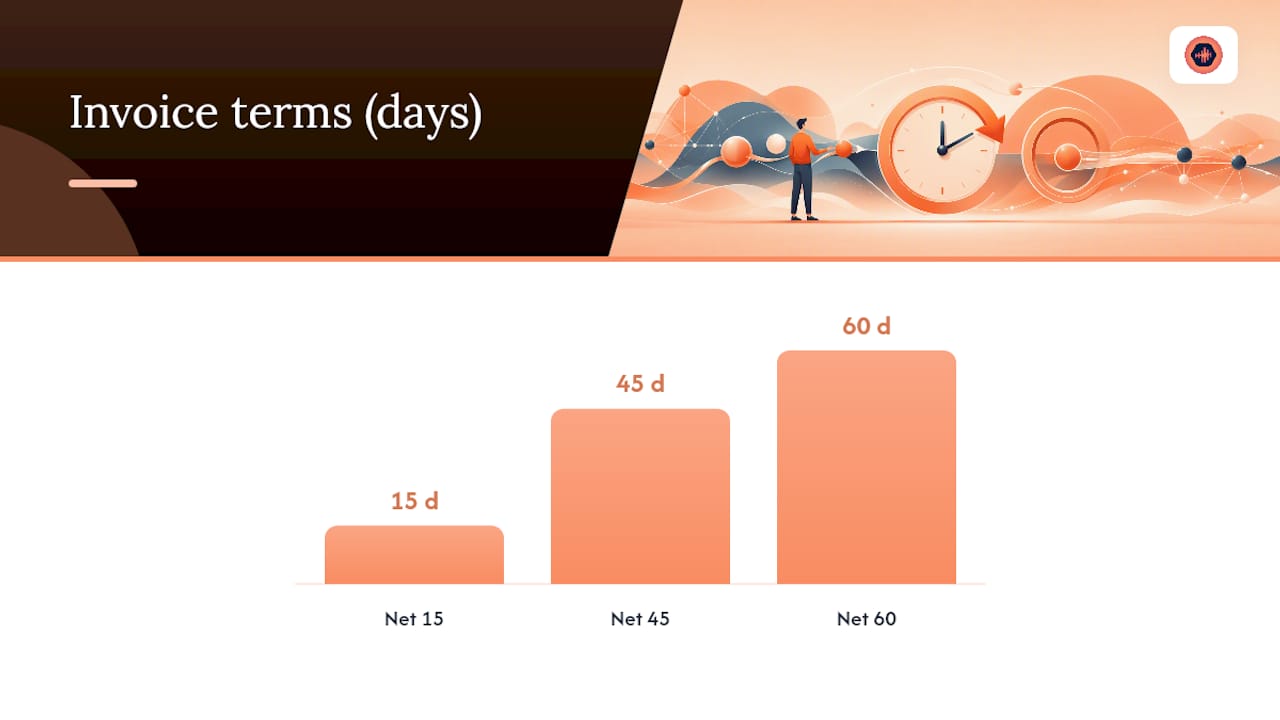
- Rising days sales outstanding (DSO): A shift from Net 15 to Net 45 can roughly triple the average time invoices sit unpaid, tightening your working capital.
- Dispute and admin overhead: Longer terms mean more time for a client’s circumstances to change, increasing the odds of a late payment or a dispute over deliverables.
- Collection risk: The longer the term, the more exposure you carry if a client goes quiet or disputes the invoice near the due date.
A quick example: invoicing a client monthly on Net 15 terms means carrying some outstanding receivables most of the time; switching the same client to Net 60 increases that balance significantly. That’s real money tied up that isn’t funding your next project.
Pro Tip: If a client’s invoice size exceeds what you’d comfortably front for two months, split the project into milestone payments instead of extending long net terms on the full amount.
How Do You Choose Payment Terms for Different Clients?
Start with a baseline, then adjust it up or down based on the client in front of you. Here’s a repeatable framework:
- Set your default. Most freelancers and small studios should default to Net 30. It’s the market norm, and clients rarely question it.
- Assess the client’s risk profile. New clients with no payment history deserve shorter terms or a deposit. Long-standing clients with a clean record can earn more flexibility.
- Match their procurement rhythm. Larger companies often run monthly or biweekly payment cycles tied to internal approval chains, and aligning your terms to that rhythm reduces friction rather than fighting it.
- Size the invoice against your cash needs. A $500 invoice on Net 60 is an inconvenience. A $15,000 invoice on Net 60 is a cash-flow problem.
- Trade, don’t just grant. If a client wants Net 60, ask for something back: a deposit, a shorter dispute window, or enrollment in an early-pay discount.
Before agreeing to anything, ask directly: “Who approves invoices on your end, and what’s your standard pay cycle?” That single question tells you whether Net 30 is realistic or whether you’re actually looking at Net 45 in practice, regardless of what the contract says.
Watch for these red flags that call for deposits or cash-in-advance instead of extended terms:
- A new client with no verifiable business history or references.
- A client who resists putting payment terms in writing.
- Unusually large first orders from unfamiliar buyers.
- A history of disputing invoices after work is delivered rather than before.
For genuinely new or high-risk clients, skipping credit terms entirely in favor of a deposit or full cash-in-advance protects you until a track record exists.
How Do You Enforce Net Terms and Handle Late Payments?
Late fees only work if they’re documented before the invoice goes unpaid, not added after the fact. The market-standard rate in US B2B contracts is 1.5% per month, or 18% annually, applied to the outstanding balance starting the day after the due date. Stating this rate on the invoice and in the contract, rather than mentioning it for the first time in a collections email, is what makes it enforceable.
A workable structure looks like this:
- Grace period: Optional, but a 3 to 5 day buffer before fees kick in avoids penalizing a client whose payment is simply processing.
- Accrual: Calculate monthly, not daily, to keep the math simple and match common late-payment interest practice.
- Admin fee: A flat fee ($25 to $50) for reissued invoices or manual follow-up work adds a mild deterrent without feeling punitive.
Disputes need a process too, not an ad hoc email exchange. A clean structure requires the client to flag any dispute before the due date, pay the undisputed portion on time regardless, and resolve the disputed amount within a fixed window.
Requiring notice of a dispute before the due date, payment of undisputed amounts on schedule, and a fixed resolution window of around several weeks keeps cash flowing while still giving clients room to raise legitimate concerns.
When a payment goes late anyway, escalate in stages: an automated reminder at the due date, a personal follow-up call or email within a week, a pause on new work if the account goes 15 to 30 days past due, and only then a move toward formal collections.
What Should Your Invoice and Contract Wording Actually Say?
Ambiguous invoice language is where most late-payment problems start. Every invoice should show an explicit calendar due date, not just “Net 30,” along with the total amount, accepted payment methods, and a contact for billing disputes. Stating the actual date rather than relying on the client to calculate it removes a common excuse for late payment.
A sample invoice line might read: “Amount due: $3,200.00. Due date: March 15, 2026. Terms: Net 30 from invoice date. Late payments accrue interest at 1.5% per month. Payment methods accepted: ACH, credit card, check.”
Your contract should go further than the invoice and lock down the mechanics in advance:
- The exact trigger (invoice date, delivery date, or milestone acceptance).
- The net period and the calendar math behind it.
- The late-fee rate and when it starts accruing.
- The dispute notice window and resolution timeline.
- Your right to suspend work or withhold final files if payment lapses.
A payment clause holds up better when it fixes four things at once: the net period, the late-payment remedy, the exact trigger, and a defined dispute process, rather than leaving any of them to interpretation.
Check your state’s usury and late-fee laws before finalizing a rate. Many contracts use language like “interest at 1.5% per month or the maximum permitted by law, whichever is lower” to stay compliant across jurisdictions. If you’re trading terms for security, say so explicitly: “Client may elect Net 45 in exchange for a 20% deposit upon signing.”
What Are the Alternatives to Standard Net Terms?
Net terms aren’t the only tool, and they’re often not the best one for higher-risk work. Deposits and milestone billing shift risk back toward you getting paid on time instead of chasing it later.
For longer projects, break payment into milestones tied to deliverables rather than waiting for one final invoice.
Early-pay discounts like 2/10 net 30 can also accelerate cash, but they need to be evaluated against your own cost of capital. That 2% discount for paying 20 days early works out to an annualized rate of roughly 37%, which is a strong incentive for the client but only worth offering if getting paid faster is worth more to you than that discount costs.
Payment technology closes the gap between what a contract says and what actually happens. Broadly useful categories include:
- Embedded pay links on invoices that let clients pay in one click instead of waiting on a check.
- Paywall-before-delivery systems that hold final files until payment clears.
- Revision billing tools that automatically charge for work beyond an agreed scope.
Pro Tip: If you’re tired of chasing final payments, set up a workflow where deliverables unlock automatically once payment is confirmed. It removes the awkward “can you send the final files” conversation entirely. Embedding pay links directly into invoices can shave days off your average collection time.
Why Clear, Enforceable Terms Change How Clients Behave
A studio that let one client drag a $4,000 balance past 90 days learned the hard way that “we’ll figure it out” isn’t a payment policy. After that, every contract got an explicit due date, a stated late fee, and a hold on final files until payment cleared. Clients didn’t push back. They paid faster, because the rules were visible from day one. One change: state your terms in writing before the first invoice goes out, not after the first late one.
— Kreg
How Audome Helps You Get Paid on Time, Every Time
Audome is built for the exact problem this article covers: getting paid without turning every invoice into a negotiation. Where net terms handle the “when,” Audome handles the “how,” locking final files behind payment so clients can’t quietly sit on a balance while using your work.

The platform’s payment integration lets you require payment before final downloads unlock, helping ensure timely payment. You can also set a limit on free revisions and bill for additional ones, helping manage scope creep in projects. Every note comes in as timestamped feedback directly on the waveform, with full version history, so there’s no dispute about what was requested or delivered. Studios using this kind of workflow spend less time policing invoices and more time mixing. Check the Audome pricing page to see the Studio and Pro plans and find the tier that fits your client volume.
Sources
- Business Payment Terms: The Complete Guide (Net 30, Net 60, 2/10 Net 30 & More) | Corpay
- Late payment rates and calculator — United States | LatePayClaim
- What are invoice payment terms? A primer for businesses | Stripe
FAQ
What Are Typical Net Terms for Small Businesses?
Net 30 is the most common standard in US business-to-business invoicing, with Net 45 used as a compromise for slower-paying clients and Net 60 or Net 90 reserved for larger accounts.
What Do Net 5 Terms Mean?
Net 5 means payment is due within 5 days of the invoice date or another agreed trigger. It’s used mainly for very small invoices or clients without an established payment history.
What Do Net 15 Terms Mean?
Net 15 gives a client 15 days from the invoice date to pay in full. It’s a middle-ground option for freelancers who want faster turnaround than Net 30 without demanding cash upfront.
What Do Net 45 Terms Mean?
Net 45 gives a client 45 days to pay, typically used with mid-size or enterprise clients whose internal approval processes move slower than a 30-day cycle allows.
How Does Audome Help Enforce Net Payment Terms?
Audome lets studios require payment through Stripe Connect before final files unlock, which prevents clients from receiving deliverables without settling the invoice.